3D micro-nano printing technology as a transformative tool apply for microneedle drug delivery

IF 4.9 3区 医学 Q1 PHARMACOLOGY & PHARMACY Journal of Drug Delivery Science and Technology Pub Date : 2024-04-25 DOI:10.1016/j.jddst.2024.105709
Xiaolu Han , Yuanke Yang , Yaying Xu , Xiaoxuan Hong , Zhiqiang Tang , Hui Zhang , Nan Liu , Meng Li , Zengming Wang , Aiping Zheng
{"title":"3D micro-nano printing technology as a transformative tool apply for microneedle drug delivery","authors":"Xiaolu Han ,&nbsp;Yuanke Yang ,&nbsp;Yaying Xu ,&nbsp;Xiaoxuan Hong ,&nbsp;Zhiqiang Tang ,&nbsp;Hui Zhang ,&nbsp;Nan Liu ,&nbsp;Meng Li ,&nbsp;Zengming Wang ,&nbsp;Aiping Zheng","doi":"10.1016/j.jddst.2024.105709","DOIUrl":null,"url":null,"abstract":"<div><p>Microneedles (MNs) penetrate the stratum corneum and reach the epidermis, bypassing nerve fibers and providing a precise and controlling pathway for the delivery small molecule drugs, proteins, and nucleic acid drugs. This approach minimizes pain and tissue damage during penetration, facilitating autonomous administration. Emerging 3D micro-nano printing technologies offer innovative fabrication strategies for MNs. In addition to enhanced printing resolution, 3D printing allows flexibility in prototype design and manufacturing methods, enabling the fabrication of complex structure MNs or polydimethylsiloxane (PDMS) molds with excellent repeatability and effectiveness. Recently, several micro-nanoscale 3D printing technologies, such as projection micro stereolithography (PμSL) and two-photon polymerization (TPP), have been integrated into various stages of MNs manufacturing. This review aims to provide a comprehensive overview of diverse strategies for drug release and delivery modes using MNs, and a specific focus on analyzing advancements in 3D micro-nano printing technologies. It emphasizes the pivotal role played by 3D printing in the field of MNs and specifically discusses future research directions and emerging trends in this domain.</p></div>","PeriodicalId":15600,"journal":{"name":"Journal of Drug Delivery Science and Technology","volume":"96 ","pages":"Article 105709"},"PeriodicalIF":4.9000,"publicationDate":"2024-04-25","publicationTypes":"Journal Article","fieldsOfStudy":null,"isOpenAccess":false,"openAccessPdf":"","citationCount":"0","resultStr":null,"platform":"Semanticscholar","paperid":null,"PeriodicalName":"Journal of Drug Delivery Science and Technology","FirstCategoryId":"3","ListUrlMain":"https://www.sciencedirect.com/science/article/pii/S1773224724003782","RegionNum":3,"RegionCategory":"医学","ArticlePicture":[],"TitleCN":null,"AbstractTextCN":null,"PMCID":null,"EPubDate":"","PubModel":"","JCR":"Q1","JCRName":"PHARMACOLOGY & PHARMACY","Score":null,"Total":0}
引用次数: 0

Abstract

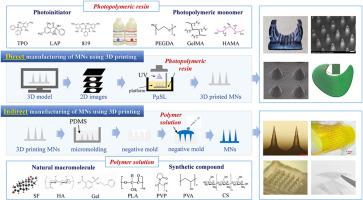
Microneedles (MNs) penetrate the stratum corneum and reach the epidermis, bypassing nerve fibers and providing a precise and controlling pathway for the delivery small molecule drugs, proteins, and nucleic acid drugs. This approach minimizes pain and tissue damage during penetration, facilitating autonomous administration. Emerging 3D micro-nano printing technologies offer innovative fabrication strategies for MNs. In addition to enhanced printing resolution, 3D printing allows flexibility in prototype design and manufacturing methods, enabling the fabrication of complex structure MNs or polydimethylsiloxane (PDMS) molds with excellent repeatability and effectiveness. Recently, several micro-nanoscale 3D printing technologies, such as projection micro stereolithography (PμSL) and two-photon polymerization (TPP), have been integrated into various stages of MNs manufacturing. This review aims to provide a comprehensive overview of diverse strategies for drug release and delivery modes using MNs, and a specific focus on analyzing advancements in 3D micro-nano printing technologies. It emphasizes the pivotal role played by 3D printing in the field of MNs and specifically discusses future research directions and emerging trends in this domain.

Abstract Image

查看原文
分享 分享
微信好友 朋友圈 QQ好友 复制链接
本刊更多论文
三维微纳打印技术作为一种变革性工具应用于微针给药
微针(MNs)可穿透角质层,直达表皮,绕过神经纤维,为小分子药物、蛋白质和核酸药物的输送提供了一条精确可控的途径。这种方法最大限度地减少了穿透过程中的疼痛和组织损伤,有利于自主给药。新兴的三维微纳打印技术为 MNs 提供了创新的制造策略。除了提高打印分辨率外,三维打印还能灵活设计原型和制造方法,从而制造出结构复杂的 MN 或聚二甲基硅氧烷(PDMS)模具,并具有出色的可重复性和有效性。最近,投影微立体光刻(PμSL)和双光子聚合(TPP)等几种微纳尺度三维打印技术已被整合到 MNs 制造的各个阶段。本综述旨在全面概述利用 MNs 实现药物释放和递送模式的各种策略,并重点分析三维微纳打印技术的进展。它强调了三维打印技术在 MNs 领域发挥的关键作用,并具体讨论了该领域的未来研究方向和新兴趋势。
本文章由计算机程序翻译,如有差异,请以英文原文为准。
求助全文
约1分钟内获得全文 去求助
来源期刊
CiteScore
8.00
自引率
8.00%
发文量
879
审稿时长
94 days
期刊介绍: The Journal of Drug Delivery Science and Technology is an international journal devoted to drug delivery and pharmaceutical technology. The journal covers all innovative aspects of all pharmaceutical dosage forms and the most advanced research on controlled release, bioavailability and drug absorption, nanomedicines, gene delivery, tissue engineering, etc. Hot topics, related to manufacturing processes and quality control, are also welcomed.
期刊最新文献
Silk-based piezoelectric biomaterials: Next-generation smart scaffolds for tissue regeneration and biomedical applications Amino acid polymer-based nano-carriers for targeted drug delivery in breast cancer therapy: Mechanisms, applications, and future perspectives: A literature review Self-assembled carrier-free drug nanoparticles for enhanced synergistic therapy of liver cancer Ligand-functionalized core–shell nanoparticles for precision therapy of luminal A breast cancer: Emerging strategies, clinical challenges, and future perspectives Multimodal iron oxide nanoparticles for breast cancer theranostics and clinical translation: From bench to bedside
×
引用
GB/T 7714-2015
复制
MLA
复制
APA
复制
导出至
BibTeX EndNote RefMan NoteFirst NoteExpress
×
×
提示
您的信息不完整,为了账户安全,请先补充。
现在去补充
×
提示
您因"违规操作"
具体请查看互助需知
我知道了
×
提示
现在去查看 取消
×
提示
确定
0
微信
客服QQ
Book学术公众号 扫码关注我们
反馈
×
意见反馈
请填写您的意见或建议
请填写您的手机或邮箱
已复制链接
已复制链接
快去分享给好友吧!
我知道了
×
扫码分享
扫码分享
Book学术官方微信
Book学术文献互助
Book学术文献互助群
群 号:604180095
Book学术
文献互助 智能选刊 最新文献 互助须知 联系我们:info@booksci.cn
Book学术提供免费学术资源搜索服务,方便国内外学者检索中英文文献。致力于提供最便捷和优质的服务体验。
Copyright © 2023 Book学术 All rights reserved.
ghs 京公网安备 11010802042870号 京ICP备2023020795号-1