Remus Ilies, Yukun Liu, S. Aw, Mireia Las Heras, Yasin Rofcanin
{"title":"Why does using personal strengths at work increase employee engagement, who makes the most out of it, and how?","authors":"Remus Ilies, Yukun Liu, S. Aw, Mireia Las Heras, Yasin Rofcanin","doi":"10.1037/ocp0000374","DOIUrl":null,"url":null,"abstract":"Engaging in behaviors that take advantage of one's personal strengths at work can promote employee flourishing in the workplace and mental health. Personal strengths use has thus gained increasing attention within occupational psychology and positive organizational scholarship. In this article, we first integrate work on personal strengths use with the latest developments in the job demands-resources theory (and its extensions) to develop a conceptual model explaining how and why personal strengths use on the job increases work engagement. Specifically, we propose that feelings of inspiration and meaningfulness explain the relationship between personal strengths use and work engagement. Second, we identify two mechanisms through which employees can amplify the benefits associated with personal strengths use at work; that is, we propose that the increased engagement associated with strengths use makes employees more likely to capitalize on the positive aspects of their work by engaging in work-family interpersonal capitalization and positive work reflection. Further, our model predicts that employees' psychological capital moderates the effects of personal strengths use. We tested our theoretical predictions in a sample of 160 full-time employees who provided ratings that comprise a three-level data set (person, week, and day) comprising 943 matched weekly ratings and 2,787 daily ratings. Our hypotheses were largely supported by these data. Implications for theory, practice, and future research are discussed. (PsycInfo Database Record (c) 2024 APA, all rights reserved).","PeriodicalId":5,"journal":{"name":"ACS Applied Materials & Interfaces","volume":"706 ","pages":"113-129"},"PeriodicalIF":8.2000,"publicationDate":"2024-04-01","publicationTypes":"Journal Article","fieldsOfStudy":null,"isOpenAccess":false,"openAccessPdf":"","citationCount":"0","resultStr":null,"platform":"Semanticscholar","paperid":null,"PeriodicalName":"ACS Applied Materials & Interfaces","FirstCategoryId":"102","ListUrlMain":"https://doi.org/10.1037/ocp0000374","RegionNum":2,"RegionCategory":"材料科学","ArticlePicture":[],"TitleCN":null,"AbstractTextCN":null,"PMCID":null,"EPubDate":"","PubModel":"","JCR":"Q1","JCRName":"MATERIALS SCIENCE, MULTIDISCIPLINARY","Score":null,"Total":0}
引用次数: 0
Abstract
Engaging in behaviors that take advantage of one's personal strengths at work can promote employee flourishing in the workplace and mental health. Personal strengths use has thus gained increasing attention within occupational psychology and positive organizational scholarship. In this article, we first integrate work on personal strengths use with the latest developments in the job demands-resources theory (and its extensions) to develop a conceptual model explaining how and why personal strengths use on the job increases work engagement. Specifically, we propose that feelings of inspiration and meaningfulness explain the relationship between personal strengths use and work engagement. Second, we identify two mechanisms through which employees can amplify the benefits associated with personal strengths use at work; that is, we propose that the increased engagement associated with strengths use makes employees more likely to capitalize on the positive aspects of their work by engaging in work-family interpersonal capitalization and positive work reflection. Further, our model predicts that employees' psychological capital moderates the effects of personal strengths use. We tested our theoretical predictions in a sample of 160 full-time employees who provided ratings that comprise a three-level data set (person, week, and day) comprising 943 matched weekly ratings and 2,787 daily ratings. Our hypotheses were largely supported by these data. Implications for theory, practice, and future research are discussed. (PsycInfo Database Record (c) 2024 APA, all rights reserved).
期刊介绍:
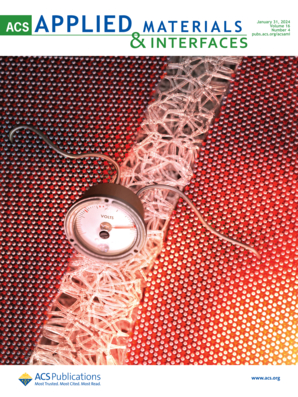
ACS Applied Materials & Interfaces is a leading interdisciplinary journal that brings together chemists, engineers, physicists, and biologists to explore the development and utilization of newly-discovered materials and interfacial processes for specific applications. Our journal has experienced remarkable growth since its establishment in 2009, both in terms of the number of articles published and the impact of the research showcased. We are proud to foster a truly global community, with the majority of published articles originating from outside the United States, reflecting the rapid growth of applied research worldwide.



 京公网安备 11010802042870号
京ICP备2023020795号-1
京公网安备 11010802042870号
京ICP备2023020795号-1

 分享
分享
 求助内容:
求助内容: 应助结果提醒方式:
 扫码关注我们
