Vaiyapuri Soundharrajan, Duong Tung Pham, Junji Piao, Subramanian Nithiananth, Jung Ho Kim, Jaekook Kim
{"title":"Aqueous Rechargeable Manganese/Iodine Battery","authors":"Vaiyapuri Soundharrajan, Duong Tung Pham, Junji Piao, Subramanian Nithiananth, Jung Ho Kim, Jaekook Kim","doi":"10.1002/batt.202400131","DOIUrl":null,"url":null,"abstract":"<p>Carbon neutralization has promoted the identification of new types of energy storage devices. Aqueous iodine batteries (AIBs) with reversible iodine redox activity are considered a viable candidate for stationary energy storage units and thus have recently drawn extensive research interest. Herein, we introduce an aqueous manganese iodine battery (AMIB), utilizing sodium iodide (NaI) as a redox-active additive in the Mn(ClO<sub>4</sub>)<sub>2</sub> (NMC) electrolyte, activated carbon (AC) as a redox host and Mn ions as the charge carrier. Taking advantage of enhanced kinetics facilitated by I<sub>2</sub>/2I<sup>−</sup> redox activity, our suggested AMIBs can be electrochemically charged/discharged with only a 6 % loss in capacity after 2,000 cycles at a low current density of 0.3 A g<sup>−1</sup> in an AC||AC coin cell configuration. Moreover, the AC||Zn−Mn hybrid full-cell configuration is also established with AC and a Zn−Mn anode involving the NMC electrolyte, which retains a high energy of 185 Wh kg<sup>−1</sup> at a specific power of 2,600 W kg<sup>−1</sup>. Overall, the AMIBs in this study preferred I<sub>2</sub>/I<sup>−</sup> conversion chemistry, yielding stable cycle stability, rate performance, and low capacity loss per cycle when compared to Manganese Ion Batteries (MIBs) which are based on Mn<sup>2+</sup> intercalation chemistry.</p>","PeriodicalId":132,"journal":{"name":"Batteries & Supercaps","volume":"7 8","pages":""},"PeriodicalIF":4.7000,"publicationDate":"2024-04-28","publicationTypes":"Journal Article","fieldsOfStudy":null,"isOpenAccess":false,"openAccessPdf":"","citationCount":"0","resultStr":null,"platform":"Semanticscholar","paperid":null,"PeriodicalName":"Batteries & Supercaps","FirstCategoryId":"88","ListUrlMain":"https://chemistry-europe.onlinelibrary.wiley.com/doi/10.1002/batt.202400131","RegionNum":4,"RegionCategory":"材料科学","ArticlePicture":[],"TitleCN":null,"AbstractTextCN":null,"PMCID":null,"EPubDate":"","PubModel":"","JCR":"Q2","JCRName":"ELECTROCHEMISTRY","Score":null,"Total":0}
引用次数: 0
Abstract
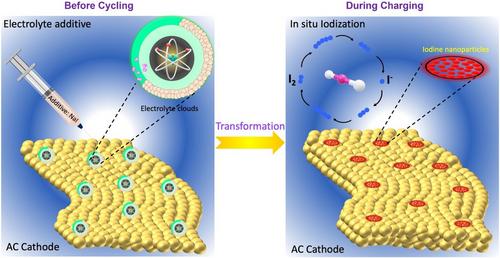
Carbon neutralization has promoted the identification of new types of energy storage devices. Aqueous iodine batteries (AIBs) with reversible iodine redox activity are considered a viable candidate for stationary energy storage units and thus have recently drawn extensive research interest. Herein, we introduce an aqueous manganese iodine battery (AMIB), utilizing sodium iodide (NaI) as a redox-active additive in the Mn(ClO4)2 (NMC) electrolyte, activated carbon (AC) as a redox host and Mn ions as the charge carrier. Taking advantage of enhanced kinetics facilitated by I2/2I− redox activity, our suggested AMIBs can be electrochemically charged/discharged with only a 6 % loss in capacity after 2,000 cycles at a low current density of 0.3 A g−1 in an AC||AC coin cell configuration. Moreover, the AC||Zn−Mn hybrid full-cell configuration is also established with AC and a Zn−Mn anode involving the NMC electrolyte, which retains a high energy of 185 Wh kg−1 at a specific power of 2,600 W kg−1. Overall, the AMIBs in this study preferred I2/I− conversion chemistry, yielding stable cycle stability, rate performance, and low capacity loss per cycle when compared to Manganese Ion Batteries (MIBs) which are based on Mn2+ intercalation chemistry.
期刊介绍:
Electrochemical energy storage devices play a transformative role in our societies. They have allowed the emergence of portable electronics devices, have triggered the resurgence of electric transportation and constitute key components in smart power grids. Batteries & Supercaps publishes international high-impact experimental and theoretical research on the fundamentals and applications of electrochemical energy storage. We support the scientific community to advance energy efficiency and sustainability.




 京公网安备 11010802042870号
京ICP备2023020795号-1
京公网安备 11010802042870号
京ICP备2023020795号-1

 分享
分享
 求助内容:
求助内容: 应助结果提醒方式:
 扫码关注我们
