Jimin Oh, Jiwon Yeom, Benediktus Madika, Kwang Man Kim, Chi Hao Liow, Joshua C. Agar, Seungbum Hong
{"title":"Composition and state prediction of lithium-ion cathode via convolutional neural network trained on scanning electron microscopy images","authors":"Jimin Oh, Jiwon Yeom, Benediktus Madika, Kwang Man Kim, Chi Hao Liow, Joshua C. Agar, Seungbum Hong","doi":"10.1038/s41524-024-01279-6","DOIUrl":null,"url":null,"abstract":"<p>High-throughput materials research is strongly required to accelerate the development of safe and high energy-density lithium-ion battery (LIB) applicable to electric vehicle and energy storage system. The artificial intelligence, including machine learning with neural networks such as Boltzmann neural networks and convolutional neural networks (CNN), is a powerful tool to explore next-generation electrode materials and functional additives. In this paper, we develop a prediction model that classifies the major composition (e.g., 333, 523, 622, and 811) and different states (e.g., pristine, pre-cycled, and 100 times cycled) of various Li(Ni, Co, Mn)O<sub>2</sub> (NCM) cathodes via CNN trained on scanning electron microscopy (SEM) images. Based on those results, our trained CNN model shows a high accuracy of 99.6% where the number of test set is 3840. In addition, the model can be applied to the case of untrained SEM data of NCM cathodes with functional electrolyte additives.</p>","PeriodicalId":19342,"journal":{"name":"npj Computational Materials","volume":"15 1","pages":""},"PeriodicalIF":11.9000,"publicationDate":"2024-05-04","publicationTypes":"Journal Article","fieldsOfStudy":null,"isOpenAccess":false,"openAccessPdf":"","citationCount":"0","resultStr":null,"platform":"Semanticscholar","paperid":null,"PeriodicalName":"npj Computational Materials","FirstCategoryId":"88","ListUrlMain":"https://doi.org/10.1038/s41524-024-01279-6","RegionNum":1,"RegionCategory":"材料科学","ArticlePicture":[],"TitleCN":null,"AbstractTextCN":null,"PMCID":null,"EPubDate":"","PubModel":"","JCR":"Q1","JCRName":"CHEMISTRY, PHYSICAL","Score":null,"Total":0}
引用次数: 0
Abstract
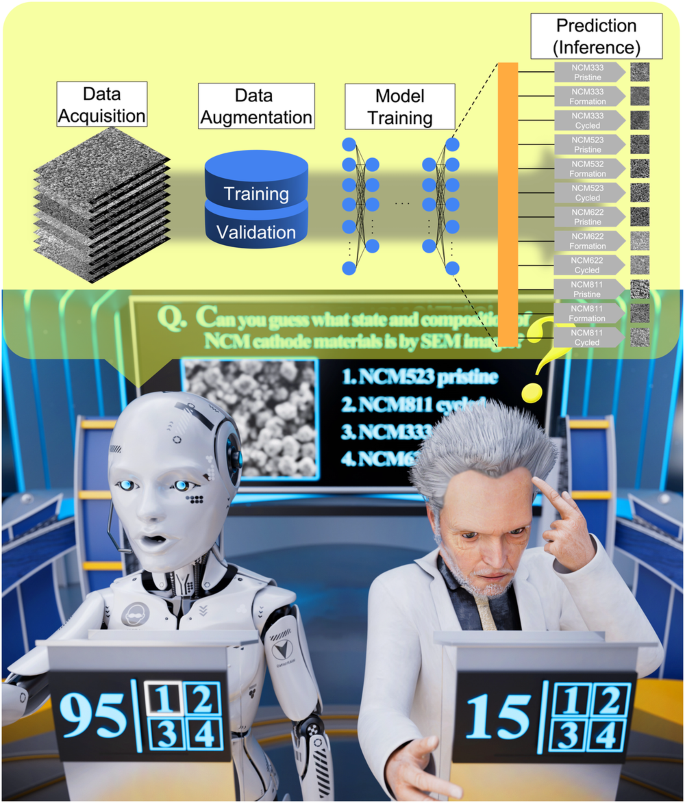
High-throughput materials research is strongly required to accelerate the development of safe and high energy-density lithium-ion battery (LIB) applicable to electric vehicle and energy storage system. The artificial intelligence, including machine learning with neural networks such as Boltzmann neural networks and convolutional neural networks (CNN), is a powerful tool to explore next-generation electrode materials and functional additives. In this paper, we develop a prediction model that classifies the major composition (e.g., 333, 523, 622, and 811) and different states (e.g., pristine, pre-cycled, and 100 times cycled) of various Li(Ni, Co, Mn)O2 (NCM) cathodes via CNN trained on scanning electron microscopy (SEM) images. Based on those results, our trained CNN model shows a high accuracy of 99.6% where the number of test set is 3840. In addition, the model can be applied to the case of untrained SEM data of NCM cathodes with functional electrolyte additives.
期刊介绍:
npj Computational Materials is a high-quality open access journal from Nature Research that publishes research papers applying computational approaches for the design of new materials and enhancing our understanding of existing ones. The journal also welcomes papers on new computational techniques and the refinement of current approaches that support these aims, as well as experimental papers that complement computational findings.
Some key features of npj Computational Materials include a 2-year impact factor of 12.241 (2021), article downloads of 1,138,590 (2021), and a fast turnaround time of 11 days from submission to the first editorial decision. The journal is indexed in various databases and services, including Chemical Abstracts Service (ACS), Astrophysics Data System (ADS), Current Contents/Physical, Chemical and Earth Sciences, Journal Citation Reports/Science Edition, SCOPUS, EI Compendex, INSPEC, Google Scholar, SCImago, DOAJ, CNKI, and Science Citation Index Expanded (SCIE), among others.



 京公网安备 11010802042870号
京ICP备2023020795号-1
京公网安备 11010802042870号
京ICP备2023020795号-1

 分享
分享
 求助内容:
求助内容: 应助结果提醒方式:
 扫码关注我们
