D. Stölzl, N. Sander, D. Siegels, I. Harder, B. Kind, M. Fonfara, L. Heinrich, Hagen Ott, S. Abraham, I. Neustädter, A. Kleinheinz, S. Gerdes, A. Wollenberg, S. Lau, K. Nemat, A. Heratizadeh, I. Gellhaus, T. Werfel, J. Schmitt, S. Weidinger, the TREATgermany study group
{"title":"Clinical and molecular response to dupilumab treatment in pediatric atopic dermatitis: Results of the German TREATkids registry","authors":"D. Stölzl, N. Sander, D. Siegels, I. Harder, B. Kind, M. Fonfara, L. Heinrich, Hagen Ott, S. Abraham, I. Neustädter, A. Kleinheinz, S. Gerdes, A. Wollenberg, S. Lau, K. Nemat, A. Heratizadeh, I. Gellhaus, T. Werfel, J. Schmitt, S. Weidinger, the TREATgermany study group","doi":"10.1111/all.16147","DOIUrl":null,"url":null,"abstract":"<p>Dupilumab is a first-in-class biologic for moderate-to-severe atopic dermatitis (AD). Whereas multiple real-world studies confirmed its robust effectiveness and favorable safety in adults,<span><sup>1</sup></span> routine data on children and adolescents are still scarce. In an interim analysis on 61 pediatric patients of the Dutch BioDay registry dupilumab significantly improved disease severity, however, results were difficult to interprete, because a considerable proportion of patients were in the wash-out or concomitantly treated with immunosuppressants at baseline.<span><sup>2</sup></span> TREATkids is a section of the TREATGermany registry and has been approved by the Medical Faculty of the Technical University of Dresden (No. EK 118032016) and by the respective ethics committees of the participating sites. It currently (data release May 2023) comprises 314 pediatric patients with moderate-to-severe AD (51.0% female, mean age 7.8). Their mean (±SD) baseline scores were Investigator Global Assessment [IGA, 3.2 (1.0)], Eczema Area and Severity Index [EASI, 13.4 (9.9)], peak pruritus numerical rating scale [PP-NRS, 5.5 (2.9)], and (Children's) Dermatology Life Quality Index [(c) DLQI, 9.5 (6.3)].</p><p>Systemic therapy was initiated in 99 of these 314 pediatric patients; most of them (<i>n</i> = 87) received dupilumab. Fifty nine of those had at least one documented follow-up visit after 3 (±14 days) or 6 months (±28 days). Baseline mean EASI, PP-NRS and (C)DLQI scores were 18.1 (±9.5), 7.1 (±2.5) and 13.0 (±5.7).</p><p>Overall, dupilumab treatment led to significant reductions of all severity scores (Figure S1). The proportion of patients with an EASI50, 75 and 90 response were 92.2%, 58.8% and 25.5% at month 3, and 91.4%, 62.9%, and 48.6% at month 6, that is, slightly higher than observed in trials.<span><sup>3</sup></span> An EASI ≤7 reflecting mild disease was achieved by 78.4% and 82.9% at month 3 and 6. PP-NRS was reduced by 55.3% and 57.6% until month 3 and 6 (<i>p</i> = 2.72e-06, <i>p</i> = 7.52e-05), and mean (C)DLQI improved by 59.7% and 62.3% (p = 7.41e-08). At month 3, 84.4% had experienced a 4-point reduction of the (C)DLQI (Table 1). Dupilumab was well tolerated with adverse events reported in only four patients. Three children experienced conjunctivitis and one child developed blepharitis, which led to discontinuation. Facial eczema was reported in one patient.</p><p>A sensitivity analysis on patients with data on both month 3 and 6 indicated that while baseline characteristics did not differ significantly between children (<i>n</i> = 14) and adolescents (<i>n</i> = 14), the latter showed slightly more pronounced improvements with a median EASI reduction at month 3 of 88.2% versus 77.5%, and EASI75 response rates of 78.6% versus 57.1% (Table S1). We additionally analyzed 21 AD candidate biomarkers in tape strips from 14 patients using a Luminex assay (Bio-techne, Minneapolis, USA). Fifteen markers moderately correlated with disease severity measured by the EASI (Table S2). Eighteen proteins showed differential expression in lesional versus non-lesional skin at baseline. At month 3, 15 of these had decreased significantly (Table S3) and no longer showed significant differences to non-lesional skin. In the absence of data on healthy individuals, it is unclear whether they reached levels of non-AD skin. The most pronounced reductions were observed for fibronectin (log2FC-4.63), IL-8 (log2FC-3.52), and S100A9 (log2FC-2.13) (Figure 1). Fibronectin is central for adhesion and internalization of <i>S. aureus</i>.<span><sup>4</sup></span> IL-8 has pleiotropic effects, including attraction and activation of neutrophils, which contribute to <i>S. aureus</i> colonization by release of neutrophil extracellular traps.<span><sup>5</sup></span> S100A9 was reported to correlate with AD severity.<span><sup>6</sup></span></p><p>The results from our analysis demonstrate that dupilumab treatment is safe and leads to clinical and molecular improvements in the majority of pediatric AD patients. Larger-size and longer-term routine data along with analysis of extended biomarker panels will be key to more comprehensively evaluate effects of systemic therapies in pediatric AD.</p><p>Dora Stölzl and Stephan Weidinger designed the study; Inken Harder and Melina Fonfara performed biomarker measurements; Dora Stölzl, Nicole Sander and Doreen Siegels contributed to methodology and analyzed and visualized the data; Jochen Schmitt, Thomas Werfel and Stephan Weidinger supervised the analysis; Dora Stölzl, Nicole Sanders and Stephan Weidinger wrote the manuscript draft; all authors reviewed and edited the manuscript.</p><p>TREATkids is the children and adolesent section of TREATgermany, which is an academic, investigator-initiated clinical disease registry that is financially supported by AbbVie Deutschland GmbH & Co. KG, Almirall Hermal GmbH, Galderma S.A., LEO Pharma GmbH, Lilly Deutschland GmbH, Pfizer Inc. and Sanofi.</p><p>Dora Stölzl has received lecture fees from Novartis and Sanofi. Susanne Abraham has received lecture and/or consultancy fees from Novartis, LEO Pharma, Amgen, Lilly, Sanofi, Beiersdorf, Janssen, UCB and AbbVie. Sascha Gerdes has been an advisor and/or received speakers' honoraria and/or received grants and/or participated in clinical trials of the following companies: AbbVie, Acelyrin, Affibody AB, Akari Therapeutics Plc, Almirall, Amgen, Anaptys Bio, Argenx BV, Biogen Idec, Bristol-Myers Squibb, Boehringer-Ingelheim, Celgene, Dermira, Eli Lilly, Galderma, Hexal AG, Incyte Inc., Janssen-Cilag, Johnson & Johnson, Klinge Pharma, Kymab, Leo Pharma, Medac, MSD, Neubourg Skin Care GmbH, Novartis, Pfizer, Principia Biopharma, Regeneron, Sandoz, Sanofi, UCB Pharma. Katja Nemat has received lecture and/or consultancy fees from Sanofi, Stallergenes, Berlin-Chemie and HAL. Susanne Lau has received grants from Novartis, DBV, Infectopharm and honoraria from ALK, Allergopharma, Boehringer, GSK, LEO Pharma, Nutricia, Lilly, Viatris, GSK, and Sanofi-Aventis. Annice Heratizadeh reports personal fees from AbbVie, Almirall, ALK, LEO Pharma, Novartis, Pierre Fabre, Klinge Pharma, Sanofi, Beiersdorf, Hans Karrer, Nutricia, Meda, and Lilly; and grants from Janssen and Pfizer. Andreas Wollenberg has received institutional research grants, consulting fees and/or study support from Abbvie, Aileens, Almirall, Beiersdorf, Galapagos, Galderma, Glenmark, GSK, Janssen, LEO Pharma, Eli Lilly, L'Oreal, MedImmune, MSD, Novartis, Pfizer, Pierre Fabre, Regeneron, Sanofi and UCB. Jochen Schmitt reports institutional grants for investigator-initiated research from the German Federal Joint Committee, German Ministry of Health, German Ministry of Research, European Union, German Federal State of Saxony, Novartis, Sanofi, ALK, and Pfizer. He participated in advisory board meetings as a paid consultant for Sanofi, Lilly, and ALK. Prof. Schmitt serves the German Ministry of Health as a member of the German National Council for Health and Care. Thomas Werfel has received institutional grants from LEO Pharma and Novartis, has performed consultancies for Abbvie, Almirall, Janssen, Galderma, LEO, Lilly, Novartis, Pfizer and Sanofi-Regeneron and has lectured at events sponsored by Abbvie, Janssen, Celgene, Galderma, LEO Pharma, Lilly, Sanofi and Novartis. Stephan Weidinger has received institutional research grants from LEO, Pfizer and Sanofi; has been an advisor and/or received speakers' honoraria from AbbVie, Almirall, Boehringer, Eli Lilly, Galderma, LEO Pharma, Pfizer, Sanofi, and Regeneron; has participated in clinical trials of AbbVie, Almirall, Anaptys Bio, Boehringer-Ingelheim, Eli Lilly, Galderma, GSK, Incyte Inc., Janssen-Cilag, Kymab, Leo Pharma, Pfizer, Regeneron, Sanofi, UCB. All of the other authors declare they have no conflicts of interest.</p>","PeriodicalId":122,"journal":{"name":"Allergy","volume":"79 10","pages":"2849-2852"},"PeriodicalIF":12.0000,"publicationDate":"2024-05-07","publicationTypes":"Journal Article","fieldsOfStudy":null,"isOpenAccess":false,"openAccessPdf":"https://onlinelibrary.wiley.com/doi/epdf/10.1111/all.16147","citationCount":"0","resultStr":null,"platform":"Semanticscholar","paperid":null,"PeriodicalName":"Allergy","FirstCategoryId":"3","ListUrlMain":"https://onlinelibrary.wiley.com/doi/10.1111/all.16147","RegionNum":1,"RegionCategory":"医学","ArticlePicture":[],"TitleCN":null,"AbstractTextCN":null,"PMCID":null,"EPubDate":"","PubModel":"","JCR":"Q1","JCRName":"ALLERGY","Score":null,"Total":0}
引用次数: 0
Abstract
Dupilumab is a first-in-class biologic for moderate-to-severe atopic dermatitis (AD). Whereas multiple real-world studies confirmed its robust effectiveness and favorable safety in adults,1 routine data on children and adolescents are still scarce. In an interim analysis on 61 pediatric patients of the Dutch BioDay registry dupilumab significantly improved disease severity, however, results were difficult to interprete, because a considerable proportion of patients were in the wash-out or concomitantly treated with immunosuppressants at baseline.2 TREATkids is a section of the TREATGermany registry and has been approved by the Medical Faculty of the Technical University of Dresden (No. EK 118032016) and by the respective ethics committees of the participating sites. It currently (data release May 2023) comprises 314 pediatric patients with moderate-to-severe AD (51.0% female, mean age 7.8). Their mean (±SD) baseline scores were Investigator Global Assessment [IGA, 3.2 (1.0)], Eczema Area and Severity Index [EASI, 13.4 (9.9)], peak pruritus numerical rating scale [PP-NRS, 5.5 (2.9)], and (Children's) Dermatology Life Quality Index [(c) DLQI, 9.5 (6.3)].
Systemic therapy was initiated in 99 of these 314 pediatric patients; most of them (n = 87) received dupilumab. Fifty nine of those had at least one documented follow-up visit after 3 (±14 days) or 6 months (±28 days). Baseline mean EASI, PP-NRS and (C)DLQI scores were 18.1 (±9.5), 7.1 (±2.5) and 13.0 (±5.7).
Overall, dupilumab treatment led to significant reductions of all severity scores (Figure S1). The proportion of patients with an EASI50, 75 and 90 response were 92.2%, 58.8% and 25.5% at month 3, and 91.4%, 62.9%, and 48.6% at month 6, that is, slightly higher than observed in trials.3 An EASI ≤7 reflecting mild disease was achieved by 78.4% and 82.9% at month 3 and 6. PP-NRS was reduced by 55.3% and 57.6% until month 3 and 6 (p = 2.72e-06, p = 7.52e-05), and mean (C)DLQI improved by 59.7% and 62.3% (p = 7.41e-08). At month 3, 84.4% had experienced a 4-point reduction of the (C)DLQI (Table 1). Dupilumab was well tolerated with adverse events reported in only four patients. Three children experienced conjunctivitis and one child developed blepharitis, which led to discontinuation. Facial eczema was reported in one patient.
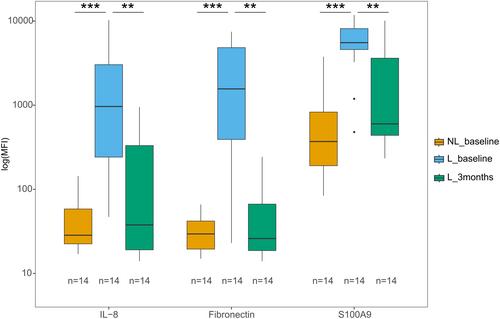
A sensitivity analysis on patients with data on both month 3 and 6 indicated that while baseline characteristics did not differ significantly between children (n = 14) and adolescents (n = 14), the latter showed slightly more pronounced improvements with a median EASI reduction at month 3 of 88.2% versus 77.5%, and EASI75 response rates of 78.6% versus 57.1% (Table S1). We additionally analyzed 21 AD candidate biomarkers in tape strips from 14 patients using a Luminex assay (Bio-techne, Minneapolis, USA). Fifteen markers moderately correlated with disease severity measured by the EASI (Table S2). Eighteen proteins showed differential expression in lesional versus non-lesional skin at baseline. At month 3, 15 of these had decreased significantly (Table S3) and no longer showed significant differences to non-lesional skin. In the absence of data on healthy individuals, it is unclear whether they reached levels of non-AD skin. The most pronounced reductions were observed for fibronectin (log2FC-4.63), IL-8 (log2FC-3.52), and S100A9 (log2FC-2.13) (Figure 1). Fibronectin is central for adhesion and internalization of S. aureus.4 IL-8 has pleiotropic effects, including attraction and activation of neutrophils, which contribute to S. aureus colonization by release of neutrophil extracellular traps.5 S100A9 was reported to correlate with AD severity.6
The results from our analysis demonstrate that dupilumab treatment is safe and leads to clinical and molecular improvements in the majority of pediatric AD patients. Larger-size and longer-term routine data along with analysis of extended biomarker panels will be key to more comprehensively evaluate effects of systemic therapies in pediatric AD.
Dora Stölzl and Stephan Weidinger designed the study; Inken Harder and Melina Fonfara performed biomarker measurements; Dora Stölzl, Nicole Sander and Doreen Siegels contributed to methodology and analyzed and visualized the data; Jochen Schmitt, Thomas Werfel and Stephan Weidinger supervised the analysis; Dora Stölzl, Nicole Sanders and Stephan Weidinger wrote the manuscript draft; all authors reviewed and edited the manuscript.
TREATkids is the children and adolesent section of TREATgermany, which is an academic, investigator-initiated clinical disease registry that is financially supported by AbbVie Deutschland GmbH & Co. KG, Almirall Hermal GmbH, Galderma S.A., LEO Pharma GmbH, Lilly Deutschland GmbH, Pfizer Inc. and Sanofi.
Dora Stölzl has received lecture fees from Novartis and Sanofi. Susanne Abraham has received lecture and/or consultancy fees from Novartis, LEO Pharma, Amgen, Lilly, Sanofi, Beiersdorf, Janssen, UCB and AbbVie. Sascha Gerdes has been an advisor and/or received speakers' honoraria and/or received grants and/or participated in clinical trials of the following companies: AbbVie, Acelyrin, Affibody AB, Akari Therapeutics Plc, Almirall, Amgen, Anaptys Bio, Argenx BV, Biogen Idec, Bristol-Myers Squibb, Boehringer-Ingelheim, Celgene, Dermira, Eli Lilly, Galderma, Hexal AG, Incyte Inc., Janssen-Cilag, Johnson & Johnson, Klinge Pharma, Kymab, Leo Pharma, Medac, MSD, Neubourg Skin Care GmbH, Novartis, Pfizer, Principia Biopharma, Regeneron, Sandoz, Sanofi, UCB Pharma. Katja Nemat has received lecture and/or consultancy fees from Sanofi, Stallergenes, Berlin-Chemie and HAL. Susanne Lau has received grants from Novartis, DBV, Infectopharm and honoraria from ALK, Allergopharma, Boehringer, GSK, LEO Pharma, Nutricia, Lilly, Viatris, GSK, and Sanofi-Aventis. Annice Heratizadeh reports personal fees from AbbVie, Almirall, ALK, LEO Pharma, Novartis, Pierre Fabre, Klinge Pharma, Sanofi, Beiersdorf, Hans Karrer, Nutricia, Meda, and Lilly; and grants from Janssen and Pfizer. Andreas Wollenberg has received institutional research grants, consulting fees and/or study support from Abbvie, Aileens, Almirall, Beiersdorf, Galapagos, Galderma, Glenmark, GSK, Janssen, LEO Pharma, Eli Lilly, L'Oreal, MedImmune, MSD, Novartis, Pfizer, Pierre Fabre, Regeneron, Sanofi and UCB. Jochen Schmitt reports institutional grants for investigator-initiated research from the German Federal Joint Committee, German Ministry of Health, German Ministry of Research, European Union, German Federal State of Saxony, Novartis, Sanofi, ALK, and Pfizer. He participated in advisory board meetings as a paid consultant for Sanofi, Lilly, and ALK. Prof. Schmitt serves the German Ministry of Health as a member of the German National Council for Health and Care. Thomas Werfel has received institutional grants from LEO Pharma and Novartis, has performed consultancies for Abbvie, Almirall, Janssen, Galderma, LEO, Lilly, Novartis, Pfizer and Sanofi-Regeneron and has lectured at events sponsored by Abbvie, Janssen, Celgene, Galderma, LEO Pharma, Lilly, Sanofi and Novartis. Stephan Weidinger has received institutional research grants from LEO, Pfizer and Sanofi; has been an advisor and/or received speakers' honoraria from AbbVie, Almirall, Boehringer, Eli Lilly, Galderma, LEO Pharma, Pfizer, Sanofi, and Regeneron; has participated in clinical trials of AbbVie, Almirall, Anaptys Bio, Boehringer-Ingelheim, Eli Lilly, Galderma, GSK, Incyte Inc., Janssen-Cilag, Kymab, Leo Pharma, Pfizer, Regeneron, Sanofi, UCB. All of the other authors declare they have no conflicts of interest.
期刊介绍:
Allergy is an international and multidisciplinary journal that aims to advance, impact, and communicate all aspects of the discipline of Allergy/Immunology. It publishes original articles, reviews, position papers, guidelines, editorials, news and commentaries, letters to the editors, and correspondences. The journal accepts articles based on their scientific merit and quality.
Allergy seeks to maintain contact between basic and clinical Allergy/Immunology and encourages contributions from contributors and readers from all countries. In addition to its publication, Allergy also provides abstracting and indexing information. Some of the databases that include Allergy abstracts are Abstracts on Hygiene & Communicable Disease, Academic Search Alumni Edition, AgBiotech News & Information, AGRICOLA Database, Biological Abstracts, PubMed Dietary Supplement Subset, and Global Health, among others.



 京公网安备 11010802042870号
京ICP备2023020795号-1
京公网安备 11010802042870号
京ICP备2023020795号-1

 分享
分享
 求助内容:
求助内容: 应助结果提醒方式:
 扫码关注我们
