{"title":"Balance measures of mini and brief balance evaluation system tests for Iranian population.","authors":"Amin Nakhostin-Ansari, Nima Naghshtabrizi, Maryam Mohammadzadeh, Soofia Naghdi, Farnaz Delavari, Maedeh Khalifeloo, Payam Vezvaei, Noureddin Nakhostin Ansari","doi":"10.15167/2421-4248/jpmh2024.65.1.3051","DOIUrl":null,"url":null,"abstract":"<p><strong>Introduction: </strong>Falling is a serious problem for all ages. There are several tests to assess balance. Mini-BESTest and brief-BESTest are balance tests for which there are no normative values for Iranian people. We aimed to provide the normative values of mini-BESTest and brief-BESTest among healthy Iranian adults.</p><p><strong>Methods: </strong>A cross-sectional study was designed. Three hundred healthy adults (150 males and 150 females) in six age groups (18-29, 30-39, 40-49, 50-59, 60-69, +70 years) completed the tests using Persian mini-BESTest and brief-BESTest. Normative values were calculated for age groups.</p><p><strong>Results: </strong>Normative values of mini-BESTest and brief- BESTest decreased significantly with age (from 27 to 21.9 for mini-BESTest and from 22.9 to 15.4 for brief BESTest). There were no significant differences between genders except for females in 30-39 and 40-49 years age groups which scored better on brief-BESTest and mini-BESTest, respectively. Males had significantly scored better in brief- BESTest in 60-69 and ≥ 70 age groups.</p><p><strong>Conclusions: </strong>The normative values of the mini-BESTest and brief-BESTest provided for healthy Iranian adults can help clinicians when assessing subjects with balance dysfunction.</p>","PeriodicalId":94106,"journal":{"name":"Journal of preventive medicine and hygiene","volume":"65 1","pages":"E83-E92"},"PeriodicalIF":0.0000,"publicationDate":"2024-03-31","publicationTypes":"Journal Article","fieldsOfStudy":null,"isOpenAccess":false,"openAccessPdf":"https://www.ncbi.nlm.nih.gov/pmc/articles/PMC11066829/pdf/","citationCount":"0","resultStr":null,"platform":"Semanticscholar","paperid":null,"PeriodicalName":"Journal of preventive medicine and hygiene","FirstCategoryId":"1085","ListUrlMain":"https://doi.org/10.15167/2421-4248/jpmh2024.65.1.3051","RegionNum":0,"RegionCategory":null,"ArticlePicture":[],"TitleCN":null,"AbstractTextCN":null,"PMCID":null,"EPubDate":"2024/3/1 0:00:00","PubModel":"eCollection","JCR":"","JCRName":"","Score":null,"Total":0}
引用次数: 0
Abstract
Introduction: Falling is a serious problem for all ages. There are several tests to assess balance. Mini-BESTest and brief-BESTest are balance tests for which there are no normative values for Iranian people. We aimed to provide the normative values of mini-BESTest and brief-BESTest among healthy Iranian adults.
Methods: A cross-sectional study was designed. Three hundred healthy adults (150 males and 150 females) in six age groups (18-29, 30-39, 40-49, 50-59, 60-69, +70 years) completed the tests using Persian mini-BESTest and brief-BESTest. Normative values were calculated for age groups.
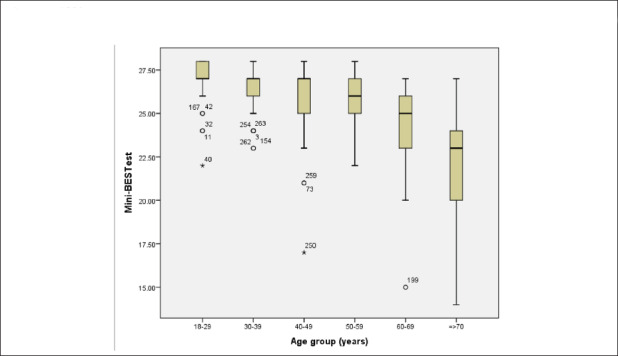
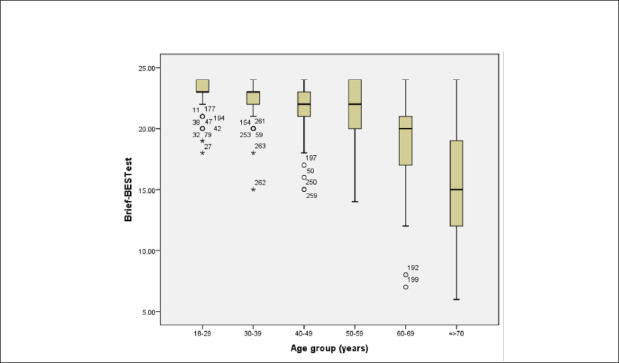
Results: Normative values of mini-BESTest and brief- BESTest decreased significantly with age (from 27 to 21.9 for mini-BESTest and from 22.9 to 15.4 for brief BESTest). There were no significant differences between genders except for females in 30-39 and 40-49 years age groups which scored better on brief-BESTest and mini-BESTest, respectively. Males had significantly scored better in brief- BESTest in 60-69 and ≥ 70 age groups.
Conclusions: The normative values of the mini-BESTest and brief-BESTest provided for healthy Iranian adults can help clinicians when assessing subjects with balance dysfunction.



 京公网安备 11010802042870号
京ICP备2023020795号-1
京公网安备 11010802042870号
京ICP备2023020795号-1

 分享
分享

 求助内容:
求助内容: 应助结果提醒方式:
 扫码关注我们
