Saira Talwar, Johneric W Smith, Johnathan Lamberth
{"title":"The Effect of Stroboscopic Vision Training on Blind-folded Straight-line Walking.","authors":"Saira Talwar, Johneric W Smith, Johnathan Lamberth","doi":"10.70252/GZDG9193","DOIUrl":null,"url":null,"abstract":"<p><p>Stroboscopic vision training has shown to improve visual-motor control and dynamic visual acuity in sport performance; however, no studies have considered using this training to enhance kinesthetic awareness during walking, applicable to high fall-risk populations.</p><p><strong>Purpose: </strong>The purpose of this study was to assess the effect of stroboscopic vision training on blind-folded straight-line walking.</p><p><strong>Methods: </strong>Thirty-seven college-aged healthy participants (age: 20.14 ± 1.23 years; females: <i>N</i> = 32, males: <i>N</i> = 5) completed this study. In this pre-posttest quasi-experimental investigation, participants with no epileptic or balance disorder history completed a four-week progressive stroboscopic vision training protocol. To assess sensorimotor feedback participants were instructed to walk a 27.5 m straight line while blindfolded. PRE and POST blind-folded straight line walk tests were completed and deviations from endpoint were measured. A paired-samples <i>t-test</i> was used to analyze the calculated deviation angles.</p><p><strong>Results: </strong>Significant difference was noted from PRE (14.48 ± 5.95) to POST (11.60 ± 6.78) deviation angles (<i>t</i>(36) = 2.71, <i>p</i> = 0.01).</p><p><strong>Conclusions: </strong>This is the first study to examine the effects of stroboscopic training on a vision restricted walking task, which demands feedback re-weighting. These findings may be valuable for clinical settings or performance where reliance on non-visual systems may be beneficial.</p>","PeriodicalId":14171,"journal":{"name":"International journal of exercise science","volume":"17 1","pages":"438-444"},"PeriodicalIF":0.0000,"publicationDate":"2024-03-01","publicationTypes":"Journal Article","fieldsOfStudy":null,"isOpenAccess":false,"openAccessPdf":"https://www.ncbi.nlm.nih.gov/pmc/articles/PMC11042846/pdf/","citationCount":"0","resultStr":null,"platform":"Semanticscholar","paperid":null,"PeriodicalName":"International journal of exercise science","FirstCategoryId":"1085","ListUrlMain":"https://doi.org/10.70252/GZDG9193","RegionNum":0,"RegionCategory":null,"ArticlePicture":[],"TitleCN":null,"AbstractTextCN":null,"PMCID":null,"EPubDate":"2024/1/1 0:00:00","PubModel":"eCollection","JCR":"Q1","JCRName":"Health Professions","Score":null,"Total":0}
引用次数: 0
Abstract
Stroboscopic vision training has shown to improve visual-motor control and dynamic visual acuity in sport performance; however, no studies have considered using this training to enhance kinesthetic awareness during walking, applicable to high fall-risk populations.
Purpose: The purpose of this study was to assess the effect of stroboscopic vision training on blind-folded straight-line walking.
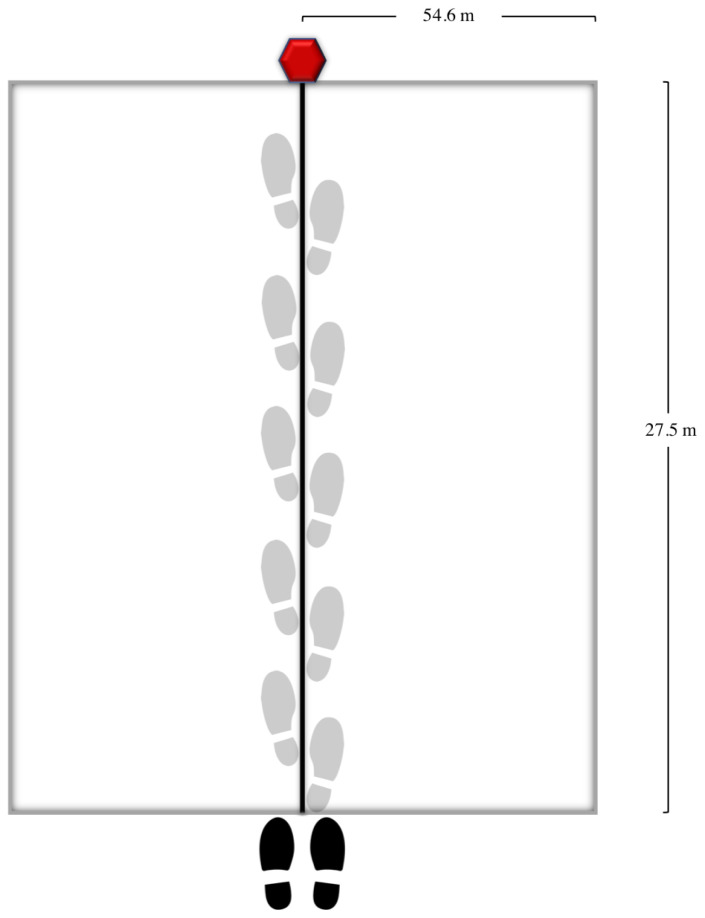
Methods: Thirty-seven college-aged healthy participants (age: 20.14 ± 1.23 years; females: N = 32, males: N = 5) completed this study. In this pre-posttest quasi-experimental investigation, participants with no epileptic or balance disorder history completed a four-week progressive stroboscopic vision training protocol. To assess sensorimotor feedback participants were instructed to walk a 27.5 m straight line while blindfolded. PRE and POST blind-folded straight line walk tests were completed and deviations from endpoint were measured. A paired-samples t-test was used to analyze the calculated deviation angles.
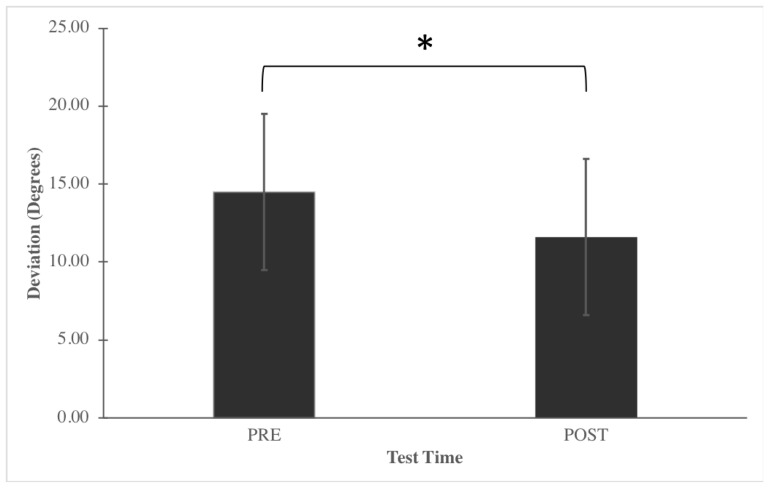
Results: Significant difference was noted from PRE (14.48 ± 5.95) to POST (11.60 ± 6.78) deviation angles (t(36) = 2.71, p = 0.01).
Conclusions: This is the first study to examine the effects of stroboscopic training on a vision restricted walking task, which demands feedback re-weighting. These findings may be valuable for clinical settings or performance where reliance on non-visual systems may be beneficial.





 京公网安备 11010802042870号
京ICP备2023020795号-1
京公网安备 11010802042870号
京ICP备2023020795号-1

 分享
分享
 求助内容:
求助内容: 应助结果提醒方式:
 扫码关注我们
