{"title":"Detection method for unrecognized spatial disorientation based on optical flow stimuli.","authors":"Chenru Hao, Rui Su, Chunnan Dong, Jingjing Zhang, Ziqiang Chi, Fanzhen Meng, Ruibin Zhao, Yanru Wu, Linlin Wang, Pengfei Li, Chengwei Chen, Qingjie Lian, Li Cheng","doi":"10.3233/THC-248030","DOIUrl":null,"url":null,"abstract":"<p><strong>Background: </strong>Flight accidents caused by spatial disorientation (SD) greatly affect flight safety.</p><p><strong>Objective: </strong>Few studies have been devoted to the evaluation of SD.</p><p><strong>Methods: </strong>10 pilots and 10 non-pilots were recruited for the experimental induction of SD. Videos for giving optical flow stimuli were played at two different flow speeds to induce SD. Subjective judgment and center of foot pressure (CoP) data were collected from the tests. The data were combined to determine the occurrence of SD and analyze the SD types.</p><p><strong>Results: </strong>The number of self-reported SD events was slightly smaller in the pilots than in the non-pilots. The average upper bound of the confidence interval for the standard deviation of CoP was 0.32 ± 0.09 cm and 0.38 ± 0.12 cm in the pilots and non-pilots, respectively. This indicator was significantly lower in the pilots than in the non-pilots (P= 0.03). The success rate of the experimental induction of unrecognized SD was 26.7% and 45.0% in the pilots and non-pilots, respectively.</p><p><strong>Conclusion: </strong>The method offered a new to analyze unrecognized SD. We could determine the occurrence unrecognized SD. This is an essential means of reducing flight accidents caused by unrecognized SD.</p>","PeriodicalId":48978,"journal":{"name":"Technology and Health Care","volume":" ","pages":"339-349"},"PeriodicalIF":1.8000,"publicationDate":"2024-01-01","publicationTypes":"Journal Article","fieldsOfStudy":null,"isOpenAccess":false,"openAccessPdf":"https://www.ncbi.nlm.nih.gov/pmc/articles/PMC11191483/pdf/","citationCount":"0","resultStr":null,"platform":"Semanticscholar","paperid":null,"PeriodicalName":"Technology and Health Care","FirstCategoryId":"5","ListUrlMain":"https://doi.org/10.3233/THC-248030","RegionNum":4,"RegionCategory":"医学","ArticlePicture":[],"TitleCN":null,"AbstractTextCN":null,"PMCID":null,"EPubDate":"","PubModel":"","JCR":"Q4","JCRName":"ENGINEERING, BIOMEDICAL","Score":null,"Total":0}
Objective: Few studies have been devoted to the evaluation of SD.
Methods: 10 pilots and 10 non-pilots were recruited for the experimental induction of SD. Videos for giving optical flow stimuli were played at two different flow speeds to induce SD. Subjective judgment and center of foot pressure (CoP) data were collected from the tests. The data were combined to determine the occurrence of SD and analyze the SD types.
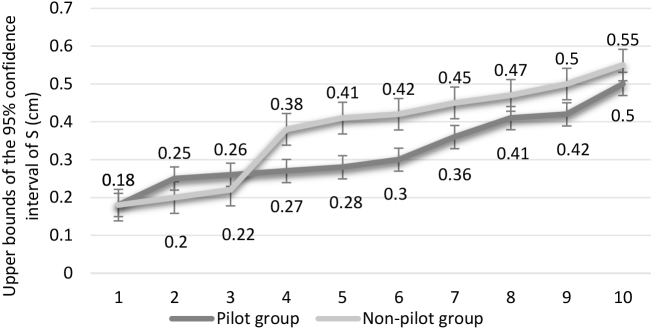
Results: The number of self-reported SD events was slightly smaller in the pilots than in the non-pilots. The average upper bound of the confidence interval for the standard deviation of CoP was 0.32 ± 0.09 cm and 0.38 ± 0.12 cm in the pilots and non-pilots, respectively. This indicator was significantly lower in the pilots than in the non-pilots (P= 0.03). The success rate of the experimental induction of unrecognized SD was 26.7% and 45.0% in the pilots and non-pilots, respectively.
Conclusion: The method offered a new to analyze unrecognized SD. We could determine the occurrence unrecognized SD. This is an essential means of reducing flight accidents caused by unrecognized SD.
期刊介绍:
Technology and Health Care is intended to serve as a forum for the presentation of original articles and technical notes, observing rigorous scientific standards. Furthermore, upon invitation, reviews, tutorials, discussion papers and minisymposia are featured. The main focus of THC is related to the overlapping areas of engineering and medicine. The following types of contributions are considered:
1.Original articles: New concepts, procedures and devices associated with the use of technology in medical research and clinical practice are presented to a readership with a widespread background in engineering and/or medicine. In particular, the clinical benefit deriving from the application of engineering methods and devices in clinical medicine should be demonstrated. Typically, full length original contributions have a length of 4000 words, thereby taking duly into account figures and tables.
2.Technical Notes and Short Communications: Technical Notes relate to novel technical developments with relevance for clinical medicine. In Short Communications, clinical applications are shortly described. 3.Both Technical Notes and Short Communications typically have a length of 1500 words.
Reviews and Tutorials (upon invitation only): Tutorial and educational articles for persons with a primarily medical background on principles of engineering with particular significance for biomedical applications and vice versa are presented. The Editorial Board is responsible for the selection of topics.
4.Minisymposia (upon invitation only): Under the leadership of a Special Editor, controversial or important issues relating to health care are highlighted and discussed by various authors.
5.Letters to the Editors: Discussions or short statements (not indexed).




 京公网安备 11010802042870号
京ICP备2023020795号-1
京公网安备 11010802042870号
京ICP备2023020795号-1

 分享
分享
 求助内容:
求助内容: 应助结果提醒方式:
 扫码关注我们
