Case of the month from the Desai Sethi Urology Institute, Florida, USA: bladder outlet obstruction-induced urinothorax after percutaneous nephrolithotomy
Ryan Chen, Joao G. Porto, Ruben Blachman-Braun, Diana M. Lopategui, Robert Marcovich, Hemendra N. Shah
{"title":"Case of the month from the Desai Sethi Urology Institute, Florida, USA: bladder outlet obstruction-induced urinothorax after percutaneous nephrolithotomy","authors":"Ryan Chen, Joao G. Porto, Ruben Blachman-Braun, Diana M. Lopategui, Robert Marcovich, Hemendra N. Shah","doi":"10.1111/bju.16393","DOIUrl":null,"url":null,"abstract":"<p>Urinothorax, a rare cause of pleural effusion characterised by the presence of urine in the pleural space, typically occurs iatrogenically after urological procedures or spontaneously due to obstructive uropathies. Its diagnosis centres on high clinical suspicion and the biochemical analysis of pleural fluid, with treatment focusing on alleviating urinary obstruction or treating traumatic injuries [<span>1-3</span>]. While the literature reports cases of urinothorax due to isolated obstructive uropathies (e.g., prostatic adenocarcinoma) [<span>2, 3</span>] or iatrogenic causes [<span>4-7</span>], our case report introduces what we believe to be the first documented instance of urinothorax precipitated by urine retention secondary to an enlarged prostate in the postoperative period after percutaneous nephrolithotomy (PCNL) with subcostal access.</p><p>A 51-year-old male with a history of hypertension and recurrent nephrolithiasis was found to have elevated PSA of 9.16 ng/mL and a left upper ureteric stone on renal ultrasonography that was carried out as a part of his annual physical examination by his primary care provider. He was asymptomatic from the stone but had LUTS with an IPSS of 13. He had a history of nephrolithiasis over the previous two decades and had undergone five ureteroscopies and one PCNL. He also had a family history of nephrolithiasis and prostate cancer. He was started on tamsulosin for LUTS by his primary care provider. His serum creatinine was 71.62 and CT confirmed the presence of a 1.3 × 3.0 × 1.5-cm stone in the left upper ureter (1630 Hounsfield units) with severe proximal hydroureteronephrosis (Fig. 1A). Multiparametric MRI of the prostate indicated a prostate size of 101.3 g, with no lesions suspicious for prostate cancer (Fig. 1C,D). His uroflowmetry was obstructed with a peak urinary flow rate (Q<sub>max</sub>) of 7.4 mL/s and a postvoid residual urine volume (PVR) of 21 mL.</p><p>Considering the large stone burden, the patient elected to proceed with left PCNL, and after shared decision making, he decided to monitor his PSA. However, before his surgery was scheduled, he developed a fever, and a left ureteric stent was placed at an outside facility to treat pyelonephritis (Fig. 1B). We subsequently performed a left tubeless PCNL with fluoroscopy-guided subcostal renal access in the prone position. During cystoscopy, we encountered a trilobar enlarged prostate with a median lobe, making access to the ureteric orifice challenging. The percutaneous tract was dilated with metal telescoping Alken dilators up to 24-Fr. Subsequently, a 24-Fr Amplatz sheath was introduced into the left kidney and the stone was fragmented with a Swiss Lithoclast™ Trilogy lithotripter (Boston Scientific, Marlborough, MA, USA; Fig. 2A). After confirming complete endoscopic and fluoroscopic stone removal, a 6-Fr 26-cm ureteric stent was deployed in an antegrade manner, and no nephrostomy tube was placed. The procedure was completed with no intra-operative complications. On postoperative day 1, the patient's serum creatinine level was 0.87 mg/dL, CT confirmed stone-free status, and he was discharged home after a successful voiding trial (Fig. 2B). Stone composition was 70% brushite, 20% calcium oxalate monohydrate, and 7% calcium phosphate hydroxyl form.</p><p>Ten days after discharge the patient returned to the emergency department complaining of abdominal pain that worsened with inspiration, worsening LUTS, and constipation that developed over the preceding 3–4 days. On evaluation, he had leucocytosis (white blood cells of 15.9 × 10<sup>3</sup>/μL) and acute kidney injury (creatinine of 3.34 mg/dL). A new CT scan demonstrated severe left hydroureteronephrosis with a 3-cm perinephric fluid collection that opacified with contrast, consistent with urine leak from a lower pole renal access with marked bladder distention and appropriately positioned left ureteric stent (Fig. 3). There was a moderate left pleural effusion of approximately 100 mL and basilar linear atelectasis, which was also observed on a chest X-ray (Figs. 3C and 4A). The patient was started on ceftriaxone, chest spirometry and physiotherapy, and was recommended to undergo Foley catheter placement. Initially, he refused the placement of a catheter, until the second day of admission, at which time he acquiesced, prompted by a rise in serum creatinine to 4.36 mg/dL and a chest X-ray that showed worsening of the left pleural effusion (Fig. 4B). He was also scheduled for thoracentesis, following a pulmonology consultation. Remarkably, after the Foley catheter was placed, there was a significant overnight decrease in his serum creatinine to 0.95 mg/dL. A subsequent chest X-ray indicated considerable reduction in the pleural effusion (Fig. 4C), leading to cancellation of the planned thoracentesis. As a result, the patient was managed conservatively, maintaining the Foley catheter for continuous drainage, and engaging in chest spirometry exercises.</p><p>On the 4th day after emergency admission the patient's serum creatinine level had further declined to 0.80 mg/dL, and a chest X-ray showed continued improvement (Fig. 4D). Consequently, he was discharged with an indwelling Foley catheter in place. At a 2-week follow-up, both his serum creatinine levels and chest X-ray had normalized, and a renal ultrasonography confirmed resolution of the perinephric fluid collection as well as a reduction in hydronephrosis, with the ureteric stent still in place (Fig. 5). Five weeks after surgery, the patient had his stent removed. However, his urinary flow remained obstructed, evidenced by a voided volume of 207 mL, a Q<sub>max</sub> of 8.7 mL/s, and a PVR of 95 mL. Despite this, he chose to persist with medical management, continuing treatment with tamsulosin.</p><p>The patient in the present report had both obstructive uropathy due to urinary retention secondary to an enlarged prostate, and iatrogenic renal trauma resulting from PCNL. Others have similarly reported urinothorax following iatrogenic trauma from PCNL, ureteroscopy, and partial nephrectomy [<span>4-9</span>]. Urinothorax has also been found to arise in the setting of obstructive prostatic adenocarcinoma and renal calculi [<span>7, 9, 10</span>]. However, each of these reported cases had a clear aetiology, and management was thus straightforward: addressing the root cause resolved the urinothorax.</p><p>The pathogenesis of urinothorax is primarily explained by two theories: one theory suggests that urine crosses a diaphragmatic defect to reach the pleural space, while the other proposes that urine from the retroperitoneal area enters the peritoneal cavity, eventually reaching the pleural cavity via lymphatic channels [<span>6, 9</span>]. We propose that our patient developed postoperative urine retention due to his large prostate, which led to secondary left vesico-ureteric reflux aggravated by an indwelling ureteric stent, thereby causing urine leakage from the site of his PCNL. Such leakage caused a pseudo-acute kidney injury with a significant increase in creatinine levels but also facilitated the migration of urine into the pleural cavity, presenting as a pleural effusion.</p><p>Management of urinothorax typically necessitates prompt diagnosis through pleural fluid analysis via thoracentesis, immediately followed by intervention for diversion, drainage, or alleviation of the obstruction [<span>2</span>]. The pleural fluid characteristic of urinothorax is transudative, with a defining feature being its creatinine concentration, which exceeds that of serum levels. Generally, the effusion is unilateral and occurs on the same side as the underlying uropathy. Many others have reported placing a pleural drainage tube to aid in the resolution of the pleural effusion [<span>5, 6</span>]. In our patient's case, the unilateral pleural effusion was swiftly resolved following insertion of a Foley catheter (Fig. 4). However, it is important to highlight that resolution of symptoms was delayed due to the patient's repeated refusal of catheter placement in the first 2 days after emergency admission, which worsened his pleural effusion and serum creatinine level. Therefore, early consideration for placement of a urethral catheter is recommended, potentially even prior to thoracentesis, especially in cases where urinothorax is suspected. Additionally, it is widely recognized that patients with symptomatic enlarged prostate and concurrent nephrolithiasis can benefit from simultaneous surgical treatment, addressing both the enlarged prostate and the stones [<span>11</span>]. Such an approach can prevent complications such as those detailed in this report.</p><p>Delayed urinothorax is a rare complication that may arise secondary to PCNL or prostate enlargement. We present a unique case of urinothorax in a patient with both an obstructive uropathy due to urinary retention resulting from an enlarged prostate and iatrogenic renal trauma resulting from PCNL. Initial conservative treatment that relieved the obstruction was sufficient and should be considered even before thoracocentesis in patients with urinothorax and multiple possible aetiologies.</p><p>The authors have no conflicts of interest to declare.</p>","PeriodicalId":8985,"journal":{"name":"BJU International","volume":"135 2","pages":"237-242"},"PeriodicalIF":4.4000,"publicationDate":"2024-05-08","publicationTypes":"Journal Article","fieldsOfStudy":null,"isOpenAccess":false,"openAccessPdf":"https://www.ncbi.nlm.nih.gov/pmc/articles/PMC11745992/pdf/","citationCount":"0","resultStr":null,"platform":"Semanticscholar","paperid":null,"PeriodicalName":"BJU International","FirstCategoryId":"3","ListUrlMain":"https://bjui-journals.onlinelibrary.wiley.com/doi/10.1111/bju.16393","RegionNum":2,"RegionCategory":"医学","ArticlePicture":[],"TitleCN":null,"AbstractTextCN":null,"PMCID":null,"EPubDate":"","PubModel":"","JCR":"Q1","JCRName":"UROLOGY & NEPHROLOGY","Score":null,"Total":0}
引用次数: 0
Abstract
Urinothorax, a rare cause of pleural effusion characterised by the presence of urine in the pleural space, typically occurs iatrogenically after urological procedures or spontaneously due to obstructive uropathies. Its diagnosis centres on high clinical suspicion and the biochemical analysis of pleural fluid, with treatment focusing on alleviating urinary obstruction or treating traumatic injuries [1-3]. While the literature reports cases of urinothorax due to isolated obstructive uropathies (e.g., prostatic adenocarcinoma) [2, 3] or iatrogenic causes [4-7], our case report introduces what we believe to be the first documented instance of urinothorax precipitated by urine retention secondary to an enlarged prostate in the postoperative period after percutaneous nephrolithotomy (PCNL) with subcostal access.
A 51-year-old male with a history of hypertension and recurrent nephrolithiasis was found to have elevated PSA of 9.16 ng/mL and a left upper ureteric stone on renal ultrasonography that was carried out as a part of his annual physical examination by his primary care provider. He was asymptomatic from the stone but had LUTS with an IPSS of 13. He had a history of nephrolithiasis over the previous two decades and had undergone five ureteroscopies and one PCNL. He also had a family history of nephrolithiasis and prostate cancer. He was started on tamsulosin for LUTS by his primary care provider. His serum creatinine was 71.62 and CT confirmed the presence of a 1.3 × 3.0 × 1.5-cm stone in the left upper ureter (1630 Hounsfield units) with severe proximal hydroureteronephrosis (Fig. 1A). Multiparametric MRI of the prostate indicated a prostate size of 101.3 g, with no lesions suspicious for prostate cancer (Fig. 1C,D). His uroflowmetry was obstructed with a peak urinary flow rate (Qmax) of 7.4 mL/s and a postvoid residual urine volume (PVR) of 21 mL.
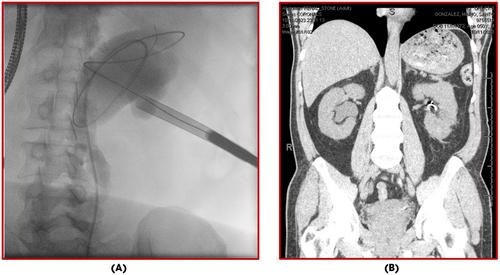
Considering the large stone burden, the patient elected to proceed with left PCNL, and after shared decision making, he decided to monitor his PSA. However, before his surgery was scheduled, he developed a fever, and a left ureteric stent was placed at an outside facility to treat pyelonephritis (Fig. 1B). We subsequently performed a left tubeless PCNL with fluoroscopy-guided subcostal renal access in the prone position. During cystoscopy, we encountered a trilobar enlarged prostate with a median lobe, making access to the ureteric orifice challenging. The percutaneous tract was dilated with metal telescoping Alken dilators up to 24-Fr. Subsequently, a 24-Fr Amplatz sheath was introduced into the left kidney and the stone was fragmented with a Swiss Lithoclast™ Trilogy lithotripter (Boston Scientific, Marlborough, MA, USA; Fig. 2A). After confirming complete endoscopic and fluoroscopic stone removal, a 6-Fr 26-cm ureteric stent was deployed in an antegrade manner, and no nephrostomy tube was placed. The procedure was completed with no intra-operative complications. On postoperative day 1, the patient's serum creatinine level was 0.87 mg/dL, CT confirmed stone-free status, and he was discharged home after a successful voiding trial (Fig. 2B). Stone composition was 70% brushite, 20% calcium oxalate monohydrate, and 7% calcium phosphate hydroxyl form.
Ten days after discharge the patient returned to the emergency department complaining of abdominal pain that worsened with inspiration, worsening LUTS, and constipation that developed over the preceding 3–4 days. On evaluation, he had leucocytosis (white blood cells of 15.9 × 10³/μL) and acute kidney injury (creatinine of 3.34 mg/dL). A new CT scan demonstrated severe left hydroureteronephrosis with a 3-cm perinephric fluid collection that opacified with contrast, consistent with urine leak from a lower pole renal access with marked bladder distention and appropriately positioned left ureteric stent (Fig. 3). There was a moderate left pleural effusion of approximately 100 mL and basilar linear atelectasis, which was also observed on a chest X-ray (Figs. 3C and 4A). The patient was started on ceftriaxone, chest spirometry and physiotherapy, and was recommended to undergo Foley catheter placement. Initially, he refused the placement of a catheter, until the second day of admission, at which time he acquiesced, prompted by a rise in serum creatinine to 4.36 mg/dL and a chest X-ray that showed worsening of the left pleural effusion (Fig. 4B). He was also scheduled for thoracentesis, following a pulmonology consultation. Remarkably, after the Foley catheter was placed, there was a significant overnight decrease in his serum creatinine to 0.95 mg/dL. A subsequent chest X-ray indicated considerable reduction in the pleural effusion (Fig. 4C), leading to cancellation of the planned thoracentesis. As a result, the patient was managed conservatively, maintaining the Foley catheter for continuous drainage, and engaging in chest spirometry exercises.
On the 4th day after emergency admission the patient's serum creatinine level had further declined to 0.80 mg/dL, and a chest X-ray showed continued improvement (Fig. 4D). Consequently, he was discharged with an indwelling Foley catheter in place. At a 2-week follow-up, both his serum creatinine levels and chest X-ray had normalized, and a renal ultrasonography confirmed resolution of the perinephric fluid collection as well as a reduction in hydronephrosis, with the ureteric stent still in place (Fig. 5). Five weeks after surgery, the patient had his stent removed. However, his urinary flow remained obstructed, evidenced by a voided volume of 207 mL, a Qmax of 8.7 mL/s, and a PVR of 95 mL. Despite this, he chose to persist with medical management, continuing treatment with tamsulosin.
The patient in the present report had both obstructive uropathy due to urinary retention secondary to an enlarged prostate, and iatrogenic renal trauma resulting from PCNL. Others have similarly reported urinothorax following iatrogenic trauma from PCNL, ureteroscopy, and partial nephrectomy [4-9]. Urinothorax has also been found to arise in the setting of obstructive prostatic adenocarcinoma and renal calculi [7, 9, 10]. However, each of these reported cases had a clear aetiology, and management was thus straightforward: addressing the root cause resolved the urinothorax.
The pathogenesis of urinothorax is primarily explained by two theories: one theory suggests that urine crosses a diaphragmatic defect to reach the pleural space, while the other proposes that urine from the retroperitoneal area enters the peritoneal cavity, eventually reaching the pleural cavity via lymphatic channels [6, 9]. We propose that our patient developed postoperative urine retention due to his large prostate, which led to secondary left vesico-ureteric reflux aggravated by an indwelling ureteric stent, thereby causing urine leakage from the site of his PCNL. Such leakage caused a pseudo-acute kidney injury with a significant increase in creatinine levels but also facilitated the migration of urine into the pleural cavity, presenting as a pleural effusion.
Management of urinothorax typically necessitates prompt diagnosis through pleural fluid analysis via thoracentesis, immediately followed by intervention for diversion, drainage, or alleviation of the obstruction [2]. The pleural fluid characteristic of urinothorax is transudative, with a defining feature being its creatinine concentration, which exceeds that of serum levels. Generally, the effusion is unilateral and occurs on the same side as the underlying uropathy. Many others have reported placing a pleural drainage tube to aid in the resolution of the pleural effusion [5, 6]. In our patient's case, the unilateral pleural effusion was swiftly resolved following insertion of a Foley catheter (Fig. 4). However, it is important to highlight that resolution of symptoms was delayed due to the patient's repeated refusal of catheter placement in the first 2 days after emergency admission, which worsened his pleural effusion and serum creatinine level. Therefore, early consideration for placement of a urethral catheter is recommended, potentially even prior to thoracentesis, especially in cases where urinothorax is suspected. Additionally, it is widely recognized that patients with symptomatic enlarged prostate and concurrent nephrolithiasis can benefit from simultaneous surgical treatment, addressing both the enlarged prostate and the stones [11]. Such an approach can prevent complications such as those detailed in this report.
Delayed urinothorax is a rare complication that may arise secondary to PCNL or prostate enlargement. We present a unique case of urinothorax in a patient with both an obstructive uropathy due to urinary retention resulting from an enlarged prostate and iatrogenic renal trauma resulting from PCNL. Initial conservative treatment that relieved the obstruction was sufficient and should be considered even before thoracocentesis in patients with urinothorax and multiple possible aetiologies.
The authors have no conflicts of interest to declare.
期刊介绍:
BJUI is one of the most highly respected medical journals in the world, with a truly international range of published papers and appeal. Every issue gives invaluable practical information in the form of original articles, reviews, comments, surgical education articles, and translational science articles in the field of urology. BJUI employs topical sections, and is in full colour, making it easier to browse or search for something specific.







 京公网安备 11010802042870号
京ICP备2023020795号-1
京公网安备 11010802042870号
京ICP备2023020795号-1

 分享
分享
 求助内容:
求助内容: 应助结果提醒方式:
 扫码关注我们
