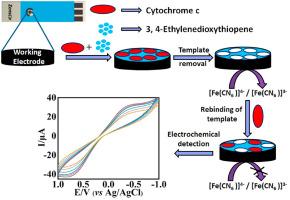
{"title":"Cytochrome c electrochemical detection utilizing molecularly imprinted poly(3, 4-ethylenedioxythiophene) on a disposable screen printed carbon electrode","authors":"Ganesan Kaniraja , Murugesan Karthikeyan , Marimuthu Dhinesh Kumar , Periyasamy Ananthappan , Karuppiah Arunsunai Kumar , Vellasamy Shanmugaiah , Vairathevar Sivasamy Vasantha , Chandran Karunakaran","doi":"10.1016/j.ab.2024.115557","DOIUrl":null,"url":null,"abstract":"<div><p>Cytochrome <em>c</em> (cyt <em>c</em>) has been found to play a function in apoptosis in cell-free models. This work presents the creation of molecularly imprinted conducting poly(3, 4-ethylenedioxythiopene) (MIPEDOT) on the surface of a screen printed carbon electrode (SPCE) for cyt <em>c</em>. Cyt <em>c</em> was imprinted by electropolymerization due to the presence of an EDOT monomer hydrophobic functional group on SPCE, using CV to obtain highly selective materials with excellent molecular recognition ability. MIPEDOT was characterized by CV, EIS, and DPV using ferricyanide/ferrocyanide as a redox probe. Further, the characterization of the sensor was accomplished using SEM for surface morphological confirmation. Using CV, the peak current measured at the potential of +1 to −1 V (<em>vs</em>. Ag/AgCl) is linear in the cyt <em>c</em> concentration range from 1 to 1200 pM, showing a remarkably low detection limit of 0.5 pM (sensitivity:0.080 μA pM). Moreover, the applicability of the approach was successfully confirmed with the detection of cyt <em>c</em> in biological samples (human plasma). Similarly, our research has proven a low-cost, simple, and efficient sensing platform for cyt <em>c</em> detection, rendering it a viable tool for the future improvement of reliable and exact non-encroaching cell death detection.</p></div>","PeriodicalId":7830,"journal":{"name":"Analytical biochemistry","volume":"692 ","pages":"Article 115557"},"PeriodicalIF":2.5000,"publicationDate":"2024-09-01","publicationTypes":"Journal Article","fieldsOfStudy":null,"isOpenAccess":false,"openAccessPdf":"","citationCount":"0","resultStr":null,"platform":"Semanticscholar","paperid":null,"PeriodicalName":"Analytical biochemistry","FirstCategoryId":"99","ListUrlMain":"https://www.sciencedirect.com/science/article/pii/S0003269724001015","RegionNum":4,"RegionCategory":"生物学","ArticlePicture":[],"TitleCN":null,"AbstractTextCN":null,"PMCID":null,"EPubDate":"2024/5/7 0:00:00","PubModel":"Epub","JCR":"Q2","JCRName":"BIOCHEMICAL RESEARCH METHODS","Score":null,"Total":0}
引用次数: 0
Abstract
Cytochrome c (cyt c) has been found to play a function in apoptosis in cell-free models. This work presents the creation of molecularly imprinted conducting poly(3, 4-ethylenedioxythiopene) (MIPEDOT) on the surface of a screen printed carbon electrode (SPCE) for cyt c. Cyt c was imprinted by electropolymerization due to the presence of an EDOT monomer hydrophobic functional group on SPCE, using CV to obtain highly selective materials with excellent molecular recognition ability. MIPEDOT was characterized by CV, EIS, and DPV using ferricyanide/ferrocyanide as a redox probe. Further, the characterization of the sensor was accomplished using SEM for surface morphological confirmation. Using CV, the peak current measured at the potential of +1 to −1 V (vs. Ag/AgCl) is linear in the cyt c concentration range from 1 to 1200 pM, showing a remarkably low detection limit of 0.5 pM (sensitivity:0.080 μA pM). Moreover, the applicability of the approach was successfully confirmed with the detection of cyt c in biological samples (human plasma). Similarly, our research has proven a low-cost, simple, and efficient sensing platform for cyt c detection, rendering it a viable tool for the future improvement of reliable and exact non-encroaching cell death detection.
期刊介绍:
The journal''s title Analytical Biochemistry: Methods in the Biological Sciences declares its broad scope: methods for the basic biological sciences that include biochemistry, molecular genetics, cell biology, proteomics, immunology, bioinformatics and wherever the frontiers of research take the field.
The emphasis is on methods from the strictly analytical to the more preparative that would include novel approaches to protein purification as well as improvements in cell and organ culture. The actual techniques are equally inclusive ranging from aptamers to zymology.
The journal has been particularly active in:
-Analytical techniques for biological molecules-
Aptamer selection and utilization-
Biosensors-
Chromatography-
Cloning, sequencing and mutagenesis-
Electrochemical methods-
Electrophoresis-
Enzyme characterization methods-
Immunological approaches-
Mass spectrometry of proteins and nucleic acids-
Metabolomics-
Nano level techniques-
Optical spectroscopy in all its forms.
The journal is reluctant to include most drug and strictly clinical studies as there are more suitable publication platforms for these types of papers.




 京公网安备 11010802042870号
京ICP备2023020795号-1
京公网安备 11010802042870号
京ICP备2023020795号-1

 分享
分享
 求助内容:
求助内容: 应助结果提醒方式:
 扫码关注我们
