Taylor P. Trentadue , Andrew R. Thoreson , Cesar Lopez , Ryan E. Breighner , Kai-Nan An , David R. Holmes III , Steven L. Moran , Sanjeev Kakar , Naveen S. Murthy , Shuai Leng , Kristin D. Zhao
{"title":"Detection of scapholunate interosseous ligament injury using dynamic computed tomography-derived arthrokinematics: A prospective clinical trial","authors":"Taylor P. Trentadue , Andrew R. Thoreson , Cesar Lopez , Ryan E. Breighner , Kai-Nan An , David R. Holmes III , Steven L. Moran , Sanjeev Kakar , Naveen S. Murthy , Shuai Leng , Kristin D. Zhao","doi":"10.1016/j.medengphy.2024.104172","DOIUrl":null,"url":null,"abstract":"<div><p>Scapholunate interosseous ligament injuries are a major cause of wrist instability and can be difficult to diagnose radiographically. To improve early diagnosis of scapholunate ligament injuries, we compared injury detection between bilateral routine clinical radiographs, static CT, and dynamic four-dimensional CT (4DCT) during wrist flexion-extension and radioulnar deviation. Participants with unilateral scapholunate ligament injuries were recruited to a prospective clinical trial investigating the diagnostic utility of 4DCT imaging for ligamentous wrist injury. Twenty-one participants underwent arthroscopic surgery to confirm scapholunate ligament injury. Arthrokinematics, defined as distributions of interosseous proximities across radioscaphoid and scapholunate articular surfaces at different positions within the motion cycle, were used as CT-derived biomarkers. Preoperative radiographs, static CT, and extrema of 4DCT were compared between uninjured and injured wrists using Wilcoxon signed rank or Kolmogorov-Smirnov tests. Median interosseous proximities at the scapholunate interval were significantly greater in the injured versus the uninjured wrists at static-neutral and maximum flexion, extension, radial deviation, and ulnar deviation. Mean cumulative distribution functions at the radioscaphoid joint were not significantly different between wrists but were significantly shifted at the scapholunate interval towards increased interosseous proximities in injured versus uninjured wrists in all positions. Median and cumulative distribution scapholunate proximities from static-neutral and 4DCT-derived extrema reflect injury status.</p></div>","PeriodicalId":49836,"journal":{"name":"Medical Engineering & Physics","volume":"128 ","pages":"Article 104172"},"PeriodicalIF":2.3000,"publicationDate":"2024-04-27","publicationTypes":"Journal Article","fieldsOfStudy":null,"isOpenAccess":false,"openAccessPdf":"","citationCount":"0","resultStr":null,"platform":"Semanticscholar","paperid":null,"PeriodicalName":"Medical Engineering & Physics","FirstCategoryId":"5","ListUrlMain":"https://www.sciencedirect.com/science/article/pii/S1350453324000730","RegionNum":4,"RegionCategory":"医学","ArticlePicture":[],"TitleCN":null,"AbstractTextCN":null,"PMCID":null,"EPubDate":"","PubModel":"","JCR":"Q3","JCRName":"ENGINEERING, BIOMEDICAL","Score":null,"Total":0}
引用次数: 0
Abstract
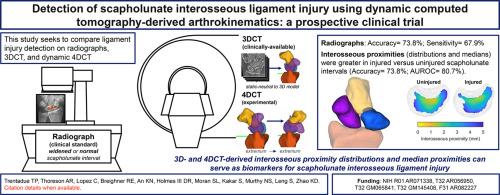
Scapholunate interosseous ligament injuries are a major cause of wrist instability and can be difficult to diagnose radiographically. To improve early diagnosis of scapholunate ligament injuries, we compared injury detection between bilateral routine clinical radiographs, static CT, and dynamic four-dimensional CT (4DCT) during wrist flexion-extension and radioulnar deviation. Participants with unilateral scapholunate ligament injuries were recruited to a prospective clinical trial investigating the diagnostic utility of 4DCT imaging for ligamentous wrist injury. Twenty-one participants underwent arthroscopic surgery to confirm scapholunate ligament injury. Arthrokinematics, defined as distributions of interosseous proximities across radioscaphoid and scapholunate articular surfaces at different positions within the motion cycle, were used as CT-derived biomarkers. Preoperative radiographs, static CT, and extrema of 4DCT were compared between uninjured and injured wrists using Wilcoxon signed rank or Kolmogorov-Smirnov tests. Median interosseous proximities at the scapholunate interval were significantly greater in the injured versus the uninjured wrists at static-neutral and maximum flexion, extension, radial deviation, and ulnar deviation. Mean cumulative distribution functions at the radioscaphoid joint were not significantly different between wrists but were significantly shifted at the scapholunate interval towards increased interosseous proximities in injured versus uninjured wrists in all positions. Median and cumulative distribution scapholunate proximities from static-neutral and 4DCT-derived extrema reflect injury status.
期刊介绍:
Medical Engineering & Physics provides a forum for the publication of the latest developments in biomedical engineering, and reflects the essential multidisciplinary nature of the subject. The journal publishes in-depth critical reviews, scientific papers and technical notes. Our focus encompasses the application of the basic principles of physics and engineering to the development of medical devices and technology, with the ultimate aim of producing improvements in the quality of health care.Topics covered include biomechanics, biomaterials, mechanobiology, rehabilitation engineering, biomedical signal processing and medical device development. Medical Engineering & Physics aims to keep both engineers and clinicians abreast of the latest applications of technology to health care.



 京公网安备 11010802042870号
京ICP备2023020795号-1
京公网安备 11010802042870号
京ICP备2023020795号-1

 分享
分享
 求助内容:
求助内容: 应助结果提醒方式:
 扫码关注我们
