Paige M. Brooks, Parker Lewis, Sara Million-Perez, Anastasia S. Yandulskaya, Mahmoud Khalil, Meredith Janes, Joseph Porco, Eleanor Walker, Jason R. Meyers
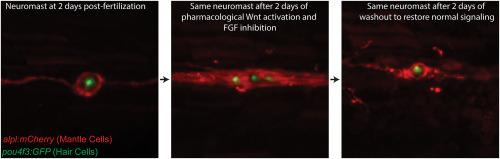
{"title":"Pharmacological reprogramming of zebrafish lateral line supporting cells to a migratory progenitor state","authors":"Paige M. Brooks, Parker Lewis, Sara Million-Perez, Anastasia S. Yandulskaya, Mahmoud Khalil, Meredith Janes, Joseph Porco, Eleanor Walker, Jason R. Meyers","doi":"10.1016/j.ydbio.2024.05.003","DOIUrl":null,"url":null,"abstract":"<div><p>In the zebrafish lateral line, non-sensory supporting cells readily re-enter the cell cycle to generate new hair cells and supporting cells during homeostatic maintenance and following damage to hair cells. This contrasts with supporting cells from mammalian vestibular and auditory sensory epithelia which rarely re-enter the cell cycle, and hence loss of hair cells results in permanent sensory deficit. Lateral line supporting cells are derived from multipotent progenitor cells that migrate down the trunk midline as a primordium and are deposited to differentiate into a neuromast. We have found that we can revert zebrafish support cells back to a migratory progenitor state by pharmacologically altering the signaling environment to mimic that of the migratory primordium, with active Wnt signaling and repressed FGF signaling. The reverted supporting cells migrate anteriorly and posteriorly along the horizontal myoseptum and will re-epithelialize to form an increased number of neuromasts along the midline when the pharmacological agents are removed. These data demonstrate that supporting cells can be readily reprogrammed to a migratory multipotent progenitor state that can form new sensory neuromasts, which has important implications for our understanding of how the lateral line system matures and expands in fish and also suggest avenues for returning mammalian supporting cells back to a proliferative state.</p></div>","PeriodicalId":11070,"journal":{"name":"Developmental biology","volume":"512 ","pages":"Pages 70-88"},"PeriodicalIF":2.1000,"publicationDate":"2024-08-01","publicationTypes":"Journal Article","fieldsOfStudy":null,"isOpenAccess":false,"openAccessPdf":"","citationCount":"0","resultStr":null,"platform":"Semanticscholar","paperid":null,"PeriodicalName":"Developmental biology","FirstCategoryId":"99","ListUrlMain":"https://www.sciencedirect.com/science/article/pii/S0012160624001143","RegionNum":3,"RegionCategory":"生物学","ArticlePicture":[],"TitleCN":null,"AbstractTextCN":null,"PMCID":null,"EPubDate":"2024/5/8 0:00:00","PubModel":"Epub","JCR":"Q2","JCRName":"DEVELOPMENTAL BIOLOGY","Score":null,"Total":0}
引用次数: 0
Abstract
In the zebrafish lateral line, non-sensory supporting cells readily re-enter the cell cycle to generate new hair cells and supporting cells during homeostatic maintenance and following damage to hair cells. This contrasts with supporting cells from mammalian vestibular and auditory sensory epithelia which rarely re-enter the cell cycle, and hence loss of hair cells results in permanent sensory deficit. Lateral line supporting cells are derived from multipotent progenitor cells that migrate down the trunk midline as a primordium and are deposited to differentiate into a neuromast. We have found that we can revert zebrafish support cells back to a migratory progenitor state by pharmacologically altering the signaling environment to mimic that of the migratory primordium, with active Wnt signaling and repressed FGF signaling. The reverted supporting cells migrate anteriorly and posteriorly along the horizontal myoseptum and will re-epithelialize to form an increased number of neuromasts along the midline when the pharmacological agents are removed. These data demonstrate that supporting cells can be readily reprogrammed to a migratory multipotent progenitor state that can form new sensory neuromasts, which has important implications for our understanding of how the lateral line system matures and expands in fish and also suggest avenues for returning mammalian supporting cells back to a proliferative state.
期刊介绍:
Developmental Biology (DB) publishes original research on mechanisms of development, differentiation, and growth in animals and plants at the molecular, cellular, genetic and evolutionary levels. Areas of particular emphasis include transcriptional control mechanisms, embryonic patterning, cell-cell interactions, growth factors and signal transduction, and regulatory hierarchies in developing plants and animals.




 京公网安备 11010802042870号
京ICP备2023020795号-1
京公网安备 11010802042870号
京ICP备2023020795号-1

 分享
分享
 求助内容:
求助内容: 应助结果提醒方式:
 扫码关注我们
