Enhancing bacterial cellulose production of Komagataeibacter nataicola through fermented coconut water by Saccharomyces cerevisiae: A metabonomics approach
Shuangwen Fei , Meijuan Fu , Jiamu Kang , Jiaxi Luo , Yanmei Wang , Jia Jia , Sixin Liu , Congfa Li
{"title":"Enhancing bacterial cellulose production of Komagataeibacter nataicola through fermented coconut water by Saccharomyces cerevisiae: A metabonomics approach","authors":"Shuangwen Fei , Meijuan Fu , Jiamu Kang , Jiaxi Luo , Yanmei Wang , Jia Jia , Sixin Liu , Congfa Li","doi":"10.1016/j.crfs.2024.100761","DOIUrl":null,"url":null,"abstract":"<div><p><em>Nata de coco</em>, an edible bacterial cellulose (BC) product, is a traditional dessert fermented in coconut water. Production of <em>Nata de coco</em> by <em>Komagataeibacter nataicola</em> is enhanced by pre-fermented coconut water, but its instability is a challenge. Here, BC production by <em>K. nataicola</em> Y19 was significantly improved by <em>Saccharomyces cerevisiae</em> 84-3 through shaping the metabolite profile of the coconut water. Different fermentation time with <em>S. cerevisiae</em> 84-3 resulted in distinct metabolite profiles and different promoting effect on BC yield. Compared to unfermented coconut water, coconut water fermented by <em>S. cerevisiae</em> 84-3 for 1d and 7d enhanced BC yield by 14.1-fold and 5.63-fold, respectively. Analysis between unfermented coconut water and 1d-fermented coconut water showed 129 significantly different metabolites, including organic acids, amino acids, nucleotides, and their derivatives. Prolonged fermentation for 7d changed levels of 155 metabolites belongs to organic acids, amino acids, nucleotides and their derivatives. Spearman correlation analysis further revealed that 17 metabolites were positively correlated with BC yield and 21 metabolites were negatively correlated with BC yield. These metabolites may affect energy metabolism, cell signaling, membrane integrity, and BC production by <em>K. nataicola</em> Y19. The further verification experiment gave the view that BC yield was not only closely related to the types of metabolites but also the concentration of metabolites. This study provides a novel theoretical framework for a highly efficient BC fermentation system utilizing stable fermented coconut water mediums.</p></div>","PeriodicalId":10939,"journal":{"name":"Current Research in Food Science","volume":"8 ","pages":"Article 100761"},"PeriodicalIF":7.0000,"publicationDate":"2024-01-01","publicationTypes":"Journal Article","fieldsOfStudy":null,"isOpenAccess":false,"openAccessPdf":"https://www.sciencedirect.com/science/article/pii/S266592712400087X/pdfft?md5=a2f3364176a470ae5767605811239771&pid=1-s2.0-S266592712400087X-main.pdf","citationCount":"0","resultStr":null,"platform":"Semanticscholar","paperid":null,"PeriodicalName":"Current Research in Food Science","FirstCategoryId":"97","ListUrlMain":"https://www.sciencedirect.com/science/article/pii/S266592712400087X","RegionNum":2,"RegionCategory":"农林科学","ArticlePicture":[],"TitleCN":null,"AbstractTextCN":null,"PMCID":null,"EPubDate":"2024/5/9 0:00:00","PubModel":"Epub","JCR":"Q1","JCRName":"FOOD SCIENCE & TECHNOLOGY","Score":null,"Total":0}
引用次数: 0
Abstract
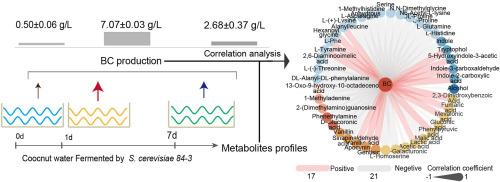
Nata de coco, an edible bacterial cellulose (BC) product, is a traditional dessert fermented in coconut water. Production of Nata de coco by Komagataeibacter nataicola is enhanced by pre-fermented coconut water, but its instability is a challenge. Here, BC production by K. nataicola Y19 was significantly improved by Saccharomyces cerevisiae 84-3 through shaping the metabolite profile of the coconut water. Different fermentation time with S. cerevisiae 84-3 resulted in distinct metabolite profiles and different promoting effect on BC yield. Compared to unfermented coconut water, coconut water fermented by S. cerevisiae 84-3 for 1d and 7d enhanced BC yield by 14.1-fold and 5.63-fold, respectively. Analysis between unfermented coconut water and 1d-fermented coconut water showed 129 significantly different metabolites, including organic acids, amino acids, nucleotides, and their derivatives. Prolonged fermentation for 7d changed levels of 155 metabolites belongs to organic acids, amino acids, nucleotides and their derivatives. Spearman correlation analysis further revealed that 17 metabolites were positively correlated with BC yield and 21 metabolites were negatively correlated with BC yield. These metabolites may affect energy metabolism, cell signaling, membrane integrity, and BC production by K. nataicola Y19. The further verification experiment gave the view that BC yield was not only closely related to the types of metabolites but also the concentration of metabolites. This study provides a novel theoretical framework for a highly efficient BC fermentation system utilizing stable fermented coconut water mediums.
Nata de coco 是一种可食用的细菌纤维素(BC)产品,是一种在椰子水中发酵的传统甜点。通过预发酵椰子水可以提高 Komagataeibacter nataicola 生产椰子果酱的能力,但椰子果酱的不稳定性是一个挑战。在这里,通过改变椰子水中的代谢产物谱,用酿酒酵母 84-3 显著提高了 K. nataicola Y19 的 BC 产量。用酿酒酵母 84-3 进行不同时间的发酵会产生不同的代谢产物谱,并对 BC 产量产生不同的促进作用。与未发酵椰子水相比,经 S. cerevisiae 84-3 发酵 1d 和 7d 的椰子水分别提高了 14.1 倍和 5.63 倍的萃取率。对未发酵椰子水和发酵 1d 的椰子水进行的分析表明,129 种代谢物存在显著差异,包括有机酸、氨基酸、核苷酸及其衍生物。延长发酵 7 天后,有机酸、氨基酸、核苷酸及其衍生物等 155 种代谢物的含量发生了变化。斯皮尔曼相关分析进一步表明,17 种代谢物与 BC 产量呈正相关,21 种代谢物与 BC 产量呈负相关。这些代谢物可能会影响 K. nataicola Y19 的能量代谢、细胞信号转导、膜完整性和 BC 产量。进一步的验证实验表明,BC产量不仅与代谢物的种类密切相关,还与代谢物的浓度有关。这项研究为利用稳定发酵椰子水培养基的高效 BC 发酵系统提供了一个新的理论框架。
期刊介绍:
Current Research in Food Science is an international peer-reviewed journal dedicated to advancing the breadth of knowledge in the field of food science. It serves as a platform for publishing original research articles and short communications that encompass a wide array of topics, including food chemistry, physics, microbiology, nutrition, nutraceuticals, process and package engineering, materials science, food sustainability, and food security. By covering these diverse areas, the journal aims to provide a comprehensive source of the latest scientific findings and technological advancements that are shaping the future of the food industry. The journal's scope is designed to address the multidisciplinary nature of food science, reflecting its commitment to promoting innovation and ensuring the safety and quality of the food supply.



 京公网安备 11010802042870号
京ICP备2023020795号-1
京公网安备 11010802042870号
京ICP备2023020795号-1

 分享
分享
 求助内容:
求助内容: 应助结果提醒方式:
 扫码关注我们
