Jian Tan, Camille Potier-Villette, Duan Ni, Maike Hoeckh, Jemma Taitz, Stephen J. Simpson, Ralph Nanan, Laurence Macia
{"title":"Succinate induces a Th2 environment in the small intestine but does not exacerbate food allergy","authors":"Jian Tan, Camille Potier-Villette, Duan Ni, Maike Hoeckh, Jemma Taitz, Stephen J. Simpson, Ralph Nanan, Laurence Macia","doi":"10.1111/all.16155","DOIUrl":null,"url":null,"abstract":"<p>Tuft cells are specialised epithelial cells present in mucosal areas. In the small intestine, they have been reported to sense parasite-derived succinate via the receptor SUCNR1, initiating a type 2 immune response.<span><sup>1</sup></span> SUCNR1 activation promotes tuft cells to produce IL-25, which in turn activates type 2 innate lymphoid cells (ILC2) to release IL-4, IL-5 and IL-13, with IL-13 further supporting the differentiation of IL-25-producing tuft cells.<span><sup>1</sup></span> Furthermore, IL-4 produced by tuft cells drives the expansion of mast cells in the intestine, contributing to the anaphylactic reaction in an epicutaneous sensitisation model of food allergy.<span><sup>2</sup></span> Diet, medication and disruption of the gut microbiota can promote a high succinate gut environment.<span><sup>3</sup></span> It has been hypothesized that increased levels of succinate may predispose to food allergy by activating the tuft cell-ILC2-Th2 circuit.<span><sup>3</sup></span></p><p>The aim of this study was to determine whether increased basal levels of succinate in the small intestine promote tuft cell-mediated type 2 immunity, and whether it exacerbates food allergy. To test this, we used a model whereby mice were administered 100 mM succinate in drinking water for 3 weeks. Following treatment, we found that small intestinal expression of the gene encoding for POU2F3 (a marker of tuft cells) was significantly increased, confirming the previously established effect of succinate on tuft cell differentiation (Figure 1A). Expression levels of genes encoding for IL-25, IL-4 and IL-13 were also increased in mice treated with succinate in drinking water (Figure 1B), highlighting that a basal increase in succinate establishes a pro-Th2 environment in the small intestine. To characterise the impact of succinate-induced Th2 response on allergy development, we induced food allergy in succinate-supplemented mice using an epicutaneous sensitisation model with ovalbumin (OVA) (Figure 1C)<span><sup>4</sup></span>, that does not itself increase circulating succinate levels (Figure S1). Despite the basal increase in the Th2 response, succinate-treated animals did not have exacerbated allergic response, and did not have elevated total IgE, MMCP-1 and Th2 cytokines (Figure 1D,E), nor OVA-specific IgE and IgG (Figure S2) compared to water-treated animals. Notably, succinate treatment actually decreased total serum IgE (Figure 1D).</p><p>We also tested whether succinate produced endogenously, via the gut microbiota, had a similar effect. We fed mice on one of ten isocaloric diets with macronutrient composition ranging from 5%–60% protein, 20%–60% carbohydrate and 5%–20% fat (by energy intake), and cecal succinate was quantified.<span><sup>5</sup></span> Using mixture modelling, we identified that protein was the main driver of succinate production in the gut (Figure S3A). Compared to mice fed on a control diet, mice fed on a high-protein diet for 6 weeks did not have increased expression of pro-Th2 cytokines (Figure S3B) suggesting that other induced metabolites interfered with the effects of succinate. High-protein feeding did not increase bodyweight nor worsen food allergy (Figure S3C–E).</p><p>In conclusion, we show that while succinate induced a tuft-cell mediated Th2 environment in the gut when administered in drinking water, it did not predispose for worse antigen-specific allergy. While a high-protein diet increased succinate, it did not translate to a pro-Th2 phenotype in the gut, suggesting that the induction of ILC2 is likely influenced by other factors such as other metabolites produced by the gut microbiota. Finally, succinate has been reported to be increased in allergic diseases, including in a similar mouse model of food allergy.<span><sup>6</sup></span> This difference may relate to the site of succinate induction (gut vs. periphery) and should be further investigated, as well as the method of sensitization (epicutaneous vs. percutaneous). Together, our observations indicate that higher levels of succinate are not necessarily a reliable marker for risk of allergies or allergic outcomes.</p><p>Jian Tan performed experiments, participated to the study design and wrote the manuscript. Camille Potier-Villette, Duan Ni, Maike Hoeckh and Jemma Taitz performed experiments. Stephen J. Simpson and Ralph Nanan contributed to experimental procedures, data discussion and interpretation. Laurence Macia participated to the study design, supervised the study and wrote the manuscript. All authors read and approved the final manuscript.</p><p>The authors declare no competing interests.</p>","PeriodicalId":122,"journal":{"name":"Allergy","volume":"79 10","pages":"2853-2855"},"PeriodicalIF":12.0000,"publicationDate":"2024-05-15","publicationTypes":"Journal Article","fieldsOfStudy":null,"isOpenAccess":false,"openAccessPdf":"https://onlinelibrary.wiley.com/doi/epdf/10.1111/all.16155","citationCount":"0","resultStr":null,"platform":"Semanticscholar","paperid":null,"PeriodicalName":"Allergy","FirstCategoryId":"3","ListUrlMain":"https://onlinelibrary.wiley.com/doi/10.1111/all.16155","RegionNum":1,"RegionCategory":"医学","ArticlePicture":[],"TitleCN":null,"AbstractTextCN":null,"PMCID":null,"EPubDate":"","PubModel":"","JCR":"Q1","JCRName":"ALLERGY","Score":null,"Total":0}
引用次数: 0
Abstract
Tuft cells are specialised epithelial cells present in mucosal areas. In the small intestine, they have been reported to sense parasite-derived succinate via the receptor SUCNR1, initiating a type 2 immune response.1 SUCNR1 activation promotes tuft cells to produce IL-25, which in turn activates type 2 innate lymphoid cells (ILC2) to release IL-4, IL-5 and IL-13, with IL-13 further supporting the differentiation of IL-25-producing tuft cells.1 Furthermore, IL-4 produced by tuft cells drives the expansion of mast cells in the intestine, contributing to the anaphylactic reaction in an epicutaneous sensitisation model of food allergy.2 Diet, medication and disruption of the gut microbiota can promote a high succinate gut environment.3 It has been hypothesized that increased levels of succinate may predispose to food allergy by activating the tuft cell-ILC2-Th2 circuit.3
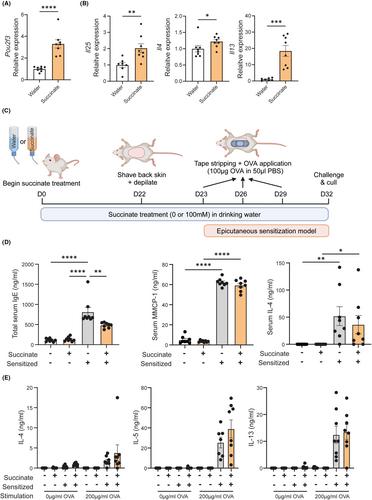
The aim of this study was to determine whether increased basal levels of succinate in the small intestine promote tuft cell-mediated type 2 immunity, and whether it exacerbates food allergy. To test this, we used a model whereby mice were administered 100 mM succinate in drinking water for 3 weeks. Following treatment, we found that small intestinal expression of the gene encoding for POU2F3 (a marker of tuft cells) was significantly increased, confirming the previously established effect of succinate on tuft cell differentiation (Figure 1A). Expression levels of genes encoding for IL-25, IL-4 and IL-13 were also increased in mice treated with succinate in drinking water (Figure 1B), highlighting that a basal increase in succinate establishes a pro-Th2 environment in the small intestine. To characterise the impact of succinate-induced Th2 response on allergy development, we induced food allergy in succinate-supplemented mice using an epicutaneous sensitisation model with ovalbumin (OVA) (Figure 1C)4, that does not itself increase circulating succinate levels (Figure S1). Despite the basal increase in the Th2 response, succinate-treated animals did not have exacerbated allergic response, and did not have elevated total IgE, MMCP-1 and Th2 cytokines (Figure 1D,E), nor OVA-specific IgE and IgG (Figure S2) compared to water-treated animals. Notably, succinate treatment actually decreased total serum IgE (Figure 1D).
We also tested whether succinate produced endogenously, via the gut microbiota, had a similar effect. We fed mice on one of ten isocaloric diets with macronutrient composition ranging from 5%–60% protein, 20%–60% carbohydrate and 5%–20% fat (by energy intake), and cecal succinate was quantified.5 Using mixture modelling, we identified that protein was the main driver of succinate production in the gut (Figure S3A). Compared to mice fed on a control diet, mice fed on a high-protein diet for 6 weeks did not have increased expression of pro-Th2 cytokines (Figure S3B) suggesting that other induced metabolites interfered with the effects of succinate. High-protein feeding did not increase bodyweight nor worsen food allergy (Figure S3C–E).
In conclusion, we show that while succinate induced a tuft-cell mediated Th2 environment in the gut when administered in drinking water, it did not predispose for worse antigen-specific allergy. While a high-protein diet increased succinate, it did not translate to a pro-Th2 phenotype in the gut, suggesting that the induction of ILC2 is likely influenced by other factors such as other metabolites produced by the gut microbiota. Finally, succinate has been reported to be increased in allergic diseases, including in a similar mouse model of food allergy.6 This difference may relate to the site of succinate induction (gut vs. periphery) and should be further investigated, as well as the method of sensitization (epicutaneous vs. percutaneous). Together, our observations indicate that higher levels of succinate are not necessarily a reliable marker for risk of allergies or allergic outcomes.
Jian Tan performed experiments, participated to the study design and wrote the manuscript. Camille Potier-Villette, Duan Ni, Maike Hoeckh and Jemma Taitz performed experiments. Stephen J. Simpson and Ralph Nanan contributed to experimental procedures, data discussion and interpretation. Laurence Macia participated to the study design, supervised the study and wrote the manuscript. All authors read and approved the final manuscript.
期刊介绍:
Allergy is an international and multidisciplinary journal that aims to advance, impact, and communicate all aspects of the discipline of Allergy/Immunology. It publishes original articles, reviews, position papers, guidelines, editorials, news and commentaries, letters to the editors, and correspondences. The journal accepts articles based on their scientific merit and quality.
Allergy seeks to maintain contact between basic and clinical Allergy/Immunology and encourages contributions from contributors and readers from all countries. In addition to its publication, Allergy also provides abstracting and indexing information. Some of the databases that include Allergy abstracts are Abstracts on Hygiene & Communicable Disease, Academic Search Alumni Edition, AgBiotech News & Information, AGRICOLA Database, Biological Abstracts, PubMed Dietary Supplement Subset, and Global Health, among others.



 京公网安备 11010802042870号
京ICP备2023020795号-1
京公网安备 11010802042870号
京ICP备2023020795号-1

 分享
分享
 求助内容:
求助内容: 应助结果提醒方式:
 扫码关注我们
