Chao Liu, Tao Wan, Peiyuan Guan, Mengyao Li, Shuo Zhang, Long Hu, Yu-Chieh Kuo, Ziheng Feng, Fandi Chen, Yanzhe Zhu, Haowei Jia, Tao Cao, Tianyue Liang, Tushar Kumeria, Dawei Su, Dewei Chu
{"title":"Unveil the Triple Roles of Water Molecule on Power Generation of MXene Derived TiO2 based Moisture Electric Generator","authors":"Chao Liu, Tao Wan, Peiyuan Guan, Mengyao Li, Shuo Zhang, Long Hu, Yu-Chieh Kuo, Ziheng Feng, Fandi Chen, Yanzhe Zhu, Haowei Jia, Tao Cao, Tianyue Liang, Tushar Kumeria, Dawei Su, Dewei Chu","doi":"10.1002/aenm.202400590","DOIUrl":null,"url":null,"abstract":"<p>Evaporation-driven electricity generators have been proposed to generate electricity by water interacting with nanostructured materials. However, several proposed mechanisms, such as intrinsic gradient of polar functional groups principle and electrokinetic effect perspective, are in wide discrepancy. Here, through the combination of theoretical calculations involving time dimension on material's moisturizing process and experimental analyses, it is revealed the working principle through the water molecule triple roles in driving moisture electric generators (MEGs): 1) intrinsic H<sub>2</sub>O absorption on the material surface and splitting into hydroxy group and proton due to the polarizability of the material surface determined by the static electric potential of the materials. This process induces the electrochemical potential difference of the materials via the work function changes; 2) freely diffused protons derived from the H<sub>2</sub>O splitting work as the ions charge carriers; 3) via the hydrogen bond of the water molecules to drive charge carriers diffuse between opposite electrodes, maintaining the internal circuit current flow. It is successfully unveiled that anatase TiO<sub>2</sub> based materials for output voltage changes correlated to the domains’ work function's difference, tuning by the surface adsorption species (H, Cl, OH) and anisotropic exposed crystal facets of the material. This work unveils MEG's general working principle.</p>","PeriodicalId":111,"journal":{"name":"Advanced Energy Materials","volume":"14 27","pages":""},"PeriodicalIF":26.0000,"publicationDate":"2024-05-14","publicationTypes":"Journal Article","fieldsOfStudy":null,"isOpenAccess":false,"openAccessPdf":"","citationCount":"0","resultStr":null,"platform":"Semanticscholar","paperid":null,"PeriodicalName":"Advanced Energy Materials","FirstCategoryId":"88","ListUrlMain":"https://advanced.onlinelibrary.wiley.com/doi/10.1002/aenm.202400590","RegionNum":1,"RegionCategory":"材料科学","ArticlePicture":[],"TitleCN":null,"AbstractTextCN":null,"PMCID":null,"EPubDate":"","PubModel":"","JCR":"Q1","JCRName":"CHEMISTRY, PHYSICAL","Score":null,"Total":0}
引用次数: 0
Abstract
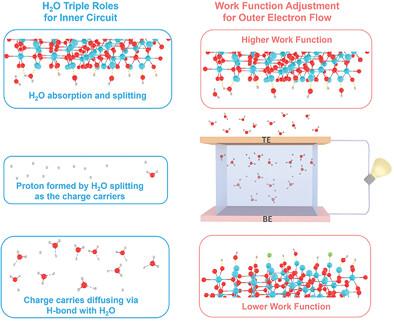
Evaporation-driven electricity generators have been proposed to generate electricity by water interacting with nanostructured materials. However, several proposed mechanisms, such as intrinsic gradient of polar functional groups principle and electrokinetic effect perspective, are in wide discrepancy. Here, through the combination of theoretical calculations involving time dimension on material's moisturizing process and experimental analyses, it is revealed the working principle through the water molecule triple roles in driving moisture electric generators (MEGs): 1) intrinsic H2O absorption on the material surface and splitting into hydroxy group and proton due to the polarizability of the material surface determined by the static electric potential of the materials. This process induces the electrochemical potential difference of the materials via the work function changes; 2) freely diffused protons derived from the H2O splitting work as the ions charge carriers; 3) via the hydrogen bond of the water molecules to drive charge carriers diffuse between opposite electrodes, maintaining the internal circuit current flow. It is successfully unveiled that anatase TiO2 based materials for output voltage changes correlated to the domains’ work function's difference, tuning by the surface adsorption species (H, Cl, OH) and anisotropic exposed crystal facets of the material. This work unveils MEG's general working principle.
期刊介绍:
Established in 2011, Advanced Energy Materials is an international, interdisciplinary, English-language journal that focuses on materials used in energy harvesting, conversion, and storage. It is regarded as a top-quality journal alongside Advanced Materials, Advanced Functional Materials, and Small.
With a 2022 Impact Factor of 27.8, Advanced Energy Materials is considered a prime source for the best energy-related research. The journal covers a wide range of topics in energy-related research, including organic and inorganic photovoltaics, batteries and supercapacitors, fuel cells, hydrogen generation and storage, thermoelectrics, water splitting and photocatalysis, solar fuels and thermosolar power, magnetocalorics, and piezoelectronics.
The readership of Advanced Energy Materials includes materials scientists, chemists, physicists, and engineers in both academia and industry. The journal is indexed in various databases and collections, such as Advanced Technologies & Aerospace Database, FIZ Karlsruhe, INSPEC (IET), Science Citation Index Expanded, Technology Collection, and Web of Science, among others.




 京公网安备 11010802042870号
京ICP备2023020795号-1
京公网安备 11010802042870号
京ICP备2023020795号-1

 分享
分享
 求助内容:
求助内容: 应助结果提醒方式:
 扫码关注我们
