{"title":"Association between synoptic types in Beijing and acute myocardial infarction hospitalizations: A comprehensive analysis of environmental factors.","authors":"Yitao Han, Yuxiong Chen, Siqi Tang, Yanbo Liu, Yakun Zhao, Xinlong Zhao, Jinyan Lei, Zhongjie Fan","doi":"10.1016/j.scitotenv.2024.173278","DOIUrl":null,"url":null,"abstract":"<p><strong>Background: </strong>Environmental factors like air pollution and temperature can trigger acute myocardial infarction (AMI). However, the link between large-scale weather patterns (synoptic types) and AMI admissions has not been extensively studied. This research aimed to identify the different synoptic air types in Beijing and investigate their association with AMI occurrences.</p><p><strong>Methods: </strong>We analyzed data from Beijing between 2013 and 2019, encompassing 2556 days and 149,632 AMI cases. Using principal component analysis and hierarchical clustering, classification into distinct synoptic types was conducted based on weather and pollution measurements. To assess the impact of each type on AMI risk over 14 days, we employed a distributed lag non-linear model (DLNM), with the reference being the lowest risk type (Type 2).</p><p><strong>Results: </strong>Four synoptic types were identified: Type 1 with warm, humid weather; Type 2 with warm temperatures, low humidity, and long sunshine duration; Type 3 with cold weather and heavy air pollution; and Type 4 with cold temperatures, dryness, and high wind speed. Type 4 exhibited the greatest cumulative relative risk (CRR) of 1.241 (95%CI: 1.150, 1.339) over 14 days. Significant effects of Types 1, 3, and 4 on AMI events were observed at varying lags: 4-12 days for Type 1, 1-6 days for Type 3, and 1-11 days for Type 4. Females were more susceptible to Types 1 and 3, while individuals younger than 65 years old showed increased vulnerability to Types 3 and 4.</p><p><strong>Conclusion: </strong>Among the four synoptic types identified in Beijing from 2013 to 2019, Type 4 (cold, dry, and windy) presented the highest risk for AMI hospitalizations. This risk was particularly pronounced for males and people under 65. Our findings collectively highlight the need for improved methods to identify synoptic types. Additionally, developing a warning system based on these synoptic conditions could be crucial for prevention.</p>","PeriodicalId":422,"journal":{"name":"Science of the Total Environment","volume":" ","pages":"173278"},"PeriodicalIF":8.0000,"publicationDate":"2024-07-15","publicationTypes":"Journal Article","fieldsOfStudy":null,"isOpenAccess":false,"openAccessPdf":"","citationCount":"0","resultStr":null,"platform":"Semanticscholar","paperid":null,"PeriodicalName":"Science of the Total Environment","FirstCategoryId":"93","ListUrlMain":"https://doi.org/10.1016/j.scitotenv.2024.173278","RegionNum":1,"RegionCategory":"环境科学与生态学","ArticlePicture":[],"TitleCN":null,"AbstractTextCN":null,"PMCID":null,"EPubDate":"2024/5/14 0:00:00","PubModel":"Epub","JCR":"Q1","JCRName":"ENVIRONMENTAL SCIENCES","Score":null,"Total":0}
引用次数: 0
Abstract
Background: Environmental factors like air pollution and temperature can trigger acute myocardial infarction (AMI). However, the link between large-scale weather patterns (synoptic types) and AMI admissions has not been extensively studied. This research aimed to identify the different synoptic air types in Beijing and investigate their association with AMI occurrences.
Methods: We analyzed data from Beijing between 2013 and 2019, encompassing 2556 days and 149,632 AMI cases. Using principal component analysis and hierarchical clustering, classification into distinct synoptic types was conducted based on weather and pollution measurements. To assess the impact of each type on AMI risk over 14 days, we employed a distributed lag non-linear model (DLNM), with the reference being the lowest risk type (Type 2).
Results: Four synoptic types were identified: Type 1 with warm, humid weather; Type 2 with warm temperatures, low humidity, and long sunshine duration; Type 3 with cold weather and heavy air pollution; and Type 4 with cold temperatures, dryness, and high wind speed. Type 4 exhibited the greatest cumulative relative risk (CRR) of 1.241 (95%CI: 1.150, 1.339) over 14 days. Significant effects of Types 1, 3, and 4 on AMI events were observed at varying lags: 4-12 days for Type 1, 1-6 days for Type 3, and 1-11 days for Type 4. Females were more susceptible to Types 1 and 3, while individuals younger than 65 years old showed increased vulnerability to Types 3 and 4.
Conclusion: Among the four synoptic types identified in Beijing from 2013 to 2019, Type 4 (cold, dry, and windy) presented the highest risk for AMI hospitalizations. This risk was particularly pronounced for males and people under 65. Our findings collectively highlight the need for improved methods to identify synoptic types. Additionally, developing a warning system based on these synoptic conditions could be crucial for prevention.
期刊介绍:
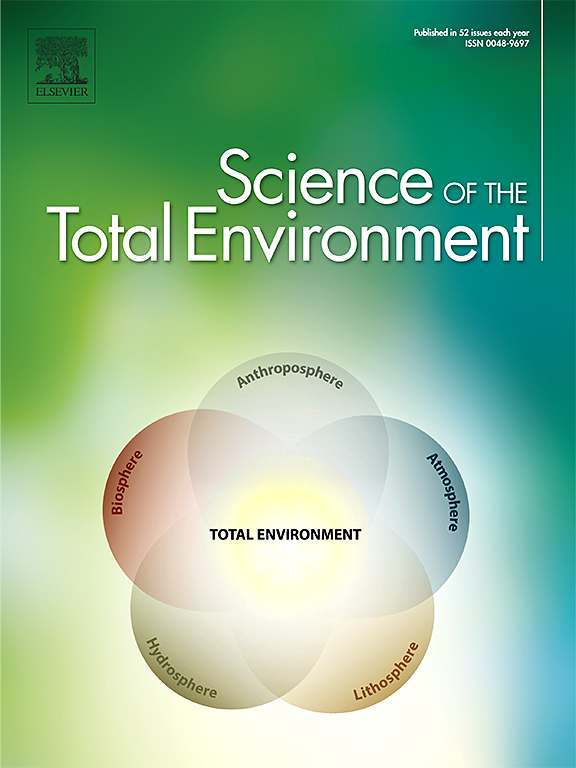
The Science of the Total Environment is an international journal dedicated to scientific research on the environment and its interaction with humanity. It covers a wide range of disciplines and seeks to publish innovative, hypothesis-driven, and impactful research that explores the entire environment, including the atmosphere, lithosphere, hydrosphere, biosphere, and anthroposphere.
The journal's updated Aims & Scope emphasizes the importance of interdisciplinary environmental research with broad impact. Priority is given to studies that advance fundamental understanding and explore the interconnectedness of multiple environmental spheres. Field studies are preferred, while laboratory experiments must demonstrate significant methodological advancements or mechanistic insights with direct relevance to the environment.



 京公网安备 11010802042870号
京ICP备2023020795号-1
京公网安备 11010802042870号
京ICP备2023020795号-1

 分享
分享
 求助内容:
求助内容: 应助结果提醒方式:
 扫码关注我们
