Mengmeng Ji , Binbin Wang , Jun Xie , Guangjun Wang , Ermeng Yu , Peng Jiang , Ronghua Lu , Jingjing Tian
{"title":"Effects of low protein feed on hepato-intestinal health and muscle quality of grass carp (Ctenopharyngodon idellus)","authors":"Mengmeng Ji , Binbin Wang , Jun Xie , Guangjun Wang , Ermeng Yu , Peng Jiang , Ronghua Lu , Jingjing Tian","doi":"10.1016/j.cbpb.2024.110989","DOIUrl":null,"url":null,"abstract":"<div><p>In this study, grass carp (33.28 ± 0.05 g) were fed three diets for 8 weeks: control (crude protein [CP] 30%, crude lipid [CL] 6%), low protein (LP; CP16%, CL6%), and low protein with high-fat (LPHF; CP16%, CL10%). The final body weight decreased in the LP and LPHF groups compared to the Control (<em>P</em> < 0.05). Liver triglycerides, total cholesterol, and nonesterified fatty acids were higher in the LP group than the Control, whereas these indexes in the LPHF group were higher than those in the LP group (<em>P</em> < 0.05). The LP group had intestinal barrier damage, while the LPHF group had a slight recovery. TNF-α, IL-8, and IL-1β content were lower in the LP group than in the Control (<em>P</em> < 0.05), and even higher in the LPHF group (<em>P</em> < 0.05). The expressions of endoplasmic reticulum stress-related genes <em>Activating transcription factor 6</em> (<em>ATF-6</em>) and <em>Glucose-regulated protein</em> (<em>GRP78</em>) were higher in the LPHF group against the LP group (<em>P</em> < 0.05). The IL-1β and TNF-α content negatively correlated with intestinal <em>Actinomycetes</em> and <em>Mycobacterium</em> abundance (<em>P</em> < 0.05). The muscle fiber diameter was smaller in both the LP and LPHF groups than the control (<em>P</em> < 0.05), with the LP group showing metabolites related to protein digestion and absorption, and LPHF group exhibiting metabolites related to taste transmission. The results demonstrate reducing dietary protein affects growth, causing liver lipid accumulation, reduced enteritis response, and increased muscle tightness, while increasing fat content accelerates fat accumulation and inflammation.</p></div>","PeriodicalId":55236,"journal":{"name":"Comparative Biochemistry and Physiology B-Biochemistry & Molecular Biology","volume":"273 ","pages":"Article 110989"},"PeriodicalIF":1.8000,"publicationDate":"2024-08-01","publicationTypes":"Journal Article","fieldsOfStudy":null,"isOpenAccess":false,"openAccessPdf":"","citationCount":"0","resultStr":null,"platform":"Semanticscholar","paperid":null,"PeriodicalName":"Comparative Biochemistry and Physiology B-Biochemistry & Molecular Biology","FirstCategoryId":"99","ListUrlMain":"https://www.sciencedirect.com/science/article/pii/S1096495924000563","RegionNum":3,"RegionCategory":"生物学","ArticlePicture":[],"TitleCN":null,"AbstractTextCN":null,"PMCID":null,"EPubDate":"2024/5/15 0:00:00","PubModel":"Epub","JCR":"Q4","JCRName":"BIOCHEMISTRY & MOLECULAR BIOLOGY","Score":null,"Total":0}
引用次数: 0
Abstract
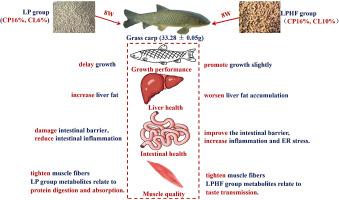
In this study, grass carp (33.28 ± 0.05 g) were fed three diets for 8 weeks: control (crude protein [CP] 30%, crude lipid [CL] 6%), low protein (LP; CP16%, CL6%), and low protein with high-fat (LPHF; CP16%, CL10%). The final body weight decreased in the LP and LPHF groups compared to the Control (P < 0.05). Liver triglycerides, total cholesterol, and nonesterified fatty acids were higher in the LP group than the Control, whereas these indexes in the LPHF group were higher than those in the LP group (P < 0.05). The LP group had intestinal barrier damage, while the LPHF group had a slight recovery. TNF-α, IL-8, and IL-1β content were lower in the LP group than in the Control (P < 0.05), and even higher in the LPHF group (P < 0.05). The expressions of endoplasmic reticulum stress-related genes Activating transcription factor 6 (ATF-6) and Glucose-regulated protein (GRP78) were higher in the LPHF group against the LP group (P < 0.05). The IL-1β and TNF-α content negatively correlated with intestinal Actinomycetes and Mycobacterium abundance (P < 0.05). The muscle fiber diameter was smaller in both the LP and LPHF groups than the control (P < 0.05), with the LP group showing metabolites related to protein digestion and absorption, and LPHF group exhibiting metabolites related to taste transmission. The results demonstrate reducing dietary protein affects growth, causing liver lipid accumulation, reduced enteritis response, and increased muscle tightness, while increasing fat content accelerates fat accumulation and inflammation.
期刊介绍:
Comparative Biochemistry & Physiology (CBP) publishes papers in comparative, environmental and evolutionary physiology.
Part B: Biochemical and Molecular Biology (CBPB), focuses on biochemical physiology, primarily bioenergetics/energy metabolism, cell biology, cellular stress responses, enzymology, intermediary metabolism, macromolecular structure and function, gene regulation, evolutionary genetics. Most studies focus on biochemical or molecular analyses that have clear ramifications for physiological processes.




 京公网安备 11010802042870号
京ICP备2023020795号-1
京公网安备 11010802042870号
京ICP备2023020795号-1

 分享
分享
 求助内容:
求助内容: 应助结果提醒方式:
 扫码关注我们
