Assia Maaoui, Raouia Chagtmi, Gartzen Lopez, Maria Cortazar, Martin Olazar, Aida Ben Hassen Trabelsi
{"title":"Impact of pyrolysis process conditions on the features of the biochar from Opuntia ficus indica fruit peels","authors":"Assia Maaoui, Raouia Chagtmi, Gartzen Lopez, Maria Cortazar, Martin Olazar, Aida Ben Hassen Trabelsi","doi":"10.1007/s13399-024-05750-8","DOIUrl":null,"url":null,"abstract":"<div><p>The valorization of agricultural by-products represents a promising approach to sustainable development. In the transition toward a circular economy, <i>Opuntia ficus indica</i> peels (OFIP) can be converted into valuable products, thereby reducing greenhouse gas emissions and contributing to climate change mitigation. This study proposes the valorization of OFIP residues through pyrolysis, focusing on biochar production. The main objective of the present study is to optimize OFIP pyrolysis, considering both slow- and fast-pyrolysis processes at temperatures ranging from 500 to 700°C. Therefore, two different pyrolysis technologies were applied: fixed bed and spouted bed reactors for slow and fast pyrolysis, respectively. The novel approach of the study lies in employing the same biomass feedstock in two different pyrolysis technologies, enabling a direct comparison of the effects of these pyrolysis approaches on biochar production. Moreover, the resulting biochars underwent comprehensive characterization by elemental, proximate, chemical composition, and thermogravimetric (TG) analysis, X-ray fluorescence (XRF), X-ray diffraction (XRD), Fourier transform infrared spectroscopy (FTIR), CO<sub>2</sub> adsorption, and scanning electron microscopy (SEM). Additionally, the potential of the obtained biochar for subsequent valorization was evaluated, and the most suitable biochar for a specific application was determined based on its properties. The obtained results revealed that slow pyrolysis of OFIP yielded slightly higher biochar amounts than fast pyrolysis, with the highest biochar production at 500°C. Regarding biochar characterization, fast pyrolysis samples had higher fixed carbon and ash contents than the ones produced from slow pyrolysis. Moreover, fast-pyrolysis biochars showed a more developed porous structure, attaining a specific surface area of 328.61 m<sup>2</sup> g<sup>−1</sup> and a micropore volume of 0.13 cm<sup>3</sup> g<sup>−1</sup> at 700°C. This study concluded that fast-pyrolysis biochars may be suitable for catalytic applications, whereas slow-pyrolysis biochars may be more appropriate for adsorption and soil applications. Nevertheless, the high ash content of the OFIP-derived biochar makes it unsuitable to be used for power generation.</p><h3>Graphical abstract</h3>\n<div><figure><div><div><picture><source><img></source></picture></div></div></figure></div></div>","PeriodicalId":488,"journal":{"name":"Biomass Conversion and Biorefinery","volume":"15 :","pages":"8771 - 8791"},"PeriodicalIF":4.1000,"publicationDate":"2024-05-17","publicationTypes":"Journal Article","fieldsOfStudy":null,"isOpenAccess":false,"openAccessPdf":"","citationCount":"0","resultStr":null,"platform":"Semanticscholar","paperid":null,"PeriodicalName":"Biomass Conversion and Biorefinery","FirstCategoryId":"5","ListUrlMain":"https://link.springer.com/article/10.1007/s13399-024-05750-8","RegionNum":4,"RegionCategory":"工程技术","ArticlePicture":[],"TitleCN":null,"AbstractTextCN":null,"PMCID":null,"EPubDate":"","PubModel":"","JCR":"Q3","JCRName":"ENERGY & FUELS","Score":null,"Total":0}
引用次数: 0
Abstract
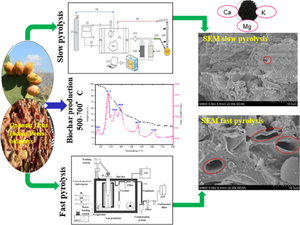
The valorization of agricultural by-products represents a promising approach to sustainable development. In the transition toward a circular economy, Opuntia ficus indica peels (OFIP) can be converted into valuable products, thereby reducing greenhouse gas emissions and contributing to climate change mitigation. This study proposes the valorization of OFIP residues through pyrolysis, focusing on biochar production. The main objective of the present study is to optimize OFIP pyrolysis, considering both slow- and fast-pyrolysis processes at temperatures ranging from 500 to 700°C. Therefore, two different pyrolysis technologies were applied: fixed bed and spouted bed reactors for slow and fast pyrolysis, respectively. The novel approach of the study lies in employing the same biomass feedstock in two different pyrolysis technologies, enabling a direct comparison of the effects of these pyrolysis approaches on biochar production. Moreover, the resulting biochars underwent comprehensive characterization by elemental, proximate, chemical composition, and thermogravimetric (TG) analysis, X-ray fluorescence (XRF), X-ray diffraction (XRD), Fourier transform infrared spectroscopy (FTIR), CO2 adsorption, and scanning electron microscopy (SEM). Additionally, the potential of the obtained biochar for subsequent valorization was evaluated, and the most suitable biochar for a specific application was determined based on its properties. The obtained results revealed that slow pyrolysis of OFIP yielded slightly higher biochar amounts than fast pyrolysis, with the highest biochar production at 500°C. Regarding biochar characterization, fast pyrolysis samples had higher fixed carbon and ash contents than the ones produced from slow pyrolysis. Moreover, fast-pyrolysis biochars showed a more developed porous structure, attaining a specific surface area of 328.61 m2 g−1 and a micropore volume of 0.13 cm3 g−1 at 700°C. This study concluded that fast-pyrolysis biochars may be suitable for catalytic applications, whereas slow-pyrolysis biochars may be more appropriate for adsorption and soil applications. Nevertheless, the high ash content of the OFIP-derived biochar makes it unsuitable to be used for power generation.
期刊介绍:
Biomass Conversion and Biorefinery presents articles and information on research, development and applications in thermo-chemical conversion; physico-chemical conversion and bio-chemical conversion, including all necessary steps for the provision and preparation of the biomass as well as all possible downstream processing steps for the environmentally sound and economically viable provision of energy and chemical products.



 京公网安备 11010802042870号
京ICP备2023020795号-1
京公网安备 11010802042870号
京ICP备2023020795号-1

 分享
分享
 求助内容:
求助内容: 应助结果提醒方式:
 扫码关注我们
