Investigating the influence of Saccharomyces cerevisiae on microbial fuel cell performance through bioelectrochemical and biochemical approaches under varied operating conditions
{"title":"Investigating the influence of Saccharomyces cerevisiae on microbial fuel cell performance through bioelectrochemical and biochemical approaches under varied operating conditions","authors":"Marcelinus Christwardana, Zahra Fauziah, Purbowatiningrum Ria Sarjono","doi":"10.1007/s13399-024-05734-8","DOIUrl":null,"url":null,"abstract":"<div><p>This study examines the intricate relationships between <i>Saccharomyces cerevisiae</i> and microbial fuel cells (MFCs) operating under diverse oxygen conditions: aerobic, semi-anaerobic, and anaerobic. The research delves into the metabolic pathways of yeast, specifically analyzing variations in pH levels and alcohol synthesis. Electron transport chain routes on yeast cells are explored, correlating with electron transfer rates to electrodes. The anaerobic, semi-anaerobic, and aerobic conditions demonstrate respective electron transfer rate constant values of 0.186 ± 0.053, 0.763 ± 0.013, and 0.396 ± 0.006 s<sup>−1</sup>, aligning with Laviron theory. Notably, MFCs under semi-anaerobic conditions achieve a substantial maximum power density of 17.077 ± 0.217 mW/m<sup>2</sup>, surpassing both aerobic (10.622 ± 0.331 mW/m<sup>2</sup>) and anaerobic (6.371 ± 0.128 mW/m<sup>2</sup>) conditions. Biofilm formation on electrodes varies with conditions, with masses of 0.829 g (anaerobic), 0.276 g (semi-anaerobic), and 0.409 g (aerobic). The findings underscore the superior performance of semi-anaerobic conditions, resulting in the highest maximum power density for yeast MFCs, suggesting its potential for efficient bioenergy production.</p></div>","PeriodicalId":488,"journal":{"name":"Biomass Conversion and Biorefinery","volume":"15 :","pages":"8189 - 8202"},"PeriodicalIF":4.1000,"publicationDate":"2024-05-17","publicationTypes":"Journal Article","fieldsOfStudy":null,"isOpenAccess":false,"openAccessPdf":"","citationCount":"0","resultStr":null,"platform":"Semanticscholar","paperid":null,"PeriodicalName":"Biomass Conversion and Biorefinery","FirstCategoryId":"5","ListUrlMain":"https://link.springer.com/article/10.1007/s13399-024-05734-8","RegionNum":4,"RegionCategory":"工程技术","ArticlePicture":[],"TitleCN":null,"AbstractTextCN":null,"PMCID":null,"EPubDate":"","PubModel":"","JCR":"Q3","JCRName":"ENERGY & FUELS","Score":null,"Total":0}
引用次数: 0
Abstract
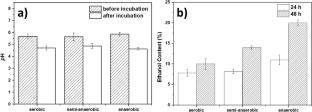
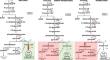
This study examines the intricate relationships between Saccharomyces cerevisiae and microbial fuel cells (MFCs) operating under diverse oxygen conditions: aerobic, semi-anaerobic, and anaerobic. The research delves into the metabolic pathways of yeast, specifically analyzing variations in pH levels and alcohol synthesis. Electron transport chain routes on yeast cells are explored, correlating with electron transfer rates to electrodes. The anaerobic, semi-anaerobic, and aerobic conditions demonstrate respective electron transfer rate constant values of 0.186 ± 0.053, 0.763 ± 0.013, and 0.396 ± 0.006 s−1, aligning with Laviron theory. Notably, MFCs under semi-anaerobic conditions achieve a substantial maximum power density of 17.077 ± 0.217 mW/m2, surpassing both aerobic (10.622 ± 0.331 mW/m2) and anaerobic (6.371 ± 0.128 mW/m2) conditions. Biofilm formation on electrodes varies with conditions, with masses of 0.829 g (anaerobic), 0.276 g (semi-anaerobic), and 0.409 g (aerobic). The findings underscore the superior performance of semi-anaerobic conditions, resulting in the highest maximum power density for yeast MFCs, suggesting its potential for efficient bioenergy production.
期刊介绍:
Biomass Conversion and Biorefinery presents articles and information on research, development and applications in thermo-chemical conversion; physico-chemical conversion and bio-chemical conversion, including all necessary steps for the provision and preparation of the biomass as well as all possible downstream processing steps for the environmentally sound and economically viable provision of energy and chemical products.



 京公网安备 11010802042870号
京ICP备2023020795号-1
京公网安备 11010802042870号
京ICP备2023020795号-1

 分享
分享
 求助内容:
求助内容: 应助结果提醒方式:
 扫码关注我们
