Pinky, Aarushi Sharma, Varun Arora, E. P. Rao, Sudheer Arava, A. Agrawal, M. Jassal, Sujata Mohanty
{"title":"Modulating the hAM/PCL Biocomposite for Expedited Wound Healing: A Chemical-Free Approach for Boosting Regenerative Potential.","authors":"Pinky, Aarushi Sharma, Varun Arora, E. P. Rao, Sudheer Arava, A. Agrawal, M. Jassal, Sujata Mohanty","doi":"10.1021/acsbiomaterials.3c01740","DOIUrl":null,"url":null,"abstract":"There is an arising need for effective wound dressings that retain the bioactivity of a cellular treatment, but without the high costs and complexities associated with manufacturing, storing, and applying cell-based products. As skin wound recovery is a dynamic and complicated process, a significant obstacle to the healing of skin wounds is the lack of an appropriate wound dressing that can imitate the microenvironment of healthy skin and prevent bacterial infection. It requires the well-orchestrated integration of biological and molecular events. In this study, we have fabricated full-thickness skin graft biocomposite membranes to target full-thickness skin excision wounds. We reinforced human amniotic membrane (hAM) with electrospun polycaprolactone (PCL) to develop composite membranes, namely, PCL/hAM and PCL/hAM/PCL. Composite membranes were compared for physical, biological, and mechanical properties with the native counterpart. PCL/hAM and PCL/hAM/PCL displayed improved stability and delayed degradation, which further synergically improved the rapid wound healing property of hAM, driven primarily by wound closure analysis and histological assessment. Moreover, PCL/hAM displayed a comparable cellular interaction to hAM. On application as a wound dressing, histological analysis demonstrated that hAM and PCL/hAM promoted early epidermis and dermis formation. Studies on in vivo wound healing revealed that although hAM accelerates cell development, the overall wound healing process is similar in PCL/hAM. This finding is further supported by the immunohistochemical analysis of COL-1/COL-3, CD-31, and TGF-β. Overall, this conjugated PCL and hAM-based membrane has considerable potential to be applied in skin wound healing. The facile fabrication of the PCL/hAM composite membrane provided the self-regenerating wound dressing with the desired mechanical strength as an ideal regenerative property for skin tissue regeneration.","PeriodicalId":5,"journal":{"name":"ACS Applied Materials & Interfaces","volume":"8 2","pages":""},"PeriodicalIF":8.2000,"publicationDate":"2024-05-16","publicationTypes":"Journal Article","fieldsOfStudy":null,"isOpenAccess":false,"openAccessPdf":"","citationCount":"0","resultStr":null,"platform":"Semanticscholar","paperid":null,"PeriodicalName":"ACS Applied Materials & Interfaces","FirstCategoryId":"5","ListUrlMain":"https://doi.org/10.1021/acsbiomaterials.3c01740","RegionNum":2,"RegionCategory":"材料科学","ArticlePicture":[],"TitleCN":null,"AbstractTextCN":null,"PMCID":null,"EPubDate":"","PubModel":"","JCR":"Q1","JCRName":"MATERIALS SCIENCE, MULTIDISCIPLINARY","Score":null,"Total":0}
引用次数: 0
Abstract
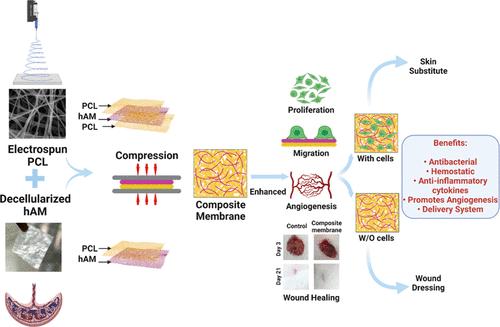
There is an arising need for effective wound dressings that retain the bioactivity of a cellular treatment, but without the high costs and complexities associated with manufacturing, storing, and applying cell-based products. As skin wound recovery is a dynamic and complicated process, a significant obstacle to the healing of skin wounds is the lack of an appropriate wound dressing that can imitate the microenvironment of healthy skin and prevent bacterial infection. It requires the well-orchestrated integration of biological and molecular events. In this study, we have fabricated full-thickness skin graft biocomposite membranes to target full-thickness skin excision wounds. We reinforced human amniotic membrane (hAM) with electrospun polycaprolactone (PCL) to develop composite membranes, namely, PCL/hAM and PCL/hAM/PCL. Composite membranes were compared for physical, biological, and mechanical properties with the native counterpart. PCL/hAM and PCL/hAM/PCL displayed improved stability and delayed degradation, which further synergically improved the rapid wound healing property of hAM, driven primarily by wound closure analysis and histological assessment. Moreover, PCL/hAM displayed a comparable cellular interaction to hAM. On application as a wound dressing, histological analysis demonstrated that hAM and PCL/hAM promoted early epidermis and dermis formation. Studies on in vivo wound healing revealed that although hAM accelerates cell development, the overall wound healing process is similar in PCL/hAM. This finding is further supported by the immunohistochemical analysis of COL-1/COL-3, CD-31, and TGF-β. Overall, this conjugated PCL and hAM-based membrane has considerable potential to be applied in skin wound healing. The facile fabrication of the PCL/hAM composite membrane provided the self-regenerating wound dressing with the desired mechanical strength as an ideal regenerative property for skin tissue regeneration.
期刊介绍:
ACS Applied Materials & Interfaces is a leading interdisciplinary journal that brings together chemists, engineers, physicists, and biologists to explore the development and utilization of newly-discovered materials and interfacial processes for specific applications. Our journal has experienced remarkable growth since its establishment in 2009, both in terms of the number of articles published and the impact of the research showcased. We are proud to foster a truly global community, with the majority of published articles originating from outside the United States, reflecting the rapid growth of applied research worldwide.



 京公网安备 11010802042870号
京ICP备2023020795号-1
京公网安备 11010802042870号
京ICP备2023020795号-1

 分享
分享
 求助内容:
求助内容: 应助结果提醒方式:
 扫码关注我们
