Studies on thermal degradation kinetics and machine learning modeling of hydrochar produced from hydrothermal carbonization of municipal sewage sludge and key lime peel
D. Venkata Padma, Kottala Ravi Kumar, S. V. A. R. Sastry, Praveen Barmavatu
{"title":"Studies on thermal degradation kinetics and machine learning modeling of hydrochar produced from hydrothermal carbonization of municipal sewage sludge and key lime peel","authors":"D. Venkata Padma, Kottala Ravi Kumar, S. V. A. R. Sastry, Praveen Barmavatu","doi":"10.1007/s13399-024-05749-1","DOIUrl":null,"url":null,"abstract":"<div><p>Hydrochar (HC), a carbonaceous material that can be used as solid fuel, is produced from wet biomass through hydrothermal carbonization (HTC). In this investigation, activated hydrochar is derived from municipal sewage sludge and key lime peel biomass. The effect of heating rate on the prepared activated hydrochar and kinetic parameters is investigated at different heating rates of 10, 15, and 20 °C/min using thermogravimetric analysis (TGA). The objective of this study is to determine the kinetic parameters associated with technological factors in two variants of activated hydrochar, produced from two different combinations of municipal sewage sludge and key lime peel, specifically in ratios of 1:1 and 2:1. Using model-free kinetics techniques, the kinetics of sample-1 (i.e., 1:1 blend ratio) and sample-2 (i.e., 2:1 blend ratio) degradation kinetics are analyzed. Three different kinetic models, namely Kissinger-Akahira-Sunose (KAS), Flynn-Wall-Ozawa (FWO), and Starink, are applied to assess the activation energies of hydrochar sample-1 and hydrochar sample-2. Activation energies for sample-1, using the Ozawa, KAS, and Starink methods, ranged from 59.61 to 48.63 kJ/mol, 56.05 to 35.12 kJ/mol, and 56.27 to 35.74 kJ/mol, respectively. Correspondingly, sample-2 activation energies ranged from 106.7 to 72.31 kJ/mol, 95.31 to 84.67 kJ/mol, and 106.35 to 72.92 kJ/mol, respectively. Additionally, multiple machine learning models, such as linear regression, polynomial regression, decision tree regression, and random forest regression, are developed to predict the degradation of prepared hydrochar samples. In these machine learning models, experimental TGA mass loss data samples are predicted by utilizing the corresponding heating rate and temperature data of the developed samples. Among all of these, the polynomial regression model is showing higher prediction performance (i.e., RMSE = 0.015282, <i>R</i><sup>2</sup> = 0.9971) than that of the remaining developed ML models.</p><h3>Graphical abstract</h3>\n<div><figure><div><div><picture><source><img></source></picture></div></div></figure></div></div>","PeriodicalId":488,"journal":{"name":"Biomass Conversion and Biorefinery","volume":"15 19","pages":"26385 - 26400"},"PeriodicalIF":4.1000,"publicationDate":"2024-05-15","publicationTypes":"Journal Article","fieldsOfStudy":null,"isOpenAccess":false,"openAccessPdf":"","citationCount":"0","resultStr":null,"platform":"Semanticscholar","paperid":null,"PeriodicalName":"Biomass Conversion and Biorefinery","FirstCategoryId":"5","ListUrlMain":"https://link.springer.com/article/10.1007/s13399-024-05749-1","RegionNum":4,"RegionCategory":"工程技术","ArticlePicture":[],"TitleCN":null,"AbstractTextCN":null,"PMCID":null,"EPubDate":"","PubModel":"","JCR":"Q3","JCRName":"ENERGY & FUELS","Score":null,"Total":0}
引用次数: 0
Abstract
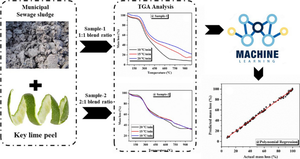
Hydrochar (HC), a carbonaceous material that can be used as solid fuel, is produced from wet biomass through hydrothermal carbonization (HTC). In this investigation, activated hydrochar is derived from municipal sewage sludge and key lime peel biomass. The effect of heating rate on the prepared activated hydrochar and kinetic parameters is investigated at different heating rates of 10, 15, and 20 °C/min using thermogravimetric analysis (TGA). The objective of this study is to determine the kinetic parameters associated with technological factors in two variants of activated hydrochar, produced from two different combinations of municipal sewage sludge and key lime peel, specifically in ratios of 1:1 and 2:1. Using model-free kinetics techniques, the kinetics of sample-1 (i.e., 1:1 blend ratio) and sample-2 (i.e., 2:1 blend ratio) degradation kinetics are analyzed. Three different kinetic models, namely Kissinger-Akahira-Sunose (KAS), Flynn-Wall-Ozawa (FWO), and Starink, are applied to assess the activation energies of hydrochar sample-1 and hydrochar sample-2. Activation energies for sample-1, using the Ozawa, KAS, and Starink methods, ranged from 59.61 to 48.63 kJ/mol, 56.05 to 35.12 kJ/mol, and 56.27 to 35.74 kJ/mol, respectively. Correspondingly, sample-2 activation energies ranged from 106.7 to 72.31 kJ/mol, 95.31 to 84.67 kJ/mol, and 106.35 to 72.92 kJ/mol, respectively. Additionally, multiple machine learning models, such as linear regression, polynomial regression, decision tree regression, and random forest regression, are developed to predict the degradation of prepared hydrochar samples. In these machine learning models, experimental TGA mass loss data samples are predicted by utilizing the corresponding heating rate and temperature data of the developed samples. Among all of these, the polynomial regression model is showing higher prediction performance (i.e., RMSE = 0.015282, R2 = 0.9971) than that of the remaining developed ML models.
期刊介绍:
Biomass Conversion and Biorefinery presents articles and information on research, development and applications in thermo-chemical conversion; physico-chemical conversion and bio-chemical conversion, including all necessary steps for the provision and preparation of the biomass as well as all possible downstream processing steps for the environmentally sound and economically viable provision of energy and chemical products.



 京公网安备 11010802042870号
京ICP备2023020795号-1
京公网安备 11010802042870号
京ICP备2023020795号-1

 分享
分享
 求助内容:
求助内容: 应助结果提醒方式:
 扫码关注我们
