L. Urzhumtseva, Charles Barchet, B. Klaholz, A. Urzhumtsev
{"title":"Program VUE: analysing distributions of cryo-EM projections using uniform spherical grids","authors":"L. Urzhumtseva, Charles Barchet, B. Klaholz, A. Urzhumtsev","doi":"10.1107/s1600576724002383","DOIUrl":null,"url":null,"abstract":"Three-dimensional cryo electron microscopy reconstructions are obtained by extracting information from a large number of projections of the object. These projections correspond to different `views' or `orientations', i.e. directions in which these projections show the reconstructed object. Uneven distribution of these views and the presence of dominating preferred orientations may distort the reconstructed spatial images. This work describes the program VUE (views on uniform grids for cryo electron microscopy), designed to study such distributions. Its algorithms, based on uniform virtual grids on a sphere, allow an easy calculation and accurate quantitative analysis of the frequency distribution of the views. The key computational element is the Lambert azimuthal equal-area projection of a spherical uniform grid onto a disc. This projection keeps the surface area constant and represents the frequency distribution with no visual bias. Since it has multiple tunable parameters, the program is easily adaptable to individual needs, and to the features of a particular project or of the figure to be produced. It can help identify problems related to an uneven distribution of views. Optionally, it can modify the list of projections, distributing the views more uniformly. The program can also be used as a teaching tool.","PeriodicalId":5,"journal":{"name":"ACS Applied Materials & Interfaces","volume":" 8","pages":""},"PeriodicalIF":8.2000,"publicationDate":"2024-05-10","publicationTypes":"Journal Article","fieldsOfStudy":null,"isOpenAccess":false,"openAccessPdf":"","citationCount":"0","resultStr":null,"platform":"Semanticscholar","paperid":null,"PeriodicalName":"ACS Applied Materials & Interfaces","FirstCategoryId":"88","ListUrlMain":"https://doi.org/10.1107/s1600576724002383","RegionNum":2,"RegionCategory":"材料科学","ArticlePicture":[],"TitleCN":null,"AbstractTextCN":null,"PMCID":null,"EPubDate":"","PubModel":"","JCR":"Q1","JCRName":"MATERIALS SCIENCE, MULTIDISCIPLINARY","Score":null,"Total":0}
引用次数: 0
Abstract
Three-dimensional cryo electron microscopy reconstructions are obtained by extracting information from a large number of projections of the object. These projections correspond to different `views' or `orientations', i.e. directions in which these projections show the reconstructed object. Uneven distribution of these views and the presence of dominating preferred orientations may distort the reconstructed spatial images. This work describes the program VUE (views on uniform grids for cryo electron microscopy), designed to study such distributions. Its algorithms, based on uniform virtual grids on a sphere, allow an easy calculation and accurate quantitative analysis of the frequency distribution of the views. The key computational element is the Lambert azimuthal equal-area projection of a spherical uniform grid onto a disc. This projection keeps the surface area constant and represents the frequency distribution with no visual bias. Since it has multiple tunable parameters, the program is easily adaptable to individual needs, and to the features of a particular project or of the figure to be produced. It can help identify problems related to an uneven distribution of views. Optionally, it can modify the list of projections, distributing the views more uniformly. The program can also be used as a teaching tool.
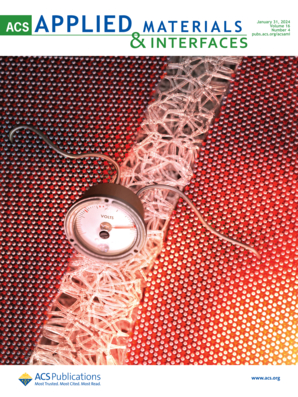
期刊介绍:
ACS Applied Materials & Interfaces is a leading interdisciplinary journal that brings together chemists, engineers, physicists, and biologists to explore the development and utilization of newly-discovered materials and interfacial processes for specific applications. Our journal has experienced remarkable growth since its establishment in 2009, both in terms of the number of articles published and the impact of the research showcased. We are proud to foster a truly global community, with the majority of published articles originating from outside the United States, reflecting the rapid growth of applied research worldwide.



 京公网安备 11010802042870号
京ICP备2023020795号-1
京公网安备 11010802042870号
京ICP备2023020795号-1

 分享
分享
 求助内容:
求助内容: 应助结果提醒方式:
 扫码关注我们
