Dan Goldhaber, John Krieg, Stephanie Liddle, Roddy Theobald
{"title":"The Long and Winding Road: Mapping the College and Employment Pathways to Teacher Education Program Completion in Washington State","authors":"Dan Goldhaber, John Krieg, Stephanie Liddle, Roddy Theobald","doi":"10.3102/0013189x241247848","DOIUrl":null,"url":null,"abstract":"Nationally, more than 75% of individuals who are credentialed to teach are prepared in traditional college- or university-based teacher education programs (TEPs). But the college and employment pathways that prospective teachers take to TEP enrollment and completion have not been comprehensively examined. A better understanding of how credentialed individuals find their way into TEPs helps us understand the sources of new teacher supply early in the prospective teacher pipeline. With that in mind, we analyze pathways into and through TEPs using historical postsecondary and unemployment insurance data from Washington State. We find that the pathways are quite varied, with around 40% of bachelor’s-level TEP completers spending at least some time in community colleges and fewer than 40% enrolling and finishing at the same university directly after high school. Pathways to master’s TEP completion are even more varied, with almost half of the completers having prior employment experience. For researchers, this varied landscape raises important questions about the relationship between pathways, candidate persistence, and eventual job performance. For policymakers, the results suggest that efforts to recruit the next generation of teachers need to look beyond the pool of students already enrolled at a 4-year university to include students at 2-year colleges or in the labor force who might be interested in entering a TEP.","PeriodicalId":5,"journal":{"name":"ACS Applied Materials & Interfaces","volume":"49 17","pages":""},"PeriodicalIF":8.2000,"publicationDate":"2024-05-06","publicationTypes":"Journal Article","fieldsOfStudy":null,"isOpenAccess":false,"openAccessPdf":"","citationCount":"0","resultStr":null,"platform":"Semanticscholar","paperid":null,"PeriodicalName":"ACS Applied Materials & Interfaces","FirstCategoryId":"95","ListUrlMain":"https://doi.org/10.3102/0013189x241247848","RegionNum":2,"RegionCategory":"材料科学","ArticlePicture":[],"TitleCN":null,"AbstractTextCN":null,"PMCID":null,"EPubDate":"","PubModel":"","JCR":"Q1","JCRName":"MATERIALS SCIENCE, MULTIDISCIPLINARY","Score":null,"Total":0}
引用次数: 0
Abstract
Nationally, more than 75% of individuals who are credentialed to teach are prepared in traditional college- or university-based teacher education programs (TEPs). But the college and employment pathways that prospective teachers take to TEP enrollment and completion have not been comprehensively examined. A better understanding of how credentialed individuals find their way into TEPs helps us understand the sources of new teacher supply early in the prospective teacher pipeline. With that in mind, we analyze pathways into and through TEPs using historical postsecondary and unemployment insurance data from Washington State. We find that the pathways are quite varied, with around 40% of bachelor’s-level TEP completers spending at least some time in community colleges and fewer than 40% enrolling and finishing at the same university directly after high school. Pathways to master’s TEP completion are even more varied, with almost half of the completers having prior employment experience. For researchers, this varied landscape raises important questions about the relationship between pathways, candidate persistence, and eventual job performance. For policymakers, the results suggest that efforts to recruit the next generation of teachers need to look beyond the pool of students already enrolled at a 4-year university to include students at 2-year colleges or in the labor force who might be interested in entering a TEP.
期刊介绍:
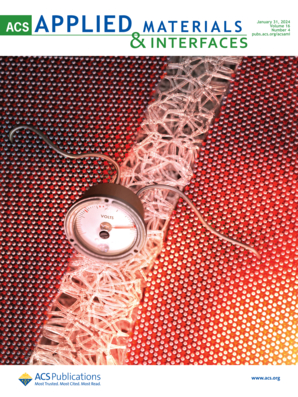
ACS Applied Materials & Interfaces is a leading interdisciplinary journal that brings together chemists, engineers, physicists, and biologists to explore the development and utilization of newly-discovered materials and interfacial processes for specific applications. Our journal has experienced remarkable growth since its establishment in 2009, both in terms of the number of articles published and the impact of the research showcased. We are proud to foster a truly global community, with the majority of published articles originating from outside the United States, reflecting the rapid growth of applied research worldwide.



 京公网安备 11010802042870号
京ICP备2023020795号-1
京公网安备 11010802042870号
京ICP备2023020795号-1

 分享
分享
 求助内容:
求助内容: 应助结果提醒方式:
 扫码关注我们
