Shisy Jose , Muneer Ahmad Malla , Nirmal Renuka , Faizal Bux , Sheena Kumari
{"title":"Cyanobacteria-green microalgae consortia enhance soil fertility and plant growth by shaping the native soil microbiome of Capsicum annuum","authors":"Shisy Jose , Muneer Ahmad Malla , Nirmal Renuka , Faizal Bux , Sheena Kumari","doi":"10.1016/j.rhisph.2024.100892","DOIUrl":null,"url":null,"abstract":"<div><p>Alternative solutions to chemical fertilizers that can enhance soil fertility, increase crop yield, promote sustainable agriculture and reduce harmful environmental impacts are urgently required. Microalgal bio-inoculants can improve soil fertility, plant growth and crop yield, yet the response of native soil microbiome to microalgal application remains largely unexplored. A pot experiment was conducted to assess the effects of microalgae (a consortium of cyanobacteria and green microalgae) inoculation on the growth and yield of chili plants, soil fertility and soil microbiome. Our results showed that microalgal inoculation significantly enhanced plant morphometric parameters and increased dehydrogenase activity (<em>p < 0.05</em>). Similarly, soil organic carbon, soil chlorophyll, total polysaccharides and nutrients such as carbon, nitrogen, phosphorus, potassium and manganese were also significantly (<em>p < 0.05</em>) enriched in microalgal treatment groups (50% and 100%) compared to the control. Results showed that microalgal inoculation increased the soil microbial diversity, with the richness being higher in treated soils than in control. Metagenomics analysis revealed a shift in bacterial and fungal community composition with firmicutes, chloroflexi, planctomycetes, proteobacteria, bacillariophyta, basidiomycota and glomeromycota dominating microalgal-treated soils, while actinobacteria, bacteroidetes, and streptomycota dominating control soils. The findings suggested that microalgal bio-inoculation can increase the diversity and composition of native soil microbiomes and enhance soil fertility, growth, and yield in chili plants.</p></div>","PeriodicalId":48589,"journal":{"name":"Rhizosphere","volume":"30 ","pages":"Article 100892"},"PeriodicalIF":3.5000,"publicationDate":"2024-06-01","publicationTypes":"Journal Article","fieldsOfStudy":null,"isOpenAccess":false,"openAccessPdf":"https://www.sciencedirect.com/science/article/pii/S2452219824000454/pdfft?md5=0b68d5807fd1337db425a72fb5b48db1&pid=1-s2.0-S2452219824000454-main.pdf","citationCount":"0","resultStr":null,"platform":"Semanticscholar","paperid":null,"PeriodicalName":"Rhizosphere","FirstCategoryId":"99","ListUrlMain":"https://www.sciencedirect.com/science/article/pii/S2452219824000454","RegionNum":3,"RegionCategory":"生物学","ArticlePicture":[],"TitleCN":null,"AbstractTextCN":null,"PMCID":null,"EPubDate":"2024/5/3 0:00:00","PubModel":"Epub","JCR":"Q1","JCRName":"PLANT SCIENCES","Score":null,"Total":0}
引用次数: 0
Abstract
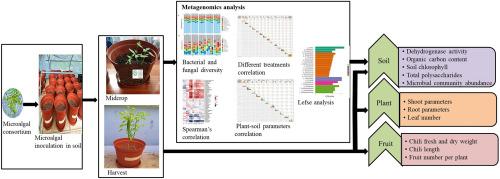
Alternative solutions to chemical fertilizers that can enhance soil fertility, increase crop yield, promote sustainable agriculture and reduce harmful environmental impacts are urgently required. Microalgal bio-inoculants can improve soil fertility, plant growth and crop yield, yet the response of native soil microbiome to microalgal application remains largely unexplored. A pot experiment was conducted to assess the effects of microalgae (a consortium of cyanobacteria and green microalgae) inoculation on the growth and yield of chili plants, soil fertility and soil microbiome. Our results showed that microalgal inoculation significantly enhanced plant morphometric parameters and increased dehydrogenase activity (p < 0.05). Similarly, soil organic carbon, soil chlorophyll, total polysaccharides and nutrients such as carbon, nitrogen, phosphorus, potassium and manganese were also significantly (p < 0.05) enriched in microalgal treatment groups (50% and 100%) compared to the control. Results showed that microalgal inoculation increased the soil microbial diversity, with the richness being higher in treated soils than in control. Metagenomics analysis revealed a shift in bacterial and fungal community composition with firmicutes, chloroflexi, planctomycetes, proteobacteria, bacillariophyta, basidiomycota and glomeromycota dominating microalgal-treated soils, while actinobacteria, bacteroidetes, and streptomycota dominating control soils. The findings suggested that microalgal bio-inoculation can increase the diversity and composition of native soil microbiomes and enhance soil fertility, growth, and yield in chili plants.
RhizosphereAgricultural and Biological Sciences-Agronomy and Crop Science
CiteScore
5.70
自引率
8.10%
发文量
155
审稿时长
29 days
期刊介绍:
Rhizosphere aims to advance the frontier of our understanding of plant-soil interactions. Rhizosphere is a multidisciplinary journal that publishes research on the interactions between plant roots, soil organisms, nutrients, and water. Except carbon fixation by photosynthesis, plants obtain all other elements primarily from soil through roots.
We are beginning to understand how communications at the rhizosphere, with soil organisms and other plant species, affect root exudates and nutrient uptake. This rapidly evolving subject utilizes molecular biology and genomic tools, food web or community structure manipulations, high performance liquid chromatography, isotopic analysis, diverse spectroscopic analytics, tomography and other microscopy, complex statistical and modeling tools.



 京公网安备 11010802042870号
京ICP备2023020795号-1
京公网安备 11010802042870号
京ICP备2023020795号-1

 分享
分享
 求助内容:
求助内容: 应助结果提醒方式:
 扫码关注我们
