Nguyen Le My Linh, Dang Thi Thanh Nhan, Dinh Quy Huong, Do Mai Nguyen, Nguyen Thi Thao Uyen, Doan Manh Dung, Trinh Ngoc Dat, Le Van Thanh Son, Tran Thanh Tam Toan, Dinh Quang Khieu
{"title":"Simultaneous determination of uric acid and xanthine in human urine using differential pulse voltammetry with ZnMn2O4 modified electrode","authors":"Nguyen Le My Linh, Dang Thi Thanh Nhan, Dinh Quy Huong, Do Mai Nguyen, Nguyen Thi Thao Uyen, Doan Manh Dung, Trinh Ngoc Dat, Le Van Thanh Son, Tran Thanh Tam Toan, Dinh Quang Khieu","doi":"10.1007/s11051-024-06018-y","DOIUrl":null,"url":null,"abstract":"<div><p>This paper demonstrates the preparation of ZnMn<sub>2</sub>O<sub>4</sub> nanoparticles through thermal hydrolysis in different solvents, such as isopropanol, ethylene glycol, glycerol, and water, combined with pyrolysis. The obtained samples were characterised by using X-ray diffraction (XRD), infrared spectroscopy (FT‒IR), scanning electron microscopy (SEM), energy-dispersive X-ray mapping, nitrogen adsorption/desorption isotherms, and a vibrating sample magnetometer. The electrocatalytic activity of ZnMn<sub>2</sub>O<sub>4</sub> nanoparticles was investigated toward the oxidation of uric acid (UA) and xanthine (XA). The ZnMn<sub>2</sub>O<sub>4</sub>-nanoparticle-modified electrode not only enhances the oxidation currents of the two purine derivatives but also successfully separates the voltammetric signals of the analytes in their binary mixture and, hence, is employed for their simultaneous determination. The factors affecting the analysis, such as pH, scan rate, linear range, detection limit, reproducibility, and interferents, were also investigated. The results show that the UA and XA limits of detection are as low as 0.55 and 1.28 µM, and the modified electrodes have satisfactory repeatability and reproducibility. The practical application of the modified electrode was demonstrated by simultaneously determining the concentrations of UA and XA in urine samples with exceptional accuracy.</p></div>","PeriodicalId":653,"journal":{"name":"Journal of Nanoparticle Research","volume":"26 5","pages":""},"PeriodicalIF":2.6000,"publicationDate":"2024-05-15","publicationTypes":"Journal Article","fieldsOfStudy":null,"isOpenAccess":false,"openAccessPdf":"","citationCount":"0","resultStr":null,"platform":"Semanticscholar","paperid":null,"PeriodicalName":"Journal of Nanoparticle Research","FirstCategoryId":"88","ListUrlMain":"https://link.springer.com/article/10.1007/s11051-024-06018-y","RegionNum":4,"RegionCategory":"材料科学","ArticlePicture":[],"TitleCN":null,"AbstractTextCN":null,"PMCID":null,"EPubDate":"","PubModel":"","JCR":"Q3","JCRName":"CHEMISTRY, MULTIDISCIPLINARY","Score":null,"Total":0}
引用次数: 0
Abstract
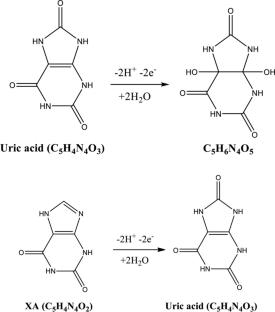
This paper demonstrates the preparation of ZnMn2O4 nanoparticles through thermal hydrolysis in different solvents, such as isopropanol, ethylene glycol, glycerol, and water, combined with pyrolysis. The obtained samples were characterised by using X-ray diffraction (XRD), infrared spectroscopy (FT‒IR), scanning electron microscopy (SEM), energy-dispersive X-ray mapping, nitrogen adsorption/desorption isotherms, and a vibrating sample magnetometer. The electrocatalytic activity of ZnMn2O4 nanoparticles was investigated toward the oxidation of uric acid (UA) and xanthine (XA). The ZnMn2O4-nanoparticle-modified electrode not only enhances the oxidation currents of the two purine derivatives but also successfully separates the voltammetric signals of the analytes in their binary mixture and, hence, is employed for their simultaneous determination. The factors affecting the analysis, such as pH, scan rate, linear range, detection limit, reproducibility, and interferents, were also investigated. The results show that the UA and XA limits of detection are as low as 0.55 and 1.28 µM, and the modified electrodes have satisfactory repeatability and reproducibility. The practical application of the modified electrode was demonstrated by simultaneously determining the concentrations of UA and XA in urine samples with exceptional accuracy.
期刊介绍:
The objective of the Journal of Nanoparticle Research is to disseminate knowledge of the physical, chemical and biological phenomena and processes in structures that have at least one lengthscale ranging from molecular to approximately 100 nm (or submicron in some situations), and exhibit improved and novel properties that are a direct result of their small size.
Nanoparticle research is a key component of nanoscience, nanoengineering and nanotechnology.
The focus of the Journal is on the specific concepts, properties, phenomena, and processes related to particles, tubes, layers, macromolecules, clusters and other finite structures of the nanoscale size range. Synthesis, assembly, transport, reactivity, and stability of such structures are considered. Development of in-situ and ex-situ instrumentation for characterization of nanoparticles and their interfaces should be based on new principles for probing properties and phenomena not well understood at the nanometer scale. Modeling and simulation may include atom-based quantum mechanics; molecular dynamics; single-particle, multi-body and continuum based models; fractals; other methods suitable for modeling particle synthesis, assembling and interaction processes. Realization and application of systems, structures and devices with novel functions obtained via precursor nanoparticles is emphasized. Approaches may include gas-, liquid-, solid-, and vacuum-based processes, size reduction, chemical- and bio-self assembly. Contributions include utilization of nanoparticle systems for enhancing a phenomenon or process and particle assembling into hierarchical structures, as well as formulation and the administration of drugs. Synergistic approaches originating from different disciplines and technologies, and interaction between the research providers and users in this field, are encouraged.



 京公网安备 11010802042870号
京ICP备2023020795号-1
京公网安备 11010802042870号
京ICP备2023020795号-1

 分享
分享
 求助内容:
求助内容: 应助结果提醒方式:
 扫码关注我们
