{"title":"Atmospheric oxygenation as a potential trigger for climate cooling","authors":"Guang-Yi Wei, Gaojun Li","doi":"10.1016/j.scib.2024.05.006","DOIUrl":null,"url":null,"abstract":"<div><div>Secular changes in atmospheric CO<sub>2</sub><span><span> and consequent global climate variations, are commonly attributed to global outgassing and the efficiency of silicate weathering, which may have been linked to mountain formation, land/arc distribution, and plant colonization through </span>geological time. Although oxidative weathering has been shown to exert a significant role in the propagation of weathering fronts through the oxidation of Fe-bearing minerals, the influence of atmospheric O</span><sub>2</sub> concentration (<em>p</em>O<sub>2</sub>) on silicate weathering, CO<sub>2</sub> consumption, and global climate has not been thoroughly evaluated. This study presents a numerical model aimed at estimating the effects of <em>p</em>O<sub>2</sub> on the climate, considering the influence of <em>p</em>O<sub>2</sub><span> on the regolith thickness and thus weathering duration of granitic domains. Our model simulations reveal that an increase in weathering efficiency, through deeper penetration of the oxidative weathering front in the granitic regolith, would independently introduce a steady-state climate cooling of up to ∼8 °C, in step with one-order of magnitude rise in </span><em>p</em>O<sub>2</sub>. This temperature change may have repeatedly initiated the runaway ice-albedo feedback, leading to global glacial events (e.g., Neoproterozoic Snowball Earth). Increasing granitic weathering efficiency caused by a substantial <em>p</em>O<sub>2</sub><span> increase may also have contributed to the development of icehouse climate during the Phanerozoic.</span></div></div>","PeriodicalId":421,"journal":{"name":"Science Bulletin","volume":"69 23","pages":"Pages 3717-3722"},"PeriodicalIF":21.1000,"publicationDate":"2024-12-15","publicationTypes":"Journal Article","fieldsOfStudy":null,"isOpenAccess":false,"openAccessPdf":"","citationCount":"0","resultStr":null,"platform":"Semanticscholar","paperid":null,"PeriodicalName":"Science Bulletin","FirstCategoryId":"103","ListUrlMain":"https://www.sciencedirect.com/science/article/pii/S2095927324003402","RegionNum":1,"RegionCategory":"综合性期刊","ArticlePicture":[],"TitleCN":null,"AbstractTextCN":null,"PMCID":null,"EPubDate":"2024/5/14 0:00:00","PubModel":"Epub","JCR":"Q1","JCRName":"MULTIDISCIPLINARY SCIENCES","Score":null,"Total":0}
引用次数: 0
Abstract
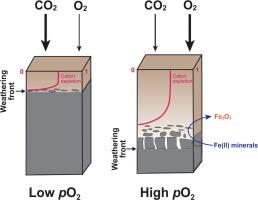
Secular changes in atmospheric CO2 and consequent global climate variations, are commonly attributed to global outgassing and the efficiency of silicate weathering, which may have been linked to mountain formation, land/arc distribution, and plant colonization through geological time. Although oxidative weathering has been shown to exert a significant role in the propagation of weathering fronts through the oxidation of Fe-bearing minerals, the influence of atmospheric O2 concentration (pO2) on silicate weathering, CO2 consumption, and global climate has not been thoroughly evaluated. This study presents a numerical model aimed at estimating the effects of pO2 on the climate, considering the influence of pO2 on the regolith thickness and thus weathering duration of granitic domains. Our model simulations reveal that an increase in weathering efficiency, through deeper penetration of the oxidative weathering front in the granitic regolith, would independently introduce a steady-state climate cooling of up to ∼8 °C, in step with one-order of magnitude rise in pO2. This temperature change may have repeatedly initiated the runaway ice-albedo feedback, leading to global glacial events (e.g., Neoproterozoic Snowball Earth). Increasing granitic weathering efficiency caused by a substantial pO2 increase may also have contributed to the development of icehouse climate during the Phanerozoic.
期刊介绍:
Science Bulletin (Sci. Bull., formerly known as Chinese Science Bulletin) is a multidisciplinary academic journal supervised by the Chinese Academy of Sciences (CAS) and co-sponsored by the CAS and the National Natural Science Foundation of China (NSFC). Sci. Bull. is a semi-monthly international journal publishing high-caliber peer-reviewed research on a broad range of natural sciences and high-tech fields on the basis of its originality, scientific significance and whether it is of general interest. In addition, we are committed to serving the scientific community with immediate, authoritative news and valuable insights into upcoming trends around the globe.





 京公网安备 11010802042870号
京ICP备2023020795号-1
京公网安备 11010802042870号
京ICP备2023020795号-1

 分享
分享
 求助内容:
求助内容: 应助结果提醒方式:
 扫码关注我们
