{"title":"Advancements in supercapacitor technology through the utilization of NiCo2X4 (X = O, S, Se) based nanocomposites as electrodes: A comprehensive review","authors":"","doi":"10.1016/j.jiec.2024.05.021","DOIUrl":null,"url":null,"abstract":"<div><p>Supercapacitors offer notable advantages in the contemporary energy and environmental context due to their affordability, fast charging and discharging capabilities, long-term stability, and high power density. However, a pivotal challenge lies in developing electrode materials that exhibit superior electrochemical behaviour remains a challenge. Recent strides in this pursuit have brought to light the promising potential of NiCo<sub>2</sub>X<sub>4</sub> (where X denotes O, S, or Se), owing to their cost-effectiveness, noteworthy redox reactions, and inherent electrical conductivity. This review meticulously provides an in-depth analysis of NiCo<sub>2</sub>X<sub>4</sub>, including its crystal structure, charge storage mechanism, and electrochemical performance. The main focus is on developing composites using NiCo<sub>2</sub>X<sub>4</sub>, and the review evaluates recent progress and suggests potential solutions to overcome challenges associated with supercapacitor electrodes. The review examines current advancements and proposes potential solutions to address ongoing challenges associated with supercapacitor electrodes. Through this exploration, the review not only provides valuable insights into the field's present state but also sheds light on future prospects, contributing to the continuous evolution of supercapacitor technology.</p></div>","PeriodicalId":363,"journal":{"name":"Journal of Industrial and Engineering Chemistry","volume":"139 ","pages":"Pages 74-93"},"PeriodicalIF":5.9000,"publicationDate":"2024-05-16","publicationTypes":"Journal Article","fieldsOfStudy":null,"isOpenAccess":false,"openAccessPdf":"","citationCount":"0","resultStr":null,"platform":"Semanticscholar","paperid":null,"PeriodicalName":"Journal of Industrial and Engineering Chemistry","FirstCategoryId":"5","ListUrlMain":"https://www.sciencedirect.com/science/article/pii/S1226086X24003277","RegionNum":3,"RegionCategory":"工程技术","ArticlePicture":[],"TitleCN":null,"AbstractTextCN":null,"PMCID":null,"EPubDate":"","PubModel":"","JCR":"Q1","JCRName":"CHEMISTRY, MULTIDISCIPLINARY","Score":null,"Total":0}
引用次数: 0
Abstract
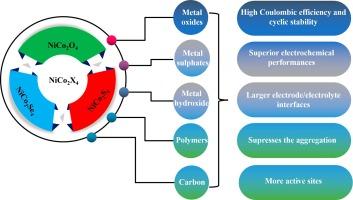
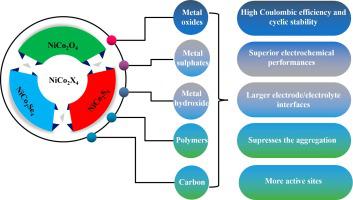
Supercapacitors offer notable advantages in the contemporary energy and environmental context due to their affordability, fast charging and discharging capabilities, long-term stability, and high power density. However, a pivotal challenge lies in developing electrode materials that exhibit superior electrochemical behaviour remains a challenge. Recent strides in this pursuit have brought to light the promising potential of NiCo2X4 (where X denotes O, S, or Se), owing to their cost-effectiveness, noteworthy redox reactions, and inherent electrical conductivity. This review meticulously provides an in-depth analysis of NiCo2X4, including its crystal structure, charge storage mechanism, and electrochemical performance. The main focus is on developing composites using NiCo2X4, and the review evaluates recent progress and suggests potential solutions to overcome challenges associated with supercapacitor electrodes. The review examines current advancements and proposes potential solutions to address ongoing challenges associated with supercapacitor electrodes. Through this exploration, the review not only provides valuable insights into the field's present state but also sheds light on future prospects, contributing to the continuous evolution of supercapacitor technology.
期刊介绍:
Journal of Industrial and Engineering Chemistry is published monthly in English by the Korean Society of Industrial and Engineering Chemistry. JIEC brings together multidisciplinary interests in one journal and is to disseminate information on all aspects of research and development in industrial and engineering chemistry. Contributions in the form of research articles, short communications, notes and reviews are considered for publication. The editors welcome original contributions that have not been and are not to be published elsewhere. Instruction to authors and a manuscript submissions form are printed at the end of each issue. Bulk reprints of individual articles can be ordered. This publication is partially supported by Korea Research Foundation and the Korean Federation of Science and Technology Societies.



 京公网安备 11010802042870号
京ICP备2023020795号-1
京公网安备 11010802042870号
京ICP备2023020795号-1

 分享
分享
 求助内容:
求助内容: 应助结果提醒方式:
 扫码关注我们
