{"title":"Mapping global lake aquatic vegetation dynamics using 10-m resolution satellite observations","authors":"","doi":"10.1016/j.scib.2024.05.009","DOIUrl":null,"url":null,"abstract":"<div><div><span>Aquatic vegetation is crucial for improving water quality, supporting fisheries and preserving biodiversity in lakes. Monitoring the spatiotemporal dynamics of aquatic vegetation is indispensable for the assessment and protection of lake ecosystems. Nevertheless, a comprehensive global assessment of lacustrine aquatic vegetation is lacking. This study introduces an automatic identification algorithm (with a total accuracy of 94.4%) for Sentinel-2 MSI, enabling the first-ever global mapping of aquatic vegetation distribution in 1.4 million lakes using 14.8 million images from 2019 to 2022. Results show that aquatic vegetation occurred in 81,116 lakes across six continents over the past four years, covering a cumulative maximum aquatic vegetation area (MVA) of 16,111.8 km</span><sup>2</sup><span>. The global median aquatic vegetation occurrence (VO, in %) is 3.0%, with notable higher values observed in South America (7.4%) and Africa (4.1%) compared with Asia (2.7%) and North America (2.4%). High VO is also observed in lakes near major rivers such as the Yangtze, Ob, and Paraná Rivers. Integrating historical data with our calculated MVA, the aquatic vegetation changes in 170 lakes worldwide were analyzed. It shows that 72.4% (123/170) of lakes experienced a decline in aquatic vegetation from the early 1980s to 2022, encompassing both submerged and overall aquatic vegetation. The most substantial decrease is observed in Asia and Africa. Our findings suggest that, beyond lake algal blooms and temperature, the physical characteristics of the lakes and their surrounding environments could also influence aquatic vegetation distribution. Our research provides valuable information for the conservation and restoration of lacustrine aquatic vegetation.</span></div></div>","PeriodicalId":421,"journal":{"name":"Science Bulletin","volume":"69 19","pages":"Pages 3115-3126"},"PeriodicalIF":21.1000,"publicationDate":"2024-10-15","publicationTypes":"Journal Article","fieldsOfStudy":null,"isOpenAccess":false,"openAccessPdf":"","citationCount":"0","resultStr":null,"platform":"Semanticscholar","paperid":null,"PeriodicalName":"Science Bulletin","FirstCategoryId":"103","ListUrlMain":"https://www.sciencedirect.com/science/article/pii/S2095927324003438","RegionNum":1,"RegionCategory":"综合性期刊","ArticlePicture":[],"TitleCN":null,"AbstractTextCN":null,"PMCID":null,"EPubDate":"2024/5/17 0:00:00","PubModel":"Epub","JCR":"Q1","JCRName":"MULTIDISCIPLINARY SCIENCES","Score":null,"Total":0}
引用次数: 0
Abstract
Aquatic vegetation is crucial for improving water quality, supporting fisheries and preserving biodiversity in lakes. Monitoring the spatiotemporal dynamics of aquatic vegetation is indispensable for the assessment and protection of lake ecosystems. Nevertheless, a comprehensive global assessment of lacustrine aquatic vegetation is lacking. This study introduces an automatic identification algorithm (with a total accuracy of 94.4%) for Sentinel-2 MSI, enabling the first-ever global mapping of aquatic vegetation distribution in 1.4 million lakes using 14.8 million images from 2019 to 2022. Results show that aquatic vegetation occurred in 81,116 lakes across six continents over the past four years, covering a cumulative maximum aquatic vegetation area (MVA) of 16,111.8 km2. The global median aquatic vegetation occurrence (VO, in %) is 3.0%, with notable higher values observed in South America (7.4%) and Africa (4.1%) compared with Asia (2.7%) and North America (2.4%). High VO is also observed in lakes near major rivers such as the Yangtze, Ob, and Paraná Rivers. Integrating historical data with our calculated MVA, the aquatic vegetation changes in 170 lakes worldwide were analyzed. It shows that 72.4% (123/170) of lakes experienced a decline in aquatic vegetation from the early 1980s to 2022, encompassing both submerged and overall aquatic vegetation. The most substantial decrease is observed in Asia and Africa. Our findings suggest that, beyond lake algal blooms and temperature, the physical characteristics of the lakes and their surrounding environments could also influence aquatic vegetation distribution. Our research provides valuable information for the conservation and restoration of lacustrine aquatic vegetation.
期刊介绍:
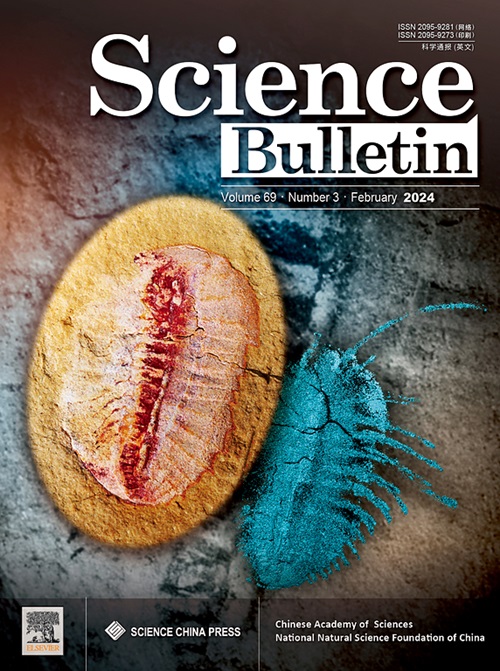
Science Bulletin (Sci. Bull., formerly known as Chinese Science Bulletin) is a multidisciplinary academic journal supervised by the Chinese Academy of Sciences (CAS) and co-sponsored by the CAS and the National Natural Science Foundation of China (NSFC). Sci. Bull. is a semi-monthly international journal publishing high-caliber peer-reviewed research on a broad range of natural sciences and high-tech fields on the basis of its originality, scientific significance and whether it is of general interest. In addition, we are committed to serving the scientific community with immediate, authoritative news and valuable insights into upcoming trends around the globe.



 京公网安备 11010802042870号
京ICP备2023020795号-1
京公网安备 11010802042870号
京ICP备2023020795号-1

 分享
分享
 求助内容:
求助内容: 应助结果提醒方式:
 扫码关注我们
