Gayathri Seenivasan, Sarwat Asma Ziya Ahmad, N. Tuti, U. P. Shaji, Susmita Das, Faiz Ahmed Khan, Roy Anindya
{"title":"Evaluation of a panel of furochromenones as the activator and inhibitor of tyrosinase.","authors":"Gayathri Seenivasan, Sarwat Asma Ziya Ahmad, N. Tuti, U. P. Shaji, Susmita Das, Faiz Ahmed Khan, Roy Anindya","doi":"10.1111/cbdd.14539","DOIUrl":null,"url":null,"abstract":"Tyrosinase is a copper-containing enzyme involved in the biosynthesis of melanin pigment. While the excess production of melanin causes hyperpigmentation of human skin, hypopigmentation results in medical conditions like vitiligo. Tyrosinase inhibitors could be used as efficient skin whitening agents and tyrosinase agonists could be used for enhanced melanin synthesis and skin protection from UV exposure. Among a wide range of tyrosinase-regulating compounds, natural and synthetic derivatives of furochromenones, such as 8-methoxypsoralen (8-MOP), are known to both activate and inhibit tyrosinase. We recently reported a synthetic approach to generate a variety of dihydrofuro[3,2-c]chromenones and furo[3,2-c]chromenones in a metal-free condition. In the present study, we investigated these compounds for their potential as antagonists or agonists of tyrosinase. Using fungal tyrosinase-based in vitro biochemical assay, we obtained one compound (3k) which could inhibit tyrosinase activity, and the other compound (4f) that stimulated tyrosinase activity. The kinetic studies revealed that compound 3k caused 'mixed' type tyrosinase inhibition and 4f stimulated the catalytic efficiency. Studying the mechanisms of these compounds may provide a basis for the development of new effective tyrosinase inhibitors or activators.","PeriodicalId":3,"journal":{"name":"ACS Applied Electronic Materials","volume":"278 4","pages":"e14539"},"PeriodicalIF":4.7000,"publicationDate":"2024-05-01","publicationTypes":"Journal Article","fieldsOfStudy":null,"isOpenAccess":false,"openAccessPdf":"","citationCount":"0","resultStr":null,"platform":"Semanticscholar","paperid":null,"PeriodicalName":"ACS Applied Electronic Materials","FirstCategoryId":"3","ListUrlMain":"https://doi.org/10.1111/cbdd.14539","RegionNum":3,"RegionCategory":"材料科学","ArticlePicture":[],"TitleCN":null,"AbstractTextCN":null,"PMCID":null,"EPubDate":"","PubModel":"","JCR":"Q1","JCRName":"ENGINEERING, ELECTRICAL & ELECTRONIC","Score":null,"Total":0}
引用次数: 0
Abstract
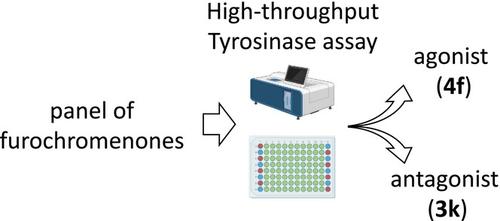
Tyrosinase is a copper-containing enzyme involved in the biosynthesis of melanin pigment. While the excess production of melanin causes hyperpigmentation of human skin, hypopigmentation results in medical conditions like vitiligo. Tyrosinase inhibitors could be used as efficient skin whitening agents and tyrosinase agonists could be used for enhanced melanin synthesis and skin protection from UV exposure. Among a wide range of tyrosinase-regulating compounds, natural and synthetic derivatives of furochromenones, such as 8-methoxypsoralen (8-MOP), are known to both activate and inhibit tyrosinase. We recently reported a synthetic approach to generate a variety of dihydrofuro[3,2-c]chromenones and furo[3,2-c]chromenones in a metal-free condition. In the present study, we investigated these compounds for their potential as antagonists or agonists of tyrosinase. Using fungal tyrosinase-based in vitro biochemical assay, we obtained one compound (3k) which could inhibit tyrosinase activity, and the other compound (4f) that stimulated tyrosinase activity. The kinetic studies revealed that compound 3k caused 'mixed' type tyrosinase inhibition and 4f stimulated the catalytic efficiency. Studying the mechanisms of these compounds may provide a basis for the development of new effective tyrosinase inhibitors or activators.
期刊介绍:
ACS Applied Electronic Materials is an interdisciplinary journal publishing original research covering all aspects of electronic materials. The journal is devoted to reports of new and original experimental and theoretical research of an applied nature that integrate knowledge in the areas of materials science, engineering, optics, physics, and chemistry into important applications of electronic materials. Sample research topics that span the journal's scope are inorganic, organic, ionic and polymeric materials with properties that include conducting, semiconducting, superconducting, insulating, dielectric, magnetic, optoelectronic, piezoelectric, ferroelectric and thermoelectric.
Indexed/Abstracted:
Web of Science SCIE
Scopus
CAS
INSPEC
Portico





 京公网安备 11010802042870号
京ICP备2023020795号-1
京公网安备 11010802042870号
京ICP备2023020795号-1

 分享
分享
 求助内容:
求助内容: 应助结果提醒方式:
 扫码关注我们
