{"title":"Interpretable Code Summarization","authors":"Md Sarwar Kamal;Sonia Farhana Nimmy;Nilanjan Dey","doi":"10.1109/TR.2024.3392876","DOIUrl":null,"url":null,"abstract":"Code summarization is a process of creating a readable natural language from programming source codes. Code summarization has become a popular research topic for software maintenance, code generation, and code recovery. Existing code summarization methods follow the encoding/decoding approach and use various machine learning techniques to generate natural language from source codes. Although most of these methods are state of the art, it is difficult to understand the complex encoding and decoding process to map the tokens with natural language words. Therefore, these coding and decoding approaches are treated as opaque models (black box). This research proposes explainable AI methods that overcome the black box features for the token mapping in code summarization process. Here, we created an abstract syntax tree (AST) from the tokens of the source code. We then embedded the AST into natural language words using a bilingual statistical probability approach to generate possible statistical parse trees. We applied a page rank algorithm among the parse trees to rank the trees. From the best-ranked tree, we generate the comment for the corresponding code snippet. To explain our code generation method, we used Takagi–Sugeno fuzzy approach, layerwise relevance propagation and a hidden Markov model. These approaches make our method trustworthy and understandable to humans to understand the process of source code token mapping with natural language words.","PeriodicalId":56305,"journal":{"name":"IEEE Transactions on Reliability","volume":"74 1","pages":"2280-2289"},"PeriodicalIF":5.7000,"publicationDate":"2024-03-14","publicationTypes":"Journal Article","fieldsOfStudy":null,"isOpenAccess":false,"openAccessPdf":"","citationCount":"0","resultStr":null,"platform":"Semanticscholar","paperid":null,"PeriodicalName":"IEEE Transactions on Reliability","FirstCategoryId":"94","ListUrlMain":"https://ieeexplore.ieee.org/document/10530504/","RegionNum":2,"RegionCategory":"计算机科学","ArticlePicture":[],"TitleCN":null,"AbstractTextCN":null,"PMCID":null,"EPubDate":"","PubModel":"","JCR":"Q1","JCRName":"COMPUTER SCIENCE, HARDWARE & ARCHITECTURE","Score":null,"Total":0}
引用次数: 0
Abstract
Code summarization is a process of creating a readable natural language from programming source codes. Code summarization has become a popular research topic for software maintenance, code generation, and code recovery. Existing code summarization methods follow the encoding/decoding approach and use various machine learning techniques to generate natural language from source codes. Although most of these methods are state of the art, it is difficult to understand the complex encoding and decoding process to map the tokens with natural language words. Therefore, these coding and decoding approaches are treated as opaque models (black box). This research proposes explainable AI methods that overcome the black box features for the token mapping in code summarization process. Here, we created an abstract syntax tree (AST) from the tokens of the source code. We then embedded the AST into natural language words using a bilingual statistical probability approach to generate possible statistical parse trees. We applied a page rank algorithm among the parse trees to rank the trees. From the best-ranked tree, we generate the comment for the corresponding code snippet. To explain our code generation method, we used Takagi–Sugeno fuzzy approach, layerwise relevance propagation and a hidden Markov model. These approaches make our method trustworthy and understandable to humans to understand the process of source code token mapping with natural language words.
期刊介绍:
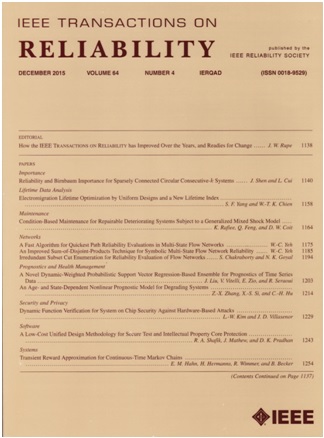
IEEE Transactions on Reliability is a refereed journal for the reliability and allied disciplines including, but not limited to, maintainability, physics of failure, life testing, prognostics, design and manufacture for reliability, reliability for systems of systems, network availability, mission success, warranty, safety, and various measures of effectiveness. Topics eligible for publication range from hardware to software, from materials to systems, from consumer and industrial devices to manufacturing plants, from individual items to networks, from techniques for making things better to ways of predicting and measuring behavior in the field. As an engineering subject that supports new and existing technologies, we constantly expand into new areas of the assurance sciences.



 京公网安备 11010802042870号
京ICP备2023020795号-1
京公网安备 11010802042870号
京ICP备2023020795号-1

 分享
分享
 求助内容:
求助内容: 应助结果提醒方式:
 扫码关注我们
