Steven H. Itzkowitz , Yue Jiang , Cristina Villagra , Jean-Frederic Colombel , Keith Sultan , Dana J. Lukin , David M. Faleck , Ellen Scherl , Shannon Chang , LeaAnn Chen , Seymour Katz , Joann Kwah , Arun Swaminath , Francesca Petralia , Virginia Sharpless , David Sachar , Lina Jandorf , Jordan E. Axelrad , New York Crohn’s and Colitis Organization
{"title":"Safety of Immunosuppression in a Prospective Cohort of Inflammatory Bowel Disease Patients With a HIstoRy of CancEr: SAPPHIRE Registry","authors":"Steven H. Itzkowitz , Yue Jiang , Cristina Villagra , Jean-Frederic Colombel , Keith Sultan , Dana J. Lukin , David M. Faleck , Ellen Scherl , Shannon Chang , LeaAnn Chen , Seymour Katz , Joann Kwah , Arun Swaminath , Francesca Petralia , Virginia Sharpless , David Sachar , Lina Jandorf , Jordan E. Axelrad , New York Crohn’s and Colitis Organization","doi":"10.1016/j.cgh.2024.05.006","DOIUrl":null,"url":null,"abstract":"<div><h3>Background & Aims</h3><div>In patients with inflammatory bowel disease (IBD) and a history of cancer, retrospective studies have suggested that exposure to immunosuppressive agents does not increase the risk of incident (recurrent or new) cancer compared with unexposed patients. Safety of Immunosuppression in a Prospective Cohort of Inflammatory Bowel Disease Patients and a HIstoRy of CancEr (SAPPHIRE) is a prospective registry aimed at addressing this issue.</div></div><div><h3>Methods</h3><div>Since 2016, patients with IBD and confirmed index cancer before enrollment were followed up annually. Patients receiving chemotherapy or radiation at enrollment, or recurrent cancer within 5 years, were excluded. The primary outcome was development of incident cancer related to exposure to immunosuppressive medications.</div></div><div><h3>Results</h3><div>Among 305 patients (47% male, 88% white), the median age at IBD diagnosis and cancer were 32 and 52 years, respectively. Index cancers were solid organ (46%), dermatologic (32%), gastrointestinal (13%), and hematologic (9%). During a median follow-up period of 4.8 years, 210 patients (69%) were exposed to immunosuppressive therapy and 46 patients (15%) developed incident cancers (25 new, 21 recurrent). In unadjusted analysis, the crude rate of incident cancer in unexposed patients was 2.58 per 100 person-years vs 4.78 per 100 person-years (relative risk, 1.85; 95% CI, 0.92–3.73) for immunosuppression-exposed patients. In a time-varying proportional hazards model adjusting for sex, smoking history, age and stage at index malignancy, and nonmelanoma skin cancer, no significant association was found between receipt of immunosuppression and incident cancer (adjusted hazard ratio, 1.41; 95% CI, 0.69–2.90), or with any major drug class.</div></div><div><h3>Conclusions</h3><div>In this interim analysis of patients with IBD and a history of cancer, despite numerically increased adjusted hazard ratios, we did not find a statistically significant association between subsequent exposure to immunosuppressive therapies and development of incident cancers.</div></div>","PeriodicalId":10347,"journal":{"name":"Clinical Gastroenterology and Hepatology","volume":"23 5","pages":"Pages 855-865.e5"},"PeriodicalIF":12.0000,"publicationDate":"2024-05-18","publicationTypes":"Journal Article","fieldsOfStudy":null,"isOpenAccess":false,"openAccessPdf":"","citationCount":"0","resultStr":null,"platform":"Semanticscholar","paperid":null,"PeriodicalName":"Clinical Gastroenterology and Hepatology","FirstCategoryId":"3","ListUrlMain":"https://www.sciencedirect.com/science/article/pii/S1542356524004798","RegionNum":1,"RegionCategory":"医学","ArticlePicture":[],"TitleCN":null,"AbstractTextCN":null,"PMCID":null,"EPubDate":"","PubModel":"","JCR":"Q1","JCRName":"GASTROENTEROLOGY & HEPATOLOGY","Score":null,"Total":0}
引用次数: 0
Abstract
Background & Aims
In patients with inflammatory bowel disease (IBD) and a history of cancer, retrospective studies have suggested that exposure to immunosuppressive agents does not increase the risk of incident (recurrent or new) cancer compared with unexposed patients. Safety of Immunosuppression in a Prospective Cohort of Inflammatory Bowel Disease Patients and a HIstoRy of CancEr (SAPPHIRE) is a prospective registry aimed at addressing this issue.
Methods
Since 2016, patients with IBD and confirmed index cancer before enrollment were followed up annually. Patients receiving chemotherapy or radiation at enrollment, or recurrent cancer within 5 years, were excluded. The primary outcome was development of incident cancer related to exposure to immunosuppressive medications.
Results
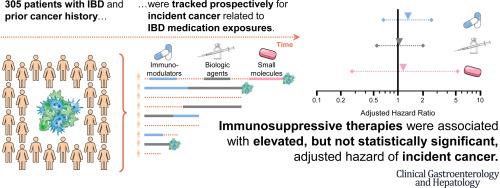
Among 305 patients (47% male, 88% white), the median age at IBD diagnosis and cancer were 32 and 52 years, respectively. Index cancers were solid organ (46%), dermatologic (32%), gastrointestinal (13%), and hematologic (9%). During a median follow-up period of 4.8 years, 210 patients (69%) were exposed to immunosuppressive therapy and 46 patients (15%) developed incident cancers (25 new, 21 recurrent). In unadjusted analysis, the crude rate of incident cancer in unexposed patients was 2.58 per 100 person-years vs 4.78 per 100 person-years (relative risk, 1.85; 95% CI, 0.92–3.73) for immunosuppression-exposed patients. In a time-varying proportional hazards model adjusting for sex, smoking history, age and stage at index malignancy, and nonmelanoma skin cancer, no significant association was found between receipt of immunosuppression and incident cancer (adjusted hazard ratio, 1.41; 95% CI, 0.69–2.90), or with any major drug class.
Conclusions
In this interim analysis of patients with IBD and a history of cancer, despite numerically increased adjusted hazard ratios, we did not find a statistically significant association between subsequent exposure to immunosuppressive therapies and development of incident cancers.
期刊介绍:
Clinical Gastroenterology and Hepatology (CGH) is dedicated to offering readers a comprehensive exploration of themes in clinical gastroenterology and hepatology. Encompassing diagnostic, endoscopic, interventional, and therapeutic advances, the journal covers areas such as cancer, inflammatory diseases, functional gastrointestinal disorders, nutrition, absorption, and secretion.
As a peer-reviewed publication, CGH features original articles and scholarly reviews, ensuring immediate relevance to the practice of gastroenterology and hepatology. Beyond peer-reviewed content, the journal includes invited key reviews and articles on endoscopy/practice-based technology, health-care policy, and practice management. Multimedia elements, including images, video abstracts, and podcasts, enhance the reader's experience. CGH remains actively engaged with its audience through updates and commentary shared via platforms such as Facebook and Twitter.




 京公网安备 11010802042870号
京ICP备2023020795号-1
京公网安备 11010802042870号
京ICP备2023020795号-1

 分享
分享
 求助内容:
求助内容: 应助结果提醒方式:
 扫码关注我们
