David J Siveter, Derek E G Briggs, Derek J Siveter, Mark D Sutton
{"title":"Preserved appendages in a Silurian binodicope: implications for the evolutionary history of ostracod crustaceans.","authors":"David J Siveter, Derek E G Briggs, Derek J Siveter, Mark D Sutton","doi":"10.1098/rsbl.2024.0097","DOIUrl":null,"url":null,"abstract":"<p><p>Ostracod crustaceans originated at least 500 Ma ago. Their tiny bivalved shells represent the most species-abundant fossil arthropods, and ostracods are omnipresent in a wide array of freshwater and marine environments today and in the past. <i>Derima paparme</i> gen. et sp. nov. from the Herefordshire Silurian Lagerstätte (~430 Ma) in the Welsh Borderland, UK, is one of only a handful of exceptionally preserved ostracods (with soft parts as well as the shell) known from the Palaeozoic. A male specimen provides the first evidence of the appendages of Binodicopina, a major group of Palaeozoic ostracods comprising some 135 Ordovician to Permian genera. The appendage morphology of <i>D. paparme</i>, but not its shell, indicates that binodicopes belong to Podocopa. The discovery that the soft-part morphology of binodicopes allies them with podocopes affirms that using the shell alone is an unreliable basis for classifying certain fossil ostracods, and knowledge of soft-part morphology is critical for the task. Current assignment of many fossil ostracods to higher taxa, and therefore the evolutionary history of the group, may require reconsideration.</p>","PeriodicalId":9005,"journal":{"name":"Biology Letters","volume":"20 5","pages":"20240097"},"PeriodicalIF":3.0000,"publicationDate":"2024-05-01","publicationTypes":"Journal Article","fieldsOfStudy":null,"isOpenAccess":false,"openAccessPdf":"https://www.ncbi.nlm.nih.gov/pmc/articles/PMC11338567/pdf/","citationCount":"0","resultStr":null,"platform":"Semanticscholar","paperid":null,"PeriodicalName":"Biology Letters","FirstCategoryId":"99","ListUrlMain":"https://doi.org/10.1098/rsbl.2024.0097","RegionNum":2,"RegionCategory":"生物学","ArticlePicture":[],"TitleCN":null,"AbstractTextCN":null,"PMCID":null,"EPubDate":"2024/5/22 0:00:00","PubModel":"Epub","JCR":"Q2","JCRName":"BIOLOGY","Score":null,"Total":0}
引用次数: 0
Abstract
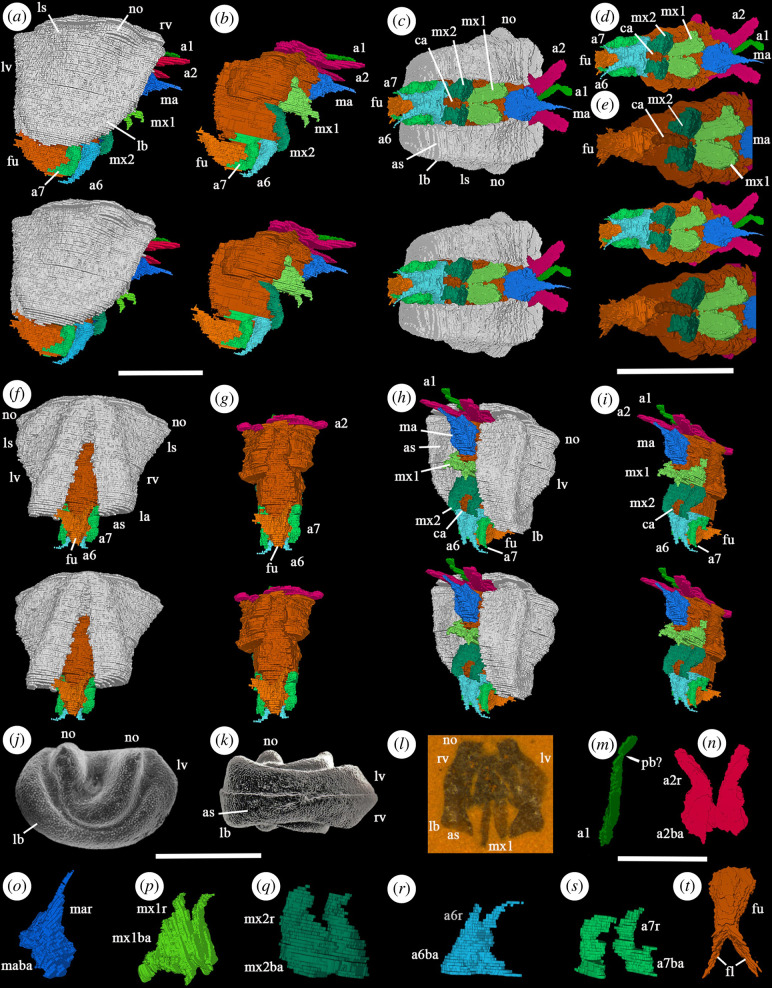
Ostracod crustaceans originated at least 500 Ma ago. Their tiny bivalved shells represent the most species-abundant fossil arthropods, and ostracods are omnipresent in a wide array of freshwater and marine environments today and in the past. Derima paparme gen. et sp. nov. from the Herefordshire Silurian Lagerstätte (~430 Ma) in the Welsh Borderland, UK, is one of only a handful of exceptionally preserved ostracods (with soft parts as well as the shell) known from the Palaeozoic. A male specimen provides the first evidence of the appendages of Binodicopina, a major group of Palaeozoic ostracods comprising some 135 Ordovician to Permian genera. The appendage morphology of D. paparme, but not its shell, indicates that binodicopes belong to Podocopa. The discovery that the soft-part morphology of binodicopes allies them with podocopes affirms that using the shell alone is an unreliable basis for classifying certain fossil ostracods, and knowledge of soft-part morphology is critical for the task. Current assignment of many fossil ostracods to higher taxa, and therefore the evolutionary history of the group, may require reconsideration.
期刊介绍:
Previously a supplement to Proceedings B, and launched as an independent journal in 2005, Biology Letters is a primarily online, peer-reviewed journal that publishes short, high-quality articles, reviews and opinion pieces from across the biological sciences. The scope of Biology Letters is vast - publishing high-quality research in any area of the biological sciences. However, we have particular strengths in the biology, evolution and ecology of whole organisms. We also publish in other areas of biology, such as molecular ecology and evolution, environmental science, and phylogenetics.




 京公网安备 11010802042870号
京ICP备2023020795号-1
京公网安备 11010802042870号
京ICP备2023020795号-1

 分享
分享
 求助内容:
求助内容: 应助结果提醒方式:
 扫码关注我们
