Comparative study of dynamic conformal arc therapy and volumetric modulated arc therapy for treating single brain metastases: A retrospective analysis of dosimetric and clinical outcomes
Isabelle Chambrelant , Delphine Jarnet , Clara Le Fèvre , Laure Kuntz , Julian Jacob , Catherine Jenny , Georges Noël
{"title":"Comparative study of dynamic conformal arc therapy and volumetric modulated arc therapy for treating single brain metastases: A retrospective analysis of dosimetric and clinical outcomes","authors":"Isabelle Chambrelant , Delphine Jarnet , Clara Le Fèvre , Laure Kuntz , Julian Jacob , Catherine Jenny , Georges Noël","doi":"10.1016/j.phro.2024.100591","DOIUrl":null,"url":null,"abstract":"<div><h3>Background and purpose</h3><p>Stereotactic radiation therapy (SRT) is commonly used to treat brain metastases (BMs). This retrospective study compared two SRT techniques, dynamic conformal arc therapy (DCAT) and volumetric modulated arc therapy (VMAT), for single BM treatments.</p></div><div><h3>Material and methods</h3><p>Data of patients treated between January 2010 and June 2020 were considered. Patients with multiple BMs, resected BMs, reirradiation, whole-brain radiation therapy and brainstem metastases were excluded. We focused our analysis on 97 patients who received 23.1 Gy in three fractions. Acute toxicities and follow-up outcomes were recorded. Dosimetric data were analyzed in two subgroups (PTV ≤ 10 cc and PTV > 10 cc).</p></div><div><h3>Results</h3><p>DCAT and VMAT were used in 70 (72.2 %) and 27 (27.8 %) patients, respectively. Acute toxicities were not significantly different between groups (p = 0.259), and no difference was detected in the incidence rate of radionecrosis, local recurrence and cerebral recurrence (p > 0.999, p > 0.999 and p = 0.682, respectively). PTV coverage was better with DCAT for small volumes (PTV ≤ 10 cc). Mean conformity index (CI) was significantly higher with VMAT and mean gradient index (GI) was significantly lower with DCAT whatever volume subgroups (p < 0.001). DCAT had more heterogeneous plans and VMAT required more monitor units. DCAT resulted in reduced low and intermediate doses, whereas VMAT led to decreased high doses.</p></div><div><h3>Conclusion</h3><p>DCAT and VMAT are two effective and safe SRT techniques for BMs treatment. In the era of re-irradiation, it is important to reduce the doses delivered to healthy tissues. Further prospective studies are needed to validate these findings.</p></div>","PeriodicalId":36850,"journal":{"name":"Physics and Imaging in Radiation Oncology","volume":"30 ","pages":"Article 100591"},"PeriodicalIF":3.3000,"publicationDate":"2024-04-01","publicationTypes":"Journal Article","fieldsOfStudy":null,"isOpenAccess":false,"openAccessPdf":"https://www.sciencedirect.com/science/article/pii/S2405631624000617/pdfft?md5=704f8fbf5e1a7f3a8afbc5267f284024&pid=1-s2.0-S2405631624000617-main.pdf","citationCount":"0","resultStr":null,"platform":"Semanticscholar","paperid":null,"PeriodicalName":"Physics and Imaging in Radiation Oncology","FirstCategoryId":"1085","ListUrlMain":"https://www.sciencedirect.com/science/article/pii/S2405631624000617","RegionNum":0,"RegionCategory":null,"ArticlePicture":[],"TitleCN":null,"AbstractTextCN":null,"PMCID":null,"EPubDate":"","PubModel":"","JCR":"Q2","JCRName":"ONCOLOGY","Score":null,"Total":0}
引用次数: 0
Abstract
Background and purpose
Stereotactic radiation therapy (SRT) is commonly used to treat brain metastases (BMs). This retrospective study compared two SRT techniques, dynamic conformal arc therapy (DCAT) and volumetric modulated arc therapy (VMAT), for single BM treatments.
Material and methods
Data of patients treated between January 2010 and June 2020 were considered. Patients with multiple BMs, resected BMs, reirradiation, whole-brain radiation therapy and brainstem metastases were excluded. We focused our analysis on 97 patients who received 23.1 Gy in three fractions. Acute toxicities and follow-up outcomes were recorded. Dosimetric data were analyzed in two subgroups (PTV ≤ 10 cc and PTV > 10 cc).
Results
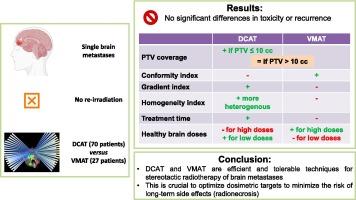
DCAT and VMAT were used in 70 (72.2 %) and 27 (27.8 %) patients, respectively. Acute toxicities were not significantly different between groups (p = 0.259), and no difference was detected in the incidence rate of radionecrosis, local recurrence and cerebral recurrence (p > 0.999, p > 0.999 and p = 0.682, respectively). PTV coverage was better with DCAT for small volumes (PTV ≤ 10 cc). Mean conformity index (CI) was significantly higher with VMAT and mean gradient index (GI) was significantly lower with DCAT whatever volume subgroups (p < 0.001). DCAT had more heterogeneous plans and VMAT required more monitor units. DCAT resulted in reduced low and intermediate doses, whereas VMAT led to decreased high doses.
Conclusion
DCAT and VMAT are two effective and safe SRT techniques for BMs treatment. In the era of re-irradiation, it is important to reduce the doses delivered to healthy tissues. Further prospective studies are needed to validate these findings.



 京公网安备 11010802042870号
京ICP备2023020795号-1
京公网安备 11010802042870号
京ICP备2023020795号-1

 分享
分享
 求助内容:
求助内容: 应助结果提醒方式:
 扫码关注我们
