Jahir Ahmed , M. Faisal , Jari S. Algethami , Mabkhoot Alsaiari , Mohammed Jalalah , Farid A. Harraz
{"title":"CeO2·ZnO@biomass-derived carbon nanocomposite-based electrochemical sensor for efficient detection of ascorbic acid","authors":"Jahir Ahmed , M. Faisal , Jari S. Algethami , Mabkhoot Alsaiari , Mohammed Jalalah , Farid A. Harraz","doi":"10.1016/j.ab.2024.115574","DOIUrl":null,"url":null,"abstract":"<div><p>Ascorbic acid (AA), a prominent antioxidant commonly found in human blood serum, serves as a biomarker for assessing oxidative stress levels. Therefore, precise detection of AA is crucial for swiftly diagnosing conditions arising from abnormal AA levels. Consequently, the primary aim of this research is to develop a sensitive and selective electrochemical sensor for accurate AA determination. To accomplish this aim, we used a novel nanocomposite comprised of CeO<sub>2</sub>-doped ZnO adorned on biomass-derived carbon (CeO<sub>2</sub>·ZnO@BC) as the active nanomaterial, effectively fabricating a glassy carbon electrode (GCE). Various analytical techniques were employed to scrutinize the structure and morphology features of the CeO<sub>2</sub>·ZnO@BC nanocomposite, ensuring its suitability as the sensing nanomaterial. This innovative sensor is capable of quantifying a wide range of AA concentrations, spanning from 0.5 to 1925 μM in a neutral phosphate buffer solution. It exhibits a remarkable sensitivity of 0.2267 μA μM<sup>−1</sup>cm<sup>−2</sup> and a practical detection limit of 0.022 μM. Thanks to its exceptional sensitivity and selectivity, this sensor enables highly accurate determination of AA concentrations in real samples. Moreover, its superior reproducibility, repeatability, and stability underscore its reliability and robustness for AA quantification.</p></div>","PeriodicalId":7830,"journal":{"name":"Analytical biochemistry","volume":"692 ","pages":"Article 115574"},"PeriodicalIF":2.5000,"publicationDate":"2024-09-01","publicationTypes":"Journal Article","fieldsOfStudy":null,"isOpenAccess":false,"openAccessPdf":"","citationCount":"0","resultStr":null,"platform":"Semanticscholar","paperid":null,"PeriodicalName":"Analytical biochemistry","FirstCategoryId":"99","ListUrlMain":"https://www.sciencedirect.com/science/article/pii/S0003269724001180","RegionNum":4,"RegionCategory":"生物学","ArticlePicture":[],"TitleCN":null,"AbstractTextCN":null,"PMCID":null,"EPubDate":"2024/5/22 0:00:00","PubModel":"Epub","JCR":"Q2","JCRName":"BIOCHEMICAL RESEARCH METHODS","Score":null,"Total":0}
引用次数: 0
Abstract
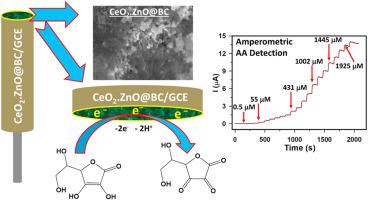
Ascorbic acid (AA), a prominent antioxidant commonly found in human blood serum, serves as a biomarker for assessing oxidative stress levels. Therefore, precise detection of AA is crucial for swiftly diagnosing conditions arising from abnormal AA levels. Consequently, the primary aim of this research is to develop a sensitive and selective electrochemical sensor for accurate AA determination. To accomplish this aim, we used a novel nanocomposite comprised of CeO2-doped ZnO adorned on biomass-derived carbon (CeO2·ZnO@BC) as the active nanomaterial, effectively fabricating a glassy carbon electrode (GCE). Various analytical techniques were employed to scrutinize the structure and morphology features of the CeO2·ZnO@BC nanocomposite, ensuring its suitability as the sensing nanomaterial. This innovative sensor is capable of quantifying a wide range of AA concentrations, spanning from 0.5 to 1925 μM in a neutral phosphate buffer solution. It exhibits a remarkable sensitivity of 0.2267 μA μM−1cm−2 and a practical detection limit of 0.022 μM. Thanks to its exceptional sensitivity and selectivity, this sensor enables highly accurate determination of AA concentrations in real samples. Moreover, its superior reproducibility, repeatability, and stability underscore its reliability and robustness for AA quantification.
期刊介绍:
The journal''s title Analytical Biochemistry: Methods in the Biological Sciences declares its broad scope: methods for the basic biological sciences that include biochemistry, molecular genetics, cell biology, proteomics, immunology, bioinformatics and wherever the frontiers of research take the field.
The emphasis is on methods from the strictly analytical to the more preparative that would include novel approaches to protein purification as well as improvements in cell and organ culture. The actual techniques are equally inclusive ranging from aptamers to zymology.
The journal has been particularly active in:
-Analytical techniques for biological molecules-
Aptamer selection and utilization-
Biosensors-
Chromatography-
Cloning, sequencing and mutagenesis-
Electrochemical methods-
Electrophoresis-
Enzyme characterization methods-
Immunological approaches-
Mass spectrometry of proteins and nucleic acids-
Metabolomics-
Nano level techniques-
Optical spectroscopy in all its forms.
The journal is reluctant to include most drug and strictly clinical studies as there are more suitable publication platforms for these types of papers.



 京公网安备 11010802042870号
京ICP备2023020795号-1
京公网安备 11010802042870号
京ICP备2023020795号-1

 分享
分享
 求助内容:
求助内容: 应助结果提醒方式:
 扫码关注我们
