Leticia Bornstein-Quevedo, Jazmín de Anda-González, Cesar Octavio Lara-Torres, Juan Pablo Flores-Gutiérrez, Rita Dorantes-Heredia, Verónica Bautista-Piña, Perla Zaragoza-Vargas, Aldo Alcaraz-Wong, Ana Karen Soto-Sañudo, Saulo Mendoza-Ramírez, Moisés Salamanca-García, Georgina Loyola-Rodríguez, Gabriela Sofia Gómez-Macías, Mario Murguia-Perez, Marcela De Luna-Sánchez, Ricardo Villalobos-Valencia, Enrique Talamantes, Claudia Arce-Salinas
{"title":"Navigating HER2-Low Testing in Invasive Breast Cancer: Update Recommendations for Pathologists.","authors":"Leticia Bornstein-Quevedo, Jazmín de Anda-González, Cesar Octavio Lara-Torres, Juan Pablo Flores-Gutiérrez, Rita Dorantes-Heredia, Verónica Bautista-Piña, Perla Zaragoza-Vargas, Aldo Alcaraz-Wong, Ana Karen Soto-Sañudo, Saulo Mendoza-Ramírez, Moisés Salamanca-García, Georgina Loyola-Rodríguez, Gabriela Sofia Gómez-Macías, Mario Murguia-Perez, Marcela De Luna-Sánchez, Ricardo Villalobos-Valencia, Enrique Talamantes, Claudia Arce-Salinas","doi":"10.3390/jpm14050467","DOIUrl":null,"url":null,"abstract":"<p><p>The article discusses the importance of accurately distinguishing HER2-low from HER2-negative breast cancer, as novel ADCs have demonstrated activity in a large population of patients with HER2-low-expressing BC. While current guidelines recommend a dichotomous classification of HER2 as either positive or negative, the emergence of the HER2-low concept calls for standardization of HER2 testing in breast cancer, using currently available assays to better discriminate HER2 levels. This review covers the evolution and latest updates of the ASCO/CAP guidelines relevant to this important biomarker in breast cancer, including still-evolving concepts such as HER2 low, HER2 heterogeneity, and HER2 evolution. Our group presents the latest Mexican recommendations for HER2 status evaluation in breast cancer, considering the ASCO/CAP guidelines and introducing the HER2-low concept. In the era of personalized medicine, accurate HER2 status assessment remains one of the most important biomarkers in breast cancer, and the commitment of Mexican pathologists to theragnostic biomarker quality is crucial for providing the most efficient care in oncology.</p>","PeriodicalId":16722,"journal":{"name":"Journal of Personalized Medicine","volume":"14 5","pages":""},"PeriodicalIF":3.0000,"publicationDate":"2024-04-28","publicationTypes":"Journal Article","fieldsOfStudy":null,"isOpenAccess":false,"openAccessPdf":"https://www.ncbi.nlm.nih.gov/pmc/articles/PMC11122297/pdf/","citationCount":"0","resultStr":null,"platform":"Semanticscholar","paperid":null,"PeriodicalName":"Journal of Personalized Medicine","FirstCategoryId":"3","ListUrlMain":"https://doi.org/10.3390/jpm14050467","RegionNum":3,"RegionCategory":"医学","ArticlePicture":[],"TitleCN":null,"AbstractTextCN":null,"PMCID":null,"EPubDate":"","PubModel":"","JCR":"Q2","JCRName":"HEALTH CARE SCIENCES & SERVICES","Score":null,"Total":0}
引用次数: 0
Abstract
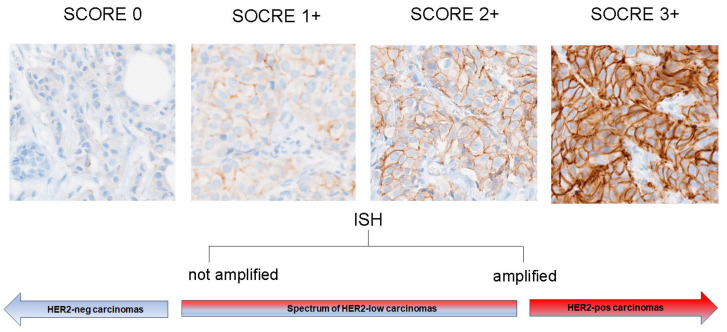
The article discusses the importance of accurately distinguishing HER2-low from HER2-negative breast cancer, as novel ADCs have demonstrated activity in a large population of patients with HER2-low-expressing BC. While current guidelines recommend a dichotomous classification of HER2 as either positive or negative, the emergence of the HER2-low concept calls for standardization of HER2 testing in breast cancer, using currently available assays to better discriminate HER2 levels. This review covers the evolution and latest updates of the ASCO/CAP guidelines relevant to this important biomarker in breast cancer, including still-evolving concepts such as HER2 low, HER2 heterogeneity, and HER2 evolution. Our group presents the latest Mexican recommendations for HER2 status evaluation in breast cancer, considering the ASCO/CAP guidelines and introducing the HER2-low concept. In the era of personalized medicine, accurate HER2 status assessment remains one of the most important biomarkers in breast cancer, and the commitment of Mexican pathologists to theragnostic biomarker quality is crucial for providing the most efficient care in oncology.
期刊介绍:
Journal of Personalized Medicine (JPM; ISSN 2075-4426) is an international, open access journal aimed at bringing all aspects of personalized medicine to one platform. JPM publishes cutting edge, innovative preclinical and translational scientific research and technologies related to personalized medicine (e.g., pharmacogenomics/proteomics, systems biology). JPM recognizes that personalized medicine—the assessment of genetic, environmental and host factors that cause variability of individuals—is a challenging, transdisciplinary topic that requires discussions from a range of experts. For a comprehensive perspective of personalized medicine, JPM aims to integrate expertise from the molecular and translational sciences, therapeutics and diagnostics, as well as discussions of regulatory, social, ethical and policy aspects. We provide a forum to bring together academic and clinical researchers, biotechnology, diagnostic and pharmaceutical companies, health professionals, regulatory and ethical experts, and government and regulatory authorities.



 京公网安备 11010802042870号
京ICP备2023020795号-1
京公网安备 11010802042870号
京ICP备2023020795号-1

 分享
分享
 求助内容:
求助内容: 应助结果提醒方式:
 扫码关注我们
