{"title":"Voluntary Disclosure in Asymmetric Contests","authors":"Christian Ewerhart, Julia Lareida","doi":"10.1093/restud/rdae001","DOIUrl":null,"url":null,"abstract":"\n This article studies the incentives for interim voluntary disclosure of verifiable information in probabilistic all-pay contests with two-sided incomplete information. Private information may concern marginal cost, valuations, and ability. Our main result says that, if the contest is uniformly asymmetric, then full revelation is the unique perfect Bayesian equilibrium outcome. This is so because the weakest type of the underdog reveals her type in an attempt to moderate the favourite, while the strongest type of the favourite tries to discourage the underdog—so that the contest unravels. This strong-form disclosure principle is robust with respect to correlation, partitional evidence, randomized disclosures, sequential moves, and continuous type spaces. Moreover, the assumption of uniform asymmetry is not needed when incomplete information is one-sided. However, the principle may break down when type distributions are too similar, contestants possess commitment power, or information is unverifiable. In fact, cheap talk will always be ignored, even if mediated by a trustworthy third party.","PeriodicalId":5,"journal":{"name":"ACS Applied Materials & Interfaces","volume":"4 7","pages":""},"PeriodicalIF":8.2000,"publicationDate":"2024-05-24","publicationTypes":"Journal Article","fieldsOfStudy":null,"isOpenAccess":false,"openAccessPdf":"","citationCount":"1","resultStr":null,"platform":"Semanticscholar","paperid":null,"PeriodicalName":"ACS Applied Materials & Interfaces","FirstCategoryId":"96","ListUrlMain":"https://doi.org/10.1093/restud/rdae001","RegionNum":2,"RegionCategory":"材料科学","ArticlePicture":[],"TitleCN":null,"AbstractTextCN":null,"PMCID":null,"EPubDate":"","PubModel":"","JCR":"Q1","JCRName":"MATERIALS SCIENCE, MULTIDISCIPLINARY","Score":null,"Total":0}
引用次数: 1
Abstract
This article studies the incentives for interim voluntary disclosure of verifiable information in probabilistic all-pay contests with two-sided incomplete information. Private information may concern marginal cost, valuations, and ability. Our main result says that, if the contest is uniformly asymmetric, then full revelation is the unique perfect Bayesian equilibrium outcome. This is so because the weakest type of the underdog reveals her type in an attempt to moderate the favourite, while the strongest type of the favourite tries to discourage the underdog—so that the contest unravels. This strong-form disclosure principle is robust with respect to correlation, partitional evidence, randomized disclosures, sequential moves, and continuous type spaces. Moreover, the assumption of uniform asymmetry is not needed when incomplete information is one-sided. However, the principle may break down when type distributions are too similar, contestants possess commitment power, or information is unverifiable. In fact, cheap talk will always be ignored, even if mediated by a trustworthy third party.
期刊介绍:
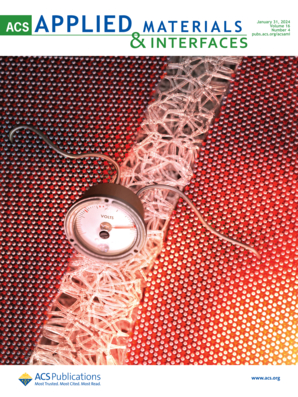
ACS Applied Materials & Interfaces is a leading interdisciplinary journal that brings together chemists, engineers, physicists, and biologists to explore the development and utilization of newly-discovered materials and interfacial processes for specific applications. Our journal has experienced remarkable growth since its establishment in 2009, both in terms of the number of articles published and the impact of the research showcased. We are proud to foster a truly global community, with the majority of published articles originating from outside the United States, reflecting the rapid growth of applied research worldwide.




 京公网安备 11010802042870号
京ICP备2023020795号-1
京公网安备 11010802042870号
京ICP备2023020795号-1

 分享
分享
 求助内容:
求助内容: 应助结果提醒方式:
 扫码关注我们
