B. Eriksson, S. Conroy, G. Ericsson, J. Eriksson, A. Hjalmarsson, C. R. Brune, M. G. Johnson, M. Nocente, S. Fugazza, M. Rebai
{"title":"First measurement in a magnetic confinement fusion experiment of the \n<mml:math xmlns:mml=\"http://www.w3.org/1998/Math/MathML\"><mml:mrow><mml:mmultiscripts><mml:mi mathvariant=\"normal\">H</mml:mi><mml:mprescripts/><mml:none/><mml:mrow><mml:mn>3</mml:mn></mml:mrow></mml:mmultiscripts><mml:mo>+</mml:mo","authors":"B. Eriksson, S. Conroy, G. Ericsson, J. Eriksson, A. Hjalmarsson, C. R. Brune, M. G. Johnson, M. Nocente, S. Fugazza, M. Rebai","doi":"10.1103/physrevc.109.054620","DOIUrl":null,"url":null,"abstract":"We report on the first experimental measurements made at a magnetic confinement fusion device of the tritium(T)-tritium(T) reaction T+T→He4+2n indicating the presence of the intermediate two-body resonant reaction T+T→He5+n. During the second deuterium-tritium campaign (DTE2) at the Joint European Torus, measurements of fusion plasmas with high tritium concentrations, nT/(nT+nD)≈0.99, heated with tritium neutral beam injection, were performed using the neutron time-of-flight (TOF) spectrometer TOFOR. We detect a peak in the neutron emission TOF spectrum consistent with the two-body resonant reaction. The TT neutron emission energy spectrum is modeled using an R-matrix framework where the distributions of the most likely model parameters given our experimental TOF data are determined utilizing a Markov chain Monte Carlo approach. We compare our best estimate of the T+T neutron emission energy spectrum with results obtained at inertial confinement fusion experiments at the OMEGA facility and find a spectral shape that is consistent with the energy dependency in the neutron spectrum observed at OMEGA.\n \n \n \n \n Published by the American Physical Society\n 2024\n \n \n","PeriodicalId":3,"journal":{"name":"ACS Applied Electronic Materials","volume":"49 11","pages":""},"PeriodicalIF":4.7000,"publicationDate":"2024-05-23","publicationTypes":"Journal Article","fieldsOfStudy":null,"isOpenAccess":false,"openAccessPdf":"","citationCount":"0","resultStr":null,"platform":"Semanticscholar","paperid":null,"PeriodicalName":"ACS Applied Electronic Materials","FirstCategoryId":"101","ListUrlMain":"https://doi.org/10.1103/physrevc.109.054620","RegionNum":3,"RegionCategory":"材料科学","ArticlePicture":[],"TitleCN":null,"AbstractTextCN":null,"PMCID":null,"EPubDate":"","PubModel":"","JCR":"Q1","JCRName":"ENGINEERING, ELECTRICAL & ELECTRONIC","Score":null,"Total":0}
引用次数: 0
Abstract
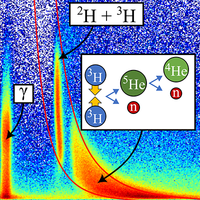
We report on the first experimental measurements made at a magnetic confinement fusion device of the tritium(T)-tritium(T) reaction T+T→He4+2n indicating the presence of the intermediate two-body resonant reaction T+T→He5+n. During the second deuterium-tritium campaign (DTE2) at the Joint European Torus, measurements of fusion plasmas with high tritium concentrations, nT/(nT+nD)≈0.99, heated with tritium neutral beam injection, were performed using the neutron time-of-flight (TOF) spectrometer TOFOR. We detect a peak in the neutron emission TOF spectrum consistent with the two-body resonant reaction. The TT neutron emission energy spectrum is modeled using an R-matrix framework where the distributions of the most likely model parameters given our experimental TOF data are determined utilizing a Markov chain Monte Carlo approach. We compare our best estimate of the T+T neutron emission energy spectrum with results obtained at inertial confinement fusion experiments at the OMEGA facility and find a spectral shape that is consistent with the energy dependency in the neutron spectrum observed at OMEGA.
Published by the American Physical Society
2024
期刊介绍:
ACS Applied Electronic Materials is an interdisciplinary journal publishing original research covering all aspects of electronic materials. The journal is devoted to reports of new and original experimental and theoretical research of an applied nature that integrate knowledge in the areas of materials science, engineering, optics, physics, and chemistry into important applications of electronic materials. Sample research topics that span the journal's scope are inorganic, organic, ionic and polymeric materials with properties that include conducting, semiconducting, superconducting, insulating, dielectric, magnetic, optoelectronic, piezoelectric, ferroelectric and thermoelectric.
Indexed/Abstracted:
Web of Science SCIE
Scopus
CAS
INSPEC
Portico




 京公网安备 11010802042870号
京ICP备2023020795号-1
京公网安备 11010802042870号
京ICP备2023020795号-1

 分享
分享
 求助内容:
求助内容: 应助结果提醒方式:
 扫码关注我们
