Ebtesam E. Ateia, Mahasen Reda, S. I. El-Dek, M. M. Arman
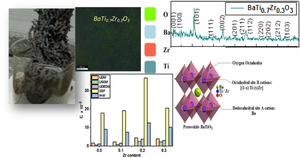
{"title":"A comparative approach for estimating microstructural characteristics of BaTi1−xZrxO3 (0.0 ≤ x ≤ 0.3) nanoparticles via X-ray diffraction patterns","authors":"Ebtesam E. Ateia, Mahasen Reda, S. I. El-Dek, M. M. Arman","doi":"10.1007/s10971-024-06389-7","DOIUrl":null,"url":null,"abstract":"<div><p>Barium titanate materials are currently a special topic for scientific research due to their effective technological applications. The tetragonal BaTi<sub>1-x</sub>Zr<sub>x</sub>O<sub>3</sub> (0.0 ≤ x ≤ 0.3) nanoparticles (NPs) were synthesized using a modified citrate technique. The current work provides a comparative approach for the calculation of crystallite size, stress, strain, and elastic characteristics based on X-ray diffraction (XRD) patterns. Various models have been developed to analyze XRD data; these models differ in their assumptions, mathematical approaches, and the type of information they provide. The Scherrer model ignores lattice micro-structures that develop in nanostructures, such as intrinsic strain. To overcome such drawbacks, three Williamson-Hall models, (the uniform deformation model (UDM)), the uniform stress deformation model (USDM), and the uniform deformation energy density model (UDEDM) have been discussed. According to the USDM model, with increasing Zr ion concentrations, interplanar space increases, causing a drop in Young’s modulus. All the previous approaches take into account the diffraction angle (2θ)-dependent peak broadening, which is thought to represent a combination of size and strain-driven induced broadening.</p><h3>Graphical Abstract</h3><div><figure><div><div><picture><source><img></source></picture></div></div></figure></div></div>","PeriodicalId":664,"journal":{"name":"Journal of Sol-Gel Science and Technology","volume":"110 3","pages":"887 - 899"},"PeriodicalIF":3.2000,"publicationDate":"2024-05-23","publicationTypes":"Journal Article","fieldsOfStudy":null,"isOpenAccess":false,"openAccessPdf":"https://link.springer.com/content/pdf/10.1007/s10971-024-06389-7.pdf","citationCount":"0","resultStr":null,"platform":"Semanticscholar","paperid":null,"PeriodicalName":"Journal of Sol-Gel Science and Technology","FirstCategoryId":"88","ListUrlMain":"https://link.springer.com/article/10.1007/s10971-024-06389-7","RegionNum":4,"RegionCategory":"材料科学","ArticlePicture":[],"TitleCN":null,"AbstractTextCN":null,"PMCID":null,"EPubDate":"","PubModel":"","JCR":"Q2","JCRName":"MATERIALS SCIENCE, CERAMICS","Score":null,"Total":0}
引用次数: 0
Abstract
Barium titanate materials are currently a special topic for scientific research due to their effective technological applications. The tetragonal BaTi1-xZrxO3 (0.0 ≤ x ≤ 0.3) nanoparticles (NPs) were synthesized using a modified citrate technique. The current work provides a comparative approach for the calculation of crystallite size, stress, strain, and elastic characteristics based on X-ray diffraction (XRD) patterns. Various models have been developed to analyze XRD data; these models differ in their assumptions, mathematical approaches, and the type of information they provide. The Scherrer model ignores lattice micro-structures that develop in nanostructures, such as intrinsic strain. To overcome such drawbacks, three Williamson-Hall models, (the uniform deformation model (UDM)), the uniform stress deformation model (USDM), and the uniform deformation energy density model (UDEDM) have been discussed. According to the USDM model, with increasing Zr ion concentrations, interplanar space increases, causing a drop in Young’s modulus. All the previous approaches take into account the diffraction angle (2θ)-dependent peak broadening, which is thought to represent a combination of size and strain-driven induced broadening.
期刊介绍:
The primary objective of the Journal of Sol-Gel Science and Technology (JSST), the official journal of the International Sol-Gel Society, is to provide an international forum for the dissemination of scientific, technological, and general knowledge about materials processed by chemical nanotechnologies known as the "sol-gel" process. The materials of interest include gels, gel-derived glasses, ceramics in form of nano- and micro-powders, bulk, fibres, thin films and coatings as well as more recent materials such as hybrid organic-inorganic materials and composites. Such materials exhibit a wide range of optical, electronic, magnetic, chemical, environmental, and biomedical properties and functionalities. Methods for producing sol-gel-derived materials and the industrial uses of these materials are also of great interest.



 京公网安备 11010802042870号
京ICP备2023020795号-1
京公网安备 11010802042870号
京ICP备2023020795号-1

 分享
分享
 求助内容:
求助内容: 应助结果提醒方式:
 扫码关注我们
