Enhancing Electrochemical Efficiency of Solid Oxide Electrolysis Cells for Carbon Dioxide Reduction Through Nickel-Doped Titanate-Based Cathode with Doped Ceria Electrolyte
{"title":"Enhancing Electrochemical Efficiency of Solid Oxide Electrolysis Cells for Carbon Dioxide Reduction Through Nickel-Doped Titanate-Based Cathode with Doped Ceria Electrolyte","authors":"Shivika Sharma, R. Stanley, Pankaj Tiwari, Suddhasatwa Basu, Vivekanand Vivekanand, Neetu Kumari","doi":"10.1002/ceat.202400046","DOIUrl":null,"url":null,"abstract":"<p>Solid oxide electrolysis cell (SOEC) is a potential technology for converting the principal greenhouse gas, carbon dioxide (CO<sub>2</sub>), into carbon monoxide (CO) by employing renewable energy. SOECs have great potential, including high-energy efficiency, fast electrode kinetics, and competitive cost; however, this technology still has challenges in developing highly active, robust CO<sub>2</sub> cathode electrocatalysts. In this work, we report the Ni-doped lanthanum strontium calcium titanate (La<sub>0.20</sub>Sr<sub>0.25</sub>Ca<sub>0.45</sub>Ni<sub>0.05</sub>Ti<sub>0.95</sub>O<sub>3−δ</sub>) cathode for application as the cathode of CO<sub>2</sub> electrolysis with gadolinia-doped ceria (Gd<sub>0.1</sub>Ce<sub>0.9</sub>O<sub>1.95</sub>) electrolyte in SOEC. The exsolution of Ni nanoparticles is achieved by a simple in situ growth method at 800 °C. The Ni doping in LSCT significantly improved the electrochemical activity of the catalyst by increasing oxygen vacancies, and the Ni metallic nanoparticles can afford much more active sites for CO<sub>2</sub> reduction. The CO<sub>2</sub> electrolysis mechanism is studied by the distribution of relaxation time analysis of impedance spectroscopy. Ni-LSCT renders a higher activity for electrolysis of CO<sub>2</sub> with an exceptionally high reduction current density of 3.89 A cm<sup>−2</sup> at 2.5 V potential applied and 800 °C temperature with GDC (Gd<sub>0.1</sub>Ce<sub>0.9</sub>O<sub>1.95</sub>) electrolyte. Ni doping is a crucial factor in controlling the electrochemical performance and catalytic activity in SOEC and GDC electrolytes, which is further helped by the high ionic conductivity.</p>","PeriodicalId":10083,"journal":{"name":"Chemical Engineering & Technology","volume":"48 2","pages":""},"PeriodicalIF":1.6000,"publicationDate":"2024-05-23","publicationTypes":"Journal Article","fieldsOfStudy":null,"isOpenAccess":false,"openAccessPdf":"","citationCount":"0","resultStr":null,"platform":"Semanticscholar","paperid":null,"PeriodicalName":"Chemical Engineering & Technology","FirstCategoryId":"5","ListUrlMain":"https://onlinelibrary.wiley.com/doi/10.1002/ceat.202400046","RegionNum":4,"RegionCategory":"工程技术","ArticlePicture":[],"TitleCN":null,"AbstractTextCN":null,"PMCID":null,"EPubDate":"","PubModel":"","JCR":"Q3","JCRName":"ENGINEERING, CHEMICAL","Score":null,"Total":0}
引用次数: 0
Abstract
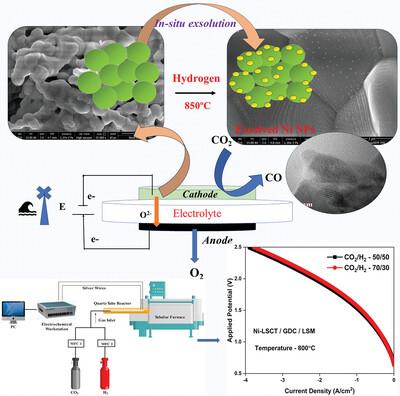
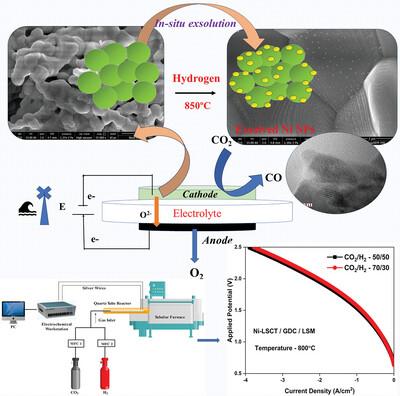
Solid oxide electrolysis cell (SOEC) is a potential technology for converting the principal greenhouse gas, carbon dioxide (CO2), into carbon monoxide (CO) by employing renewable energy. SOECs have great potential, including high-energy efficiency, fast electrode kinetics, and competitive cost; however, this technology still has challenges in developing highly active, robust CO2 cathode electrocatalysts. In this work, we report the Ni-doped lanthanum strontium calcium titanate (La0.20Sr0.25Ca0.45Ni0.05Ti0.95O3−δ) cathode for application as the cathode of CO2 electrolysis with gadolinia-doped ceria (Gd0.1Ce0.9O1.95) electrolyte in SOEC. The exsolution of Ni nanoparticles is achieved by a simple in situ growth method at 800 °C. The Ni doping in LSCT significantly improved the electrochemical activity of the catalyst by increasing oxygen vacancies, and the Ni metallic nanoparticles can afford much more active sites for CO2 reduction. The CO2 electrolysis mechanism is studied by the distribution of relaxation time analysis of impedance spectroscopy. Ni-LSCT renders a higher activity for electrolysis of CO2 with an exceptionally high reduction current density of 3.89 A cm−2 at 2.5 V potential applied and 800 °C temperature with GDC (Gd0.1Ce0.9O1.95) electrolyte. Ni doping is a crucial factor in controlling the electrochemical performance and catalytic activity in SOEC and GDC electrolytes, which is further helped by the high ionic conductivity.
期刊介绍:
This is the journal for chemical engineers looking for first-hand information in all areas of chemical and process engineering.
Chemical Engineering & Technology is:
Competent with contributions written and refereed by outstanding professionals from around the world.
Essential because it is an international forum for the exchange of ideas and experiences.
Topical because its articles treat the very latest developments in the field.



 京公网安备 11010802042870号
京ICP备2023020795号-1
京公网安备 11010802042870号
京ICP备2023020795号-1

 分享
分享
 求助内容:
求助内容: 应助结果提醒方式:
 扫码关注我们
