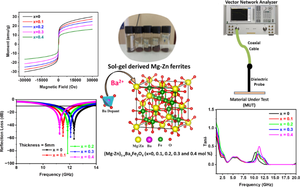
{"title":"Barium-doped Mg-Zn ferrites: synthesis, characterization, and microwave absorption properties for radar absorption applications","authors":"Saran Srihari Sripada Panda, Saidi Reddy Parne, Sahil Sharma, Suman Gandi, Trilochan Panigrahi","doi":"10.1007/s10971-024-06419-4","DOIUrl":null,"url":null,"abstract":"<div><p>The present study aimed to develop barium-doped Mg-Zn ferrites as a potential radar absorption material. To achieve this, Mg-Zn ferrite composites were synthesized using a sol-gel technique and sintered at a high temperature. The composition of the ferrites was denoted as (Mg−Zn)<sub>1−x</sub>Ba<sub>x</sub>Fe<sub>2</sub>O<sub>4</sub>, with varying Ba concentrations of x = 0, 0.1, 0.2, 0.3, and 0.4. The samples were analyzed using XRD, RAMAN and FTIR spectroscopy, which confirmed the presence of different ferrite phases and spinel structures. The energy band gap values were determined for varying Ba concentrations, with values of 1.41, 1.58, 1.60, 1.61, and 1.57 eV found for x = 0, 0.1, 0.2, 0.3, and 0.4, respectively. Magnetic properties of the ferrite composites were also studied, which revealed their S-shaped ferrimagnetic nature. The microwave absorption results showed that the composition with x = 0 achieved the maximum reflection loss (RL<sub>max</sub>) of −89.61 dB at 11.21 GHz for a 5.5 mm thickness, covering 56.4% of the X-band. The same composition also had an effective absorption bandwidth (EAB) of 3.23 GHz for a 4 mm thickness, covering 57% of the Ku-band. Doping with Ba concentration shifted the matching frequency towards the lower frequency range in both the X and Ku bands. The composition with x = 0.2 doping concentration of Ba showed good results with an RL<sub>max</sub> of −84.11 dB at 11.52 GHz for a 5 mm thickness, with an EAB of 2.23 GHz, covering 53.09% of the X band, and an EAB of 3.18 GHz for a 3.5 mm thickness, covering 55.53% of the Ku-band. Overall, the results demonstrate the potential of barium-doped Mg-Zn ferrites as a promising material for microwave absorption applications.</p><h3>Graphical Abstract</h3><div><figure><div><div><picture><source><img></source></picture></div></div></figure></div></div>","PeriodicalId":664,"journal":{"name":"Journal of Sol-Gel Science and Technology","volume":"116 1","pages":"1 - 15"},"PeriodicalIF":3.2000,"publicationDate":"2024-05-20","publicationTypes":"Journal Article","fieldsOfStudy":null,"isOpenAccess":false,"openAccessPdf":"","citationCount":"0","resultStr":null,"platform":"Semanticscholar","paperid":null,"PeriodicalName":"Journal of Sol-Gel Science and Technology","FirstCategoryId":"88","ListUrlMain":"https://link.springer.com/article/10.1007/s10971-024-06419-4","RegionNum":4,"RegionCategory":"材料科学","ArticlePicture":[],"TitleCN":null,"AbstractTextCN":null,"PMCID":null,"EPubDate":"","PubModel":"","JCR":"Q2","JCRName":"MATERIALS SCIENCE, CERAMICS","Score":null,"Total":0}
引用次数: 0
Abstract
The present study aimed to develop barium-doped Mg-Zn ferrites as a potential radar absorption material. To achieve this, Mg-Zn ferrite composites were synthesized using a sol-gel technique and sintered at a high temperature. The composition of the ferrites was denoted as (Mg−Zn)1−xBaxFe2O4, with varying Ba concentrations of x = 0, 0.1, 0.2, 0.3, and 0.4. The samples were analyzed using XRD, RAMAN and FTIR spectroscopy, which confirmed the presence of different ferrite phases and spinel structures. The energy band gap values were determined for varying Ba concentrations, with values of 1.41, 1.58, 1.60, 1.61, and 1.57 eV found for x = 0, 0.1, 0.2, 0.3, and 0.4, respectively. Magnetic properties of the ferrite composites were also studied, which revealed their S-shaped ferrimagnetic nature. The microwave absorption results showed that the composition with x = 0 achieved the maximum reflection loss (RLmax) of −89.61 dB at 11.21 GHz for a 5.5 mm thickness, covering 56.4% of the X-band. The same composition also had an effective absorption bandwidth (EAB) of 3.23 GHz for a 4 mm thickness, covering 57% of the Ku-band. Doping with Ba concentration shifted the matching frequency towards the lower frequency range in both the X and Ku bands. The composition with x = 0.2 doping concentration of Ba showed good results with an RLmax of −84.11 dB at 11.52 GHz for a 5 mm thickness, with an EAB of 2.23 GHz, covering 53.09% of the X band, and an EAB of 3.18 GHz for a 3.5 mm thickness, covering 55.53% of the Ku-band. Overall, the results demonstrate the potential of barium-doped Mg-Zn ferrites as a promising material for microwave absorption applications.
期刊介绍:
The primary objective of the Journal of Sol-Gel Science and Technology (JSST), the official journal of the International Sol-Gel Society, is to provide an international forum for the dissemination of scientific, technological, and general knowledge about materials processed by chemical nanotechnologies known as the "sol-gel" process. The materials of interest include gels, gel-derived glasses, ceramics in form of nano- and micro-powders, bulk, fibres, thin films and coatings as well as more recent materials such as hybrid organic-inorganic materials and composites. Such materials exhibit a wide range of optical, electronic, magnetic, chemical, environmental, and biomedical properties and functionalities. Methods for producing sol-gel-derived materials and the industrial uses of these materials are also of great interest.




 京公网安备 11010802042870号
京ICP备2023020795号-1
京公网安备 11010802042870号
京ICP备2023020795号-1

 分享
分享
 求助内容:
求助内容: 应助结果提醒方式:
 扫码关注我们
