David M. Díez-Fernández, Alba Esteban-Simón, Andrés Baena-Raya, David Rodríguez-Rosell, Filipe Conceição, Manuel A. Rodríguez-Pérez, Alberto Soriano-Maldonado
{"title":"Optimizing exercise prescription during breast cancer rehabilitation in women: Analysis of the load–velocity relationship in the box squat exercise","authors":"David M. Díez-Fernández, Alba Esteban-Simón, Andrés Baena-Raya, David Rodríguez-Rosell, Filipe Conceição, Manuel A. Rodríguez-Pérez, Alberto Soriano-Maldonado","doi":"10.1002/ejsc.12130","DOIUrl":null,"url":null,"abstract":"<p>The aims of this study were to assess (i) the load–velocity relationship during the box squat exercise in women survivors of breast cancer, (ii) which velocity variable (mean velocity [MV], mean propulsive velocity [MPV], or peak velocity [PV]) shows stronger relationship with the relative load (%1RM), and (iii) which regression model (linear [LA] or polynomic [PA]) provides a greater fit for predicting the velocities associated with each %1RM. Nineteen women survivors of breast cancer (age: 53.2 ± 6.9 years, weight: 70.9 ± 13.1 kg, and height: 163.5 ± 7.4 cm) completed an incremental load test up to one-repetition maximum in the box squat exercise. The MV, MPV, and the PV were measured during the concentric phase of each repetition with a linear velocity transducer. These measurements were analyzed by regression models using LA and PA. Strong correlations of MV with %1RM (<i>R</i><sup>2</sup> = 0.903/0.904; the standard error of the estimate (SEE) = 0.05 m<sup>.</sup>s<sup>−1</sup> by LA/PA) and MPV (<i>R</i><sup>2</sup> = 0.900; SEE = 0.06 m<sup>.</sup>s<sup>−1</sup> by LA and PA) were observed. In contrast, PV showed a weaker association with %1RM (<i>R</i><sup>2</sup> = 0.704; SEE = 0.15 m<sup>.</sup>s<sup>−1</sup> by LA and PA). The MV and MPV of 1RM was 0.22 ± 0.04 m·s<sup>−1</sup>, whereas the PV at 1RM was 0.63 ± 0.18 m<sup>.</sup>s<sup>−1</sup>. These findings suggest that the use of MV to prescribe relative loads during resistance training, as well as LA and PA regression models, accurately predicted velocities for each %1RM. Assessing and prescribing resistance exercises during breast cancer rehabilitation can be facilitated through the monitoring of movement velocity.</p>","PeriodicalId":93999,"journal":{"name":"European journal of sport science","volume":"24 7","pages":"1021-1031"},"PeriodicalIF":3.0000,"publicationDate":"2024-05-20","publicationTypes":"Journal Article","fieldsOfStudy":null,"isOpenAccess":false,"openAccessPdf":"https://onlinelibrary.wiley.com/doi/epdf/10.1002/ejsc.12130","citationCount":"0","resultStr":null,"platform":"Semanticscholar","paperid":null,"PeriodicalName":"European journal of sport science","FirstCategoryId":"1085","ListUrlMain":"https://onlinelibrary.wiley.com/doi/10.1002/ejsc.12130","RegionNum":0,"RegionCategory":null,"ArticlePicture":[],"TitleCN":null,"AbstractTextCN":null,"PMCID":null,"EPubDate":"","PubModel":"","JCR":"","JCRName":"","Score":null,"Total":0}
引用次数: 0
Abstract
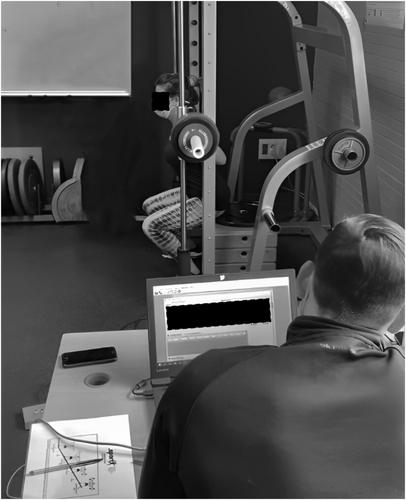
The aims of this study were to assess (i) the load–velocity relationship during the box squat exercise in women survivors of breast cancer, (ii) which velocity variable (mean velocity [MV], mean propulsive velocity [MPV], or peak velocity [PV]) shows stronger relationship with the relative load (%1RM), and (iii) which regression model (linear [LA] or polynomic [PA]) provides a greater fit for predicting the velocities associated with each %1RM. Nineteen women survivors of breast cancer (age: 53.2 ± 6.9 years, weight: 70.9 ± 13.1 kg, and height: 163.5 ± 7.4 cm) completed an incremental load test up to one-repetition maximum in the box squat exercise. The MV, MPV, and the PV were measured during the concentric phase of each repetition with a linear velocity transducer. These measurements were analyzed by regression models using LA and PA. Strong correlations of MV with %1RM (R2 = 0.903/0.904; the standard error of the estimate (SEE) = 0.05 m.s−1 by LA/PA) and MPV (R2 = 0.900; SEE = 0.06 m.s−1 by LA and PA) were observed. In contrast, PV showed a weaker association with %1RM (R2 = 0.704; SEE = 0.15 m.s−1 by LA and PA). The MV and MPV of 1RM was 0.22 ± 0.04 m·s−1, whereas the PV at 1RM was 0.63 ± 0.18 m.s−1. These findings suggest that the use of MV to prescribe relative loads during resistance training, as well as LA and PA regression models, accurately predicted velocities for each %1RM. Assessing and prescribing resistance exercises during breast cancer rehabilitation can be facilitated through the monitoring of movement velocity.



 京公网安备 11010802042870号
京ICP备2023020795号-1
京公网安备 11010802042870号
京ICP备2023020795号-1

 分享
分享

 求助内容:
求助内容: 应助结果提醒方式:
 扫码关注我们
