A. Messaoudi, Aref Omri, A. Benali, M. A. Ghebouli, A. Djemli, M. Fatmi, N. Hamdaoui, R. Ajjel, M. Habila, Asma A. Alothman, Saikh Mohammad, B. F. O. Costa, M. F. P. Graca, K. Khirouni
{"title":"Dielectric and structural properties of Co0.6Zn0.4Fe2O4 nanoferrites: sol–gel synthesis","authors":"A. Messaoudi, Aref Omri, A. Benali, M. A. Ghebouli, A. Djemli, M. Fatmi, N. Hamdaoui, R. Ajjel, M. Habila, Asma A. Alothman, Saikh Mohammad, B. F. O. Costa, M. F. P. Graca, K. Khirouni","doi":"10.1007/s10971-024-06396-8","DOIUrl":null,"url":null,"abstract":"<div><p>This study investigated the synthesis and analysis of Co–Zn nanoferrites, specifically Co<sub>0.6</sub>Zn<sub>0.4</sub>Fe<sub>2</sub>O<sub>4</sub>, using the sol–gel method. The morphological, structural, and electrical properties of these ferrites were explored. The Co<sub>0.6</sub>Zn<sub>0.4</sub>Fe<sub>2</sub>O<sub>4</sub> spinel ferrite was synthesized using metal nitrate reagents and ethylene glycol, followed by a series of heating and sintering processes. Rietveld-refined X-ray diffraction (XRD) confirmed the crystalline structure and phase purity, revealing a monophasic spinel structure. Scanning electron microscopy (SEM) analysis showed distinct grain agglomeration and porosity, indicating the material’s unique microstructure. Impedance measurements further characterized the optical and electrical properties. The electrical conductivity of Co<sub>0.6</sub>Zn<sub>0.4</sub>Fe<sub>2</sub>O<sub>4</sub> demonstrated a thermally activated conduction process, adhering to Jonscher’s universal power law. The complex impedance analysis revealed thermally activated behavior, confirming the presence of relaxation processes influenced by temperature. Nyquist plots indicated the contributions of grains, grain boundaries, and electrodes to the electrical behavior. The complex electrical modulus and dielectric studies provided insights into the dielectric characteristics, confirming high space charge polarization at grain boundaries and low dielectric loss. These findings suggested that Co<sub>0.6</sub>Zn<sub>0.4</sub>Fe<sub>2</sub>O<sub>4</sub> nanoferrites synthesized via the sol–gel method exhibited desirable electrical and structural properties, making them promising for various technological applications.</p><h3>Graphical Abstract</h3><div><figure><div><div><picture><source><img></source></picture></div><div><p>Sol–gel synthesis steps for Co<sub>0.6</sub>Zn<sub>0.4</sub>Fe<sub>2</sub>O<sub>4</sub> ferrite.</p></div></div></figure></div></div>","PeriodicalId":664,"journal":{"name":"Journal of Sol-Gel Science and Technology","volume":"116 1","pages":"16 - 33"},"PeriodicalIF":3.2000,"publicationDate":"2024-05-20","publicationTypes":"Journal Article","fieldsOfStudy":null,"isOpenAccess":false,"openAccessPdf":"","citationCount":"0","resultStr":null,"platform":"Semanticscholar","paperid":null,"PeriodicalName":"Journal of Sol-Gel Science and Technology","FirstCategoryId":"88","ListUrlMain":"https://link.springer.com/article/10.1007/s10971-024-06396-8","RegionNum":4,"RegionCategory":"材料科学","ArticlePicture":[],"TitleCN":null,"AbstractTextCN":null,"PMCID":null,"EPubDate":"","PubModel":"","JCR":"Q2","JCRName":"MATERIALS SCIENCE, CERAMICS","Score":null,"Total":0}
引用次数: 0
Abstract
This study investigated the synthesis and analysis of Co–Zn nanoferrites, specifically Co0.6Zn0.4Fe2O4, using the sol–gel method. The morphological, structural, and electrical properties of these ferrites were explored. The Co0.6Zn0.4Fe2O4 spinel ferrite was synthesized using metal nitrate reagents and ethylene glycol, followed by a series of heating and sintering processes. Rietveld-refined X-ray diffraction (XRD) confirmed the crystalline structure and phase purity, revealing a monophasic spinel structure. Scanning electron microscopy (SEM) analysis showed distinct grain agglomeration and porosity, indicating the material’s unique microstructure. Impedance measurements further characterized the optical and electrical properties. The electrical conductivity of Co0.6Zn0.4Fe2O4 demonstrated a thermally activated conduction process, adhering to Jonscher’s universal power law. The complex impedance analysis revealed thermally activated behavior, confirming the presence of relaxation processes influenced by temperature. Nyquist plots indicated the contributions of grains, grain boundaries, and electrodes to the electrical behavior. The complex electrical modulus and dielectric studies provided insights into the dielectric characteristics, confirming high space charge polarization at grain boundaries and low dielectric loss. These findings suggested that Co0.6Zn0.4Fe2O4 nanoferrites synthesized via the sol–gel method exhibited desirable electrical and structural properties, making them promising for various technological applications.
Graphical Abstract
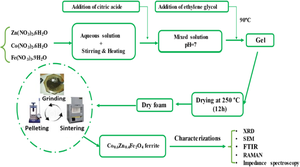
Sol–gel synthesis steps for Co0.6Zn0.4Fe2O4 ferrite.
期刊介绍:
The primary objective of the Journal of Sol-Gel Science and Technology (JSST), the official journal of the International Sol-Gel Society, is to provide an international forum for the dissemination of scientific, technological, and general knowledge about materials processed by chemical nanotechnologies known as the "sol-gel" process. The materials of interest include gels, gel-derived glasses, ceramics in form of nano- and micro-powders, bulk, fibres, thin films and coatings as well as more recent materials such as hybrid organic-inorganic materials and composites. Such materials exhibit a wide range of optical, electronic, magnetic, chemical, environmental, and biomedical properties and functionalities. Methods for producing sol-gel-derived materials and the industrial uses of these materials are also of great interest.



 京公网安备 11010802042870号
京ICP备2023020795号-1
京公网安备 11010802042870号
京ICP备2023020795号-1

 分享
分享
 求助内容:
求助内容: 应助结果提醒方式:
 扫码关注我们
