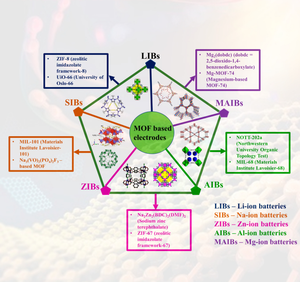
{"title":"Recent Advances in Metal–Organic Framework Electrode Materials for all-Metal-Ion Batteries","authors":"Brindha Ramasubramanian, Goutam Kumar Dalapati, Seeram Ramakrishna","doi":"10.1007/s11664-024-11126-5","DOIUrl":null,"url":null,"abstract":"<div><p>This study presents a collective review of the latest developments in the application of metal–organic frameworks (MOFs) in various metal-ion batteries (MIBs), including lithium-ion batteries (LIBs) and multivalent-ion batteries, from 2015 to 2023. First, the types of MOFs, standard fabrication methods, and electrochemical properties required for building efficient batteries are discussed. Next, MOFs suitable for specific MIBs and their electrode features, underlying mechanisms, and device performance are discussed. ZIF-8, UiO-66, and MIL-101 are primarily studied in LIBs, while Na<sub>2</sub>Zn<sub>2</sub>(BDC)<sub>2</sub>(DMF)<sub>2</sub> and MIL-101 are the main MOFs examined as cathode materials in SIBs due to their structural stability and favorable ion diffusion characteristics. However, MOFs are limited in magnesium- and aluminum-ion batteries due to the complex electrochemical redox reactions and interfacial stability issues involved. MOFs based on Fe, Mn, and Li show potential as cathodes, and MOF-derived carbon anodes are commonly used in all MIBs. The article further explores the three-dimensional (3D) electrode structure of MOFs, which favors faster ion diffusion within the electrolyte and external electron transport. MOF use in all-metal batteries still needs to be explored, and the article highlights the complexities involved.</p><h3>Graphical Abstract</h3>\n<div><figure><div><div><picture><source><img></source></picture></div></div></figure></div></div>","PeriodicalId":626,"journal":{"name":"Journal of Electronic Materials","volume":"53 7","pages":"3642 - 3669"},"PeriodicalIF":2.5000,"publicationDate":"2024-05-20","publicationTypes":"Journal Article","fieldsOfStudy":null,"isOpenAccess":false,"openAccessPdf":"","citationCount":"0","resultStr":null,"platform":"Semanticscholar","paperid":null,"PeriodicalName":"Journal of Electronic Materials","FirstCategoryId":"5","ListUrlMain":"https://link.springer.com/article/10.1007/s11664-024-11126-5","RegionNum":4,"RegionCategory":"工程技术","ArticlePicture":[],"TitleCN":null,"AbstractTextCN":null,"PMCID":null,"EPubDate":"","PubModel":"","JCR":"Q3","JCRName":"ENGINEERING, ELECTRICAL & ELECTRONIC","Score":null,"Total":0}
引用次数: 0
Abstract
This study presents a collective review of the latest developments in the application of metal–organic frameworks (MOFs) in various metal-ion batteries (MIBs), including lithium-ion batteries (LIBs) and multivalent-ion batteries, from 2015 to 2023. First, the types of MOFs, standard fabrication methods, and electrochemical properties required for building efficient batteries are discussed. Next, MOFs suitable for specific MIBs and their electrode features, underlying mechanisms, and device performance are discussed. ZIF-8, UiO-66, and MIL-101 are primarily studied in LIBs, while Na2Zn2(BDC)2(DMF)2 and MIL-101 are the main MOFs examined as cathode materials in SIBs due to their structural stability and favorable ion diffusion characteristics. However, MOFs are limited in magnesium- and aluminum-ion batteries due to the complex electrochemical redox reactions and interfacial stability issues involved. MOFs based on Fe, Mn, and Li show potential as cathodes, and MOF-derived carbon anodes are commonly used in all MIBs. The article further explores the three-dimensional (3D) electrode structure of MOFs, which favors faster ion diffusion within the electrolyte and external electron transport. MOF use in all-metal batteries still needs to be explored, and the article highlights the complexities involved.
期刊介绍:
The Journal of Electronic Materials (JEM) reports monthly on the science and technology of electronic materials, while examining new applications for semiconductors, magnetic alloys, dielectrics, nanoscale materials, and photonic materials. The journal welcomes articles on methods for preparing and evaluating the chemical, physical, electronic, and optical properties of these materials. Specific areas of interest are materials for state-of-the-art transistors, nanotechnology, electronic packaging, detectors, emitters, metallization, superconductivity, and energy applications.
Review papers on current topics enable individuals in the field of electronics to keep abreast of activities in areas peripheral to their own. JEM also selects papers from conferences such as the Electronic Materials Conference, the U.S. Workshop on the Physics and Chemistry of II-VI Materials, and the International Conference on Thermoelectrics. It benefits both specialists and non-specialists in the electronic materials field.
A journal of The Minerals, Metals & Materials Society.



 京公网安备 11010802042870号
京ICP备2023020795号-1
京公网安备 11010802042870号
京ICP备2023020795号-1

 分享
分享
 求助内容:
求助内容: 应助结果提醒方式:
 扫码关注我们
