Daniel Asenso-Gyambibi, Joseph Agyei Danquah, Edwin Kojo Larbi, Michael Stanley Peprah, Naa Lamkai Quaye-Ballard
{"title":"Enhancing survey field data with artificial intelligence: a real-time kinematic GPS study","authors":"Daniel Asenso-Gyambibi, Joseph Agyei Danquah, Edwin Kojo Larbi, Michael Stanley Peprah, Naa Lamkai Quaye-Ballard","doi":"10.1007/s12517-024-11989-2","DOIUrl":null,"url":null,"abstract":"<div><p>The significance of adjustment and computation studies has grown in recent years, influencing allied fields like arithmetic and satellite geodesy. This empirical study explores the effectiveness of various soft and traditional regression methods in correcting survey field data. Specifically, it investigates soft computing techniques such as back-propagation artificial neural network (BPANN), radial basis function artificial neural network (RBFANN), generalized regression artificial neural network (GRANN), and traditional regression methods like polynomial regression model (PRM) and least square regression (LSR) techniques. The study aims to fill the knowledge gap regarding soft computing strategies for modifying real-time kinematics (RTK) GPS field data and the ongoing debate between artificial intelligence techniques (ANN) and traditional methods on which technique offers the best results in modifying survey field data. Performance criteria, including horizontal displacement (HE), arithmetic mean error (AME), arithmetic mean square error (AMSE), minimum and maximum error values, and arithmetic standard deviation (ASD), were used to assess each model technique. Statistical analysis revealed that RBFANN, BPANN, and GRANN achieved superior accuracy compared to conventional techniques (PRM and LSR) in adjusting real-time kinematics GPS data. RBFANN outperformed BPANN and GRANN in terms of AME, AMSE, and ASD of their horizontal displacement. These findings suggest that soft computing techniques enhance real-time kinematics GPS field data adjustment, addressing critical issues in accurate positioning, particularly in Ghana. This study contributes to the knowledge base for developing an accurate geodetic datum in Ghana for national and local objectives. This will lay a foundation for the global determination of exact positions in Ghana. RBFANN emerges as a promising option for real-time kinematics GPS field data adjustment in topographic surveys. However, care should be taken to check issues of data overfitting.</p></div>","PeriodicalId":476,"journal":{"name":"Arabian Journal of Geosciences","volume":"17 6","pages":""},"PeriodicalIF":1.8270,"publicationDate":"2024-05-20","publicationTypes":"Journal Article","fieldsOfStudy":null,"isOpenAccess":false,"openAccessPdf":"","citationCount":"0","resultStr":null,"platform":"Semanticscholar","paperid":null,"PeriodicalName":"Arabian Journal of Geosciences","FirstCategoryId":"1085","ListUrlMain":"https://link.springer.com/article/10.1007/s12517-024-11989-2","RegionNum":0,"RegionCategory":null,"ArticlePicture":[],"TitleCN":null,"AbstractTextCN":null,"PMCID":null,"EPubDate":"","PubModel":"","JCR":"Q2","JCRName":"Earth and Planetary Sciences","Score":null,"Total":0}
引用次数: 0
Abstract
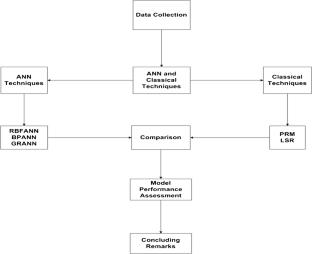
The significance of adjustment and computation studies has grown in recent years, influencing allied fields like arithmetic and satellite geodesy. This empirical study explores the effectiveness of various soft and traditional regression methods in correcting survey field data. Specifically, it investigates soft computing techniques such as back-propagation artificial neural network (BPANN), radial basis function artificial neural network (RBFANN), generalized regression artificial neural network (GRANN), and traditional regression methods like polynomial regression model (PRM) and least square regression (LSR) techniques. The study aims to fill the knowledge gap regarding soft computing strategies for modifying real-time kinematics (RTK) GPS field data and the ongoing debate between artificial intelligence techniques (ANN) and traditional methods on which technique offers the best results in modifying survey field data. Performance criteria, including horizontal displacement (HE), arithmetic mean error (AME), arithmetic mean square error (AMSE), minimum and maximum error values, and arithmetic standard deviation (ASD), were used to assess each model technique. Statistical analysis revealed that RBFANN, BPANN, and GRANN achieved superior accuracy compared to conventional techniques (PRM and LSR) in adjusting real-time kinematics GPS data. RBFANN outperformed BPANN and GRANN in terms of AME, AMSE, and ASD of their horizontal displacement. These findings suggest that soft computing techniques enhance real-time kinematics GPS field data adjustment, addressing critical issues in accurate positioning, particularly in Ghana. This study contributes to the knowledge base for developing an accurate geodetic datum in Ghana for national and local objectives. This will lay a foundation for the global determination of exact positions in Ghana. RBFANN emerges as a promising option for real-time kinematics GPS field data adjustment in topographic surveys. However, care should be taken to check issues of data overfitting.
期刊介绍:
The Arabian Journal of Geosciences is the official journal of the Saudi Society for Geosciences and publishes peer-reviewed original and review articles on the entire range of Earth Science themes, focused on, but not limited to, those that have regional significance to the Middle East and the Euro-Mediterranean Zone.
Key topics therefore include; geology, hydrogeology, earth system science, petroleum sciences, geophysics, seismology and crustal structures, tectonics, sedimentology, palaeontology, metamorphic and igneous petrology, natural hazards, environmental sciences and sustainable development, geoarchaeology, geomorphology, paleo-environment studies, oceanography, atmospheric sciences, GIS and remote sensing, geodesy, mineralogy, volcanology, geochemistry and metallogenesis.



 京公网安备 11010802042870号
京ICP备2023020795号-1
京公网安备 11010802042870号
京ICP备2023020795号-1

 分享
分享
 求助内容:
求助内容: 应助结果提醒方式:
 扫码关注我们
