Wei Xu*, Haobin Zhong, Chunshui Lin, Ru-Jin Huang, Jurgita Ovadnevaite, Darius Ceburnis* and Colin O’Dowd,
{"title":"Identification of Sub-micrometer Ambient Sea Salt Number Size Distribution by Positive Matrix Factorization","authors":"Wei Xu*, Haobin Zhong, Chunshui Lin, Ru-Jin Huang, Jurgita Ovadnevaite, Darius Ceburnis* and Colin O’Dowd, ","doi":"10.1021/acsestair.3c00092","DOIUrl":null,"url":null,"abstract":"<p >Sea salt aerosol is the largest natural aerosol source. The particle number size distribution (PNSD) of sea salt aerosol determines its direct and indirect radiative forcing. The PNSD of sea salt is important in quantifying the contribution of sea salt to marine cloud nuclei population. However, measuring the PNSD of sea salt is challenging, especially for sub-micrometer particles. In this study, we propose an approach to determine the PNSD of sea salt by applying positive matrix factorization (PMF) on ambient particle number size distribution data. Using the bulk PM<sub>1</sub> (particulate matter smaller than 1 μm in diameter) sea salt mass concentration as an external constraint, the PNSD of sea salt can be successfully retrieved. This approach is expected to advance our understanding of the global distribution and climate impact of sea salt aerosol.</p>","PeriodicalId":100014,"journal":{"name":"ACS ES&T Air","volume":"1 7","pages":"608–616"},"PeriodicalIF":0.0000,"publicationDate":"2024-05-03","publicationTypes":"Journal Article","fieldsOfStudy":null,"isOpenAccess":false,"openAccessPdf":"","citationCount":"0","resultStr":null,"platform":"Semanticscholar","paperid":null,"PeriodicalName":"ACS ES&T Air","FirstCategoryId":"1085","ListUrlMain":"https://pubs.acs.org/doi/10.1021/acsestair.3c00092","RegionNum":0,"RegionCategory":null,"ArticlePicture":[],"TitleCN":null,"AbstractTextCN":null,"PMCID":null,"EPubDate":"","PubModel":"","JCR":"","JCRName":"","Score":null,"Total":0}
引用次数: 0
Abstract
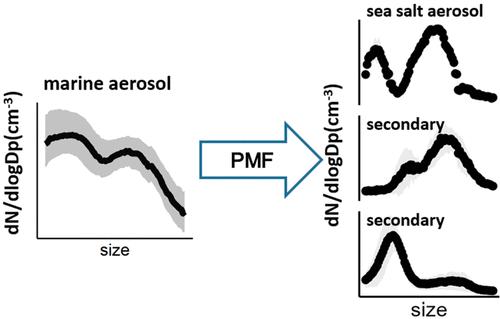
Sea salt aerosol is the largest natural aerosol source. The particle number size distribution (PNSD) of sea salt aerosol determines its direct and indirect radiative forcing. The PNSD of sea salt is important in quantifying the contribution of sea salt to marine cloud nuclei population. However, measuring the PNSD of sea salt is challenging, especially for sub-micrometer particles. In this study, we propose an approach to determine the PNSD of sea salt by applying positive matrix factorization (PMF) on ambient particle number size distribution data. Using the bulk PM1 (particulate matter smaller than 1 μm in diameter) sea salt mass concentration as an external constraint, the PNSD of sea salt can be successfully retrieved. This approach is expected to advance our understanding of the global distribution and climate impact of sea salt aerosol.



 京公网安备 11010802042870号
京ICP备2023020795号-1
京公网安备 11010802042870号
京ICP备2023020795号-1

 分享
分享

 求助内容:
求助内容: 应助结果提醒方式:
 扫码关注我们
