{"title":"DNA and bovine serum albumin protein (BSA) interaction of antitumor supramolecular nickel(II) complex: Inference for drug design","authors":"","doi":"10.1016/j.jiec.2024.05.042","DOIUrl":null,"url":null,"abstract":"<div><div><span>To explore the therapeutic potential of supramolecular nickel(II) Schiff base self-assemble complexes, the Schiff base ligand (N, N′-bis(salicylidene)-1,3-diamino-2-propanol) and its Ni(II) complex [Ni</span><sub>2</sub>(H<sub>2</sub>L)<sub>2</sub>(NCS)<sub>2</sub>(CH<sub>3</sub>OH)<sub>2</sub>](CH<sub>3</sub>OH)<sub>2</sub> were synthesized. Characterization by X-ray crystallography (for the complex), FT-IR, UV–Vis spectroscopy, <sup>1</sup>HNMR and elemental analysis (CHN) were performed. Single-crystal X-ray structure of the complex exhibited a distorted octahedral geometry in which each nickel(II) center, in the asymmetric unit, was six coordinated with three N atoms and three O atoms (from Schiff base ligand, methanol and NCS). <em>In vitro</em><span> Fish Sperm DNA (FS-DNA) and Bovine Serum Albumin (BSA) binding studies of the complex employed UV–Vis and fluorescence spectroscopy, cyclic voltammetry, viscosity measurement and molecular docking. The complex indicated a good binding propensity to BSA and was also bound to FS-DNA, preferably </span><em>via</em> intercalation. The outputs of the molecular docking study confirmed the experimental results. The complex was found to exert high anticancer activity against the gastric and prostate cancerous cells with putative selective anticancer properties. The death-induced mechanism underlying the complex is mainly related to the intercalator interactions, which may result in apoptosis-programmed cell death.</div></div>","PeriodicalId":363,"journal":{"name":"Journal of Industrial and Engineering Chemistry","volume":"140 ","pages":"Pages 225-236"},"PeriodicalIF":7.1000,"publicationDate":"2024-12-25","publicationTypes":"Journal Article","fieldsOfStudy":null,"isOpenAccess":false,"openAccessPdf":"","citationCount":"0","resultStr":null,"platform":"Semanticscholar","paperid":null,"PeriodicalName":"Journal of Industrial and Engineering Chemistry","FirstCategoryId":"5","ListUrlMain":"https://www.sciencedirect.com/science/article/pii/S1226086X24003484","RegionNum":3,"RegionCategory":"工程技术","ArticlePicture":[],"TitleCN":null,"AbstractTextCN":null,"PMCID":null,"EPubDate":"2024/5/21 0:00:00","PubModel":"Epub","JCR":"Q1","JCRName":"CHEMISTRY, MULTIDISCIPLINARY","Score":null,"Total":0}
引用次数: 0
Abstract
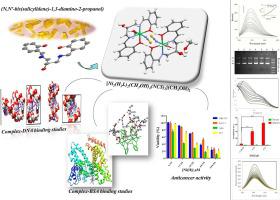
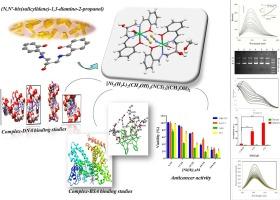
To explore the therapeutic potential of supramolecular nickel(II) Schiff base self-assemble complexes, the Schiff base ligand (N, N′-bis(salicylidene)-1,3-diamino-2-propanol) and its Ni(II) complex [Ni2(H2L)2(NCS)2(CH3OH)2](CH3OH)2 were synthesized. Characterization by X-ray crystallography (for the complex), FT-IR, UV–Vis spectroscopy, 1HNMR and elemental analysis (CHN) were performed. Single-crystal X-ray structure of the complex exhibited a distorted octahedral geometry in which each nickel(II) center, in the asymmetric unit, was six coordinated with three N atoms and three O atoms (from Schiff base ligand, methanol and NCS). In vitro Fish Sperm DNA (FS-DNA) and Bovine Serum Albumin (BSA) binding studies of the complex employed UV–Vis and fluorescence spectroscopy, cyclic voltammetry, viscosity measurement and molecular docking. The complex indicated a good binding propensity to BSA and was also bound to FS-DNA, preferably via intercalation. The outputs of the molecular docking study confirmed the experimental results. The complex was found to exert high anticancer activity against the gastric and prostate cancerous cells with putative selective anticancer properties. The death-induced mechanism underlying the complex is mainly related to the intercalator interactions, which may result in apoptosis-programmed cell death.
为了探索超分子镍(II)希夫碱自组装配合物的治疗潜力,合成了希夫碱配体(N, N′-双(水杨醛)-1,3-二氨基-2-丙醇)及其镍(II)配合物[Ni2(H2L)2(NCS)2(CH3OH)2](CH3OH)2。通过 X 射线晶体学(复合物)、傅立叶变换红外光谱、紫外可见光谱、1HNMR 和元素分析(CHN)对其进行了表征。该复合物的单晶 X 射线结构显示出扭曲的八面体几何形状,其中不对称单元中的每个镍(II)中心与三个 N 原子和三个 O 原子(来自希夫碱配体、甲醇和 NCS)配位。利用紫外可见光谱和荧光光谱、循环伏安法、粘度测量和分子对接法对该复合物进行了鱼精 DNA(FS-DNA)和牛血清白蛋白(BSA)体外结合研究。结果表明,该复合物与 BSA 有良好的结合倾向,而且还与 FS-DNA 结合,最好是通过插层结合。分子对接研究的结果证实了实验结果。研究发现,该复合物对胃癌和前列腺癌细胞具有很高的抗癌活性,并具有假定的选择性抗癌特性。该复合物诱导细胞死亡的机制主要与插入子相互作用有关,这可能会导致细胞凋亡程序性死亡。
期刊介绍:
Journal of Industrial and Engineering Chemistry is published monthly in English by the Korean Society of Industrial and Engineering Chemistry. JIEC brings together multidisciplinary interests in one journal and is to disseminate information on all aspects of research and development in industrial and engineering chemistry. Contributions in the form of research articles, short communications, notes and reviews are considered for publication. The editors welcome original contributions that have not been and are not to be published elsewhere. Instruction to authors and a manuscript submissions form are printed at the end of each issue. Bulk reprints of individual articles can be ordered. This publication is partially supported by Korea Research Foundation and the Korean Federation of Science and Technology Societies.




 京公网安备 11010802042870号
京ICP备2023020795号-1
京公网安备 11010802042870号
京ICP备2023020795号-1

 分享
分享
 求助内容:
求助内容: 应助结果提醒方式:
 扫码关注我们
