{"title":"Sustainable approach to treat the hazardous medical waste polluted soil under greenhouse condition with Jatropha integerrima","authors":"Mysoon M. Al-Ansari, Latifah A. Al-Humaid","doi":"10.1016/j.jtice.2024.105526","DOIUrl":null,"url":null,"abstract":"<div><h3>Background</h3><div>An improper disposal of hazardous medical waste in soil cause severe soil pollution and is becoming challenging to handle by eco-friendly way. Fortunately, the selective plant based treatment on medical waste polluted soil can be a feasible approach. Thus, the metal removal competence of <em>Jatropha integerrima</em> was analyzed in this research on medical waste polluted soil.</div></div><div><h3>Methods</h3><div>The soil characteristics like pH, Ag, As, Cd, Cr, Hg, Pb, Zn, and Mg were analyzed by typical digital pH meter and acid digestion method. The greenhouse experiment was performed with <em>J. integerrima</em> on test soil sample. The plant pigments and peroxidises (POD) activity was recorded in these study respective standard methods.</div></div><div><h3>Significant findings</h3><div>Soil has alkaline pH and tested heavy metal contents were beyond the permissible limits. The <em>J. integerrima</em> based phytoremediation study revealed that the soil alkaline pH was considerably minimized as close to neutral. Metal quantities such as Ag: 3.0 ± 0.11, As: 4.46 ± 0.21, Cd: 38.41 ± 1.65, Cr: 36.02 ± 1.3, Hg: 3.25 ± 0.14, Pb: 38.34 ± 1.32, Zn: 45.91 ± 2.28, and Mg: 29.02 ± 1.52 mg Kg<sup>−1</sup> were reduced from 100 m soil and they accumulated in plant biomass. The real-field experiment will be performed to assess this plant potential and it will be the future perspective of this study.</div></div>","PeriodicalId":381,"journal":{"name":"Journal of the Taiwan Institute of Chemical Engineers","volume":"166 ","pages":"Article 105526"},"PeriodicalIF":6.3000,"publicationDate":"2025-01-01","publicationTypes":"Journal Article","fieldsOfStudy":null,"isOpenAccess":false,"openAccessPdf":"","citationCount":"0","resultStr":null,"platform":"Semanticscholar","paperid":null,"PeriodicalName":"Journal of the Taiwan Institute of Chemical Engineers","FirstCategoryId":"5","ListUrlMain":"https://www.sciencedirect.com/science/article/pii/S1876107024001846","RegionNum":3,"RegionCategory":"工程技术","ArticlePicture":[],"TitleCN":null,"AbstractTextCN":null,"PMCID":null,"EPubDate":"2024/5/7 0:00:00","PubModel":"Epub","JCR":"Q1","JCRName":"ENGINEERING, CHEMICAL","Score":null,"Total":0}
引用次数: 0
Abstract
Background
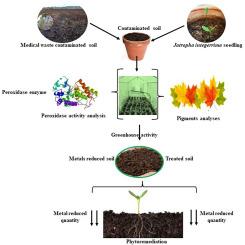
An improper disposal of hazardous medical waste in soil cause severe soil pollution and is becoming challenging to handle by eco-friendly way. Fortunately, the selective plant based treatment on medical waste polluted soil can be a feasible approach. Thus, the metal removal competence of Jatropha integerrima was analyzed in this research on medical waste polluted soil.
Methods
The soil characteristics like pH, Ag, As, Cd, Cr, Hg, Pb, Zn, and Mg were analyzed by typical digital pH meter and acid digestion method. The greenhouse experiment was performed with J. integerrima on test soil sample. The plant pigments and peroxidises (POD) activity was recorded in these study respective standard methods.
Significant findings
Soil has alkaline pH and tested heavy metal contents were beyond the permissible limits. The J. integerrima based phytoremediation study revealed that the soil alkaline pH was considerably minimized as close to neutral. Metal quantities such as Ag: 3.0 ± 0.11, As: 4.46 ± 0.21, Cd: 38.41 ± 1.65, Cr: 36.02 ± 1.3, Hg: 3.25 ± 0.14, Pb: 38.34 ± 1.32, Zn: 45.91 ± 2.28, and Mg: 29.02 ± 1.52 mg Kg−1 were reduced from 100 m soil and they accumulated in plant biomass. The real-field experiment will be performed to assess this plant potential and it will be the future perspective of this study.
期刊介绍:
Journal of the Taiwan Institute of Chemical Engineers (formerly known as Journal of the Chinese Institute of Chemical Engineers) publishes original works, from fundamental principles to practical applications, in the broad field of chemical engineering with special focus on three aspects: Chemical and Biomolecular Science and Technology, Energy and Environmental Science and Technology, and Materials Science and Technology. Authors should choose for their manuscript an appropriate aspect section and a few related classifications when submitting to the journal online.



 京公网安备 11010802042870号
京ICP备2023020795号-1
京公网安备 11010802042870号
京ICP备2023020795号-1

 分享
分享
 求助内容:
求助内容: 应助结果提醒方式:
 扫码关注我们
