M. Srinivasulu , Naga Raju Maddela , M. Subhosh Chandra , P. Chandramati Shankar , V. Rangaswamy , Ram Prasad
{"title":"Microbe-pesticide interactions: Soil enzyme analysis and bacterial degradation of chlorpyrifos","authors":"M. Srinivasulu , Naga Raju Maddela , M. Subhosh Chandra , P. Chandramati Shankar , V. Rangaswamy , Ram Prasad","doi":"10.1016/j.enceco.2024.05.004","DOIUrl":null,"url":null,"abstract":"<div><p>With the objective of understanding microbe—pesticide interactions in soil, the effect of pesticides alone and in combination on the activities of amylase, cellulase, and invertase was assessed in black, and red soils collected from the groundnut (<em>Arachis hypogaea</em> L.) cultivated fields of Andhra Pradesh, India. In addition, the potential bacteria that can break down chlorpyrifos was identified using biochemical assays and a partial 16S rRNA gene sequence analysis. Soil enzymes were analyzed using standard procedures described elsewhere. The activities of amylase, cellulase, and invertase were solely dependent on the dose of pesticides used in the current study. Enzyme activities were significantly increased at the level of 2.5 or 5.0 kg ha<sup>–1,</sup> whereas increases in the concentration of pesticides at 7.5–10 kg ha<sup>−1</sup> were lethal to the enzyme activities in both soils at 10-day incubation. The effective combination for the increase in the activities of amylase, cellulase, and invertase were monocrotophos + mancozeb. Mineral salts medium with 50 ppm chlorpyrifos as a carbon source had the greatest growth of the bacteria (i.e. <em>Pseudomonas citronellolis</em> strain CF3) at 14th h of incubation with OD value of 0.24 at 660 nm, and the same strain could eliminate 75% of the chlorpyrifos within 24 h from the medium. Based on the present study it was concluded that insecticides used alone or in combination with fungicides at specific doses (2.5 or 5.0 kg ha<sup>−1</sup>) improved the amylase, cellulase, and invertase activities, which are involved in the carbon cycle in soils. <em>Pseudomonas citronellolis</em> strain CF3 is a potential bacterium in the remediation of chlorpyrifos-contaminated sites.</p></div>","PeriodicalId":100480,"journal":{"name":"Environmental Chemistry and Ecotoxicology","volume":"6 ","pages":"Pages 180-191"},"PeriodicalIF":8.2000,"publicationDate":"2024-01-01","publicationTypes":"Journal Article","fieldsOfStudy":null,"isOpenAccess":false,"openAccessPdf":"https://www.sciencedirect.com/science/article/pii/S2590182624000122/pdfft?md5=440c5472472a8ab4fae70e2de61ba535&pid=1-s2.0-S2590182624000122-main.pdf","citationCount":"0","resultStr":null,"platform":"Semanticscholar","paperid":null,"PeriodicalName":"Environmental Chemistry and Ecotoxicology","FirstCategoryId":"1085","ListUrlMain":"https://www.sciencedirect.com/science/article/pii/S2590182624000122","RegionNum":0,"RegionCategory":null,"ArticlePicture":[],"TitleCN":null,"AbstractTextCN":null,"PMCID":null,"EPubDate":"2024/5/22 0:00:00","PubModel":"Epub","JCR":"Q1","JCRName":"ENVIRONMENTAL SCIENCES","Score":null,"Total":0}
引用次数: 0
Abstract
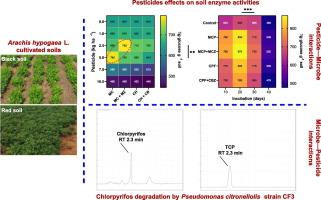
With the objective of understanding microbe—pesticide interactions in soil, the effect of pesticides alone and in combination on the activities of amylase, cellulase, and invertase was assessed in black, and red soils collected from the groundnut (Arachis hypogaea L.) cultivated fields of Andhra Pradesh, India. In addition, the potential bacteria that can break down chlorpyrifos was identified using biochemical assays and a partial 16S rRNA gene sequence analysis. Soil enzymes were analyzed using standard procedures described elsewhere. The activities of amylase, cellulase, and invertase were solely dependent on the dose of pesticides used in the current study. Enzyme activities were significantly increased at the level of 2.5 or 5.0 kg ha–1, whereas increases in the concentration of pesticides at 7.5–10 kg ha−1 were lethal to the enzyme activities in both soils at 10-day incubation. The effective combination for the increase in the activities of amylase, cellulase, and invertase were monocrotophos + mancozeb. Mineral salts medium with 50 ppm chlorpyrifos as a carbon source had the greatest growth of the bacteria (i.e. Pseudomonas citronellolis strain CF3) at 14th h of incubation with OD value of 0.24 at 660 nm, and the same strain could eliminate 75% of the chlorpyrifos within 24 h from the medium. Based on the present study it was concluded that insecticides used alone or in combination with fungicides at specific doses (2.5 or 5.0 kg ha−1) improved the amylase, cellulase, and invertase activities, which are involved in the carbon cycle in soils. Pseudomonas citronellolis strain CF3 is a potential bacterium in the remediation of chlorpyrifos-contaminated sites.




 京公网安备 11010802042870号
京ICP备2023020795号-1
京公网安备 11010802042870号
京ICP备2023020795号-1

 分享
分享

 求助内容:
求助内容: 应助结果提醒方式:
 扫码关注我们
