{"title":"Gadolinium stannate nanoparticles decorated 2D-graphene oxide nanolayer composite for effective electrochemical detection of chloramphenicol in food samples","authors":"","doi":"10.1016/j.jiec.2024.05.036","DOIUrl":null,"url":null,"abstract":"<div><p><span><span>A highly and simply sensitive electrochemical sensor has been developed for the determination of chloramphenicol (CAP) in food samples based on </span>gadolinium<span> stannate (Gd</span></span><sub>2</sub>Sn<sub>2</sub>O<sub>7</sub><span><span> denote as GdSnO) reinforced graphene oxide<span><span><span><span><span> (GdSnO/GO) composite modified classy carbon electrode (GCE) (GdSnO/GO/GCE). GdSnO/GO composite was synthesized using an ultrasonication technique and confirmed by analytical and spectroscopic methods, including </span>PXRD, FT-IR, FE-SEM, </span>EDX mapping, </span>XPS, and HR-TEM. Further, the </span>electrocatalytic activity of GdSnO/GO/GCE was investigated using cyclic </span></span>voltammetry<span> (CV) and differential pulse voltammetry (DPV). Under the optimized experimental conditions, the fabricated sensor exhibited a low limit of detection (LOD) of 98 nm, a linear range of 0.02 − 522.43 µM, and sensitivity is 0.41 μA μM</span></span><sup>−1</sup> cm<sup>−2</sup><span><span><span>. Additionally, the constructed sensor demonstrated impressive repeatability, reproducibility, and superior selectivity in the presence of other co-interference including </span>metal ions, biological molecules, and </span>nitro compounds<span>, enabling the electrochemical detection<span> of CAP. Additionally, the modified electrode was applied in the determination of CAP in the food samples such as milk and honey. The recoveries were between 99.69–102.86 % and 97.85–99.34 % with relative standard deviations (RSD) ranging from 1.03 % – 1.33 %, indicating that GdSnO/GO/GCE was suitable for the determination of CAP in food samples.</span></span></span></p></div>","PeriodicalId":363,"journal":{"name":"Journal of Industrial and Engineering Chemistry","volume":"139 ","pages":"Pages 601-610"},"PeriodicalIF":5.9000,"publicationDate":"2024-11-25","publicationTypes":"Journal Article","fieldsOfStudy":null,"isOpenAccess":false,"openAccessPdf":"","citationCount":"0","resultStr":null,"platform":"Semanticscholar","paperid":null,"PeriodicalName":"Journal of Industrial and Engineering Chemistry","FirstCategoryId":"5","ListUrlMain":"https://www.sciencedirect.com/science/article/pii/S1226086X24003423","RegionNum":3,"RegionCategory":"工程技术","ArticlePicture":[],"TitleCN":null,"AbstractTextCN":null,"PMCID":null,"EPubDate":"2024/5/23 0:00:00","PubModel":"Epub","JCR":"Q1","JCRName":"CHEMISTRY, MULTIDISCIPLINARY","Score":null,"Total":0}
引用次数: 0
Abstract
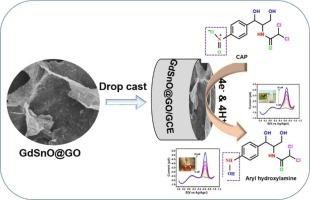
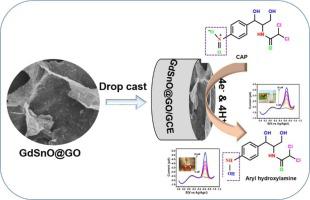
A highly and simply sensitive electrochemical sensor has been developed for the determination of chloramphenicol (CAP) in food samples based on gadolinium stannate (Gd2Sn2O7 denote as GdSnO) reinforced graphene oxide (GdSnO/GO) composite modified classy carbon electrode (GCE) (GdSnO/GO/GCE). GdSnO/GO composite was synthesized using an ultrasonication technique and confirmed by analytical and spectroscopic methods, including PXRD, FT-IR, FE-SEM, EDX mapping, XPS, and HR-TEM. Further, the electrocatalytic activity of GdSnO/GO/GCE was investigated using cyclic voltammetry (CV) and differential pulse voltammetry (DPV). Under the optimized experimental conditions, the fabricated sensor exhibited a low limit of detection (LOD) of 98 nm, a linear range of 0.02 − 522.43 µM, and sensitivity is 0.41 μA μM−1 cm−2. Additionally, the constructed sensor demonstrated impressive repeatability, reproducibility, and superior selectivity in the presence of other co-interference including metal ions, biological molecules, and nitro compounds, enabling the electrochemical detection of CAP. Additionally, the modified electrode was applied in the determination of CAP in the food samples such as milk and honey. The recoveries were between 99.69–102.86 % and 97.85–99.34 % with relative standard deviations (RSD) ranging from 1.03 % – 1.33 %, indicating that GdSnO/GO/GCE was suitable for the determination of CAP in food samples.
期刊介绍:
Journal of Industrial and Engineering Chemistry is published monthly in English by the Korean Society of Industrial and Engineering Chemistry. JIEC brings together multidisciplinary interests in one journal and is to disseminate information on all aspects of research and development in industrial and engineering chemistry. Contributions in the form of research articles, short communications, notes and reviews are considered for publication. The editors welcome original contributions that have not been and are not to be published elsewhere. Instruction to authors and a manuscript submissions form are printed at the end of each issue. Bulk reprints of individual articles can be ordered. This publication is partially supported by Korea Research Foundation and the Korean Federation of Science and Technology Societies.



 京公网安备 11010802042870号
京ICP备2023020795号-1
京公网安备 11010802042870号
京ICP备2023020795号-1

 分享
分享
 求助内容:
求助内容: 应助结果提醒方式:
 扫码关注我们
