Catalytic pulsed plasma treatment for organic micropollutants: unveiling the synergistic role of photocatalysts in radical generation and degradation mechanisms†
{"title":"Catalytic pulsed plasma treatment for organic micropollutants: unveiling the synergistic role of photocatalysts in radical generation and degradation mechanisms†","authors":"Ritik Anand and Ligy Philip","doi":"10.1039/D4EW00167B","DOIUrl":null,"url":null,"abstract":"<p >This work aims toward the remediation of multiple organic micropollutants simultaneously present in municipal wastewater. Catalytic pulsed plasma treatment (CPPT) coupled with TiO<small><sub>2</sub></small> and N-TiO<small><sub>2</sub></small> photocatalysts was employed to degrade naproxen (NPX), triclosan (TCS), and reactive red 180 (RR180). This study addressed a key challenge towards achieving Sustainable Development Goal (SDG) 6 for clean water and sanitation. The operating conditions were 23 kV at a pulse frequency of 33 Hz for a 50 mL sample volume. The synergy of photocatalysts with plasma was observed with N-TiO<small><sub>2</sub></small> reducing the treatment time for complete degradation by 50% as compared to the non-catalytic system. This improvement was due to enhanced radical generation, catalyst activation by UV-visible light, and increased surface area. The enhancement in radical generation noted was ∼85% for H<small><sub>2</sub></small>O<small><sub>2</sub></small> and ∼100% for ˙OH. The role of SO<small><sub>4</sub></small>˙<small><sup>−</sup></small> in RR180 degradation was noted. The disc diffusion test showed no inhibition zone for NPX and TCS at 1 mg L<small><sup>−1</sup></small> and RR180 at 10 mg L<small><sup>−1</sup></small> within 8 min. The degradation yield increased by 25% compared to the non-catalytic system. The mineralization efficiency follows the order TCS > RR180 > NPX. Finally, CPPT demonstrates >99% degradation efficiency in the multipollutant system of real secondary treated wastewater, showcasing its broad applicability in diverse wastewater scenarios.</p>","PeriodicalId":75,"journal":{"name":"Environmental Science: Water Research & Technology","volume":" 8","pages":" 1809-1826"},"PeriodicalIF":3.1000,"publicationDate":"2024-05-22","publicationTypes":"Journal Article","fieldsOfStudy":null,"isOpenAccess":false,"openAccessPdf":"","citationCount":"0","resultStr":null,"platform":"Semanticscholar","paperid":null,"PeriodicalName":"Environmental Science: Water Research & Technology","FirstCategoryId":"93","ListUrlMain":"https://pubs.rsc.org/en/content/articlelanding/2024/ew/d4ew00167b","RegionNum":4,"RegionCategory":"环境科学与生态学","ArticlePicture":[],"TitleCN":null,"AbstractTextCN":null,"PMCID":null,"EPubDate":"","PubModel":"","JCR":"Q3","JCRName":"ENGINEERING, ENVIRONMENTAL","Score":null,"Total":0}
引用次数: 0
Abstract
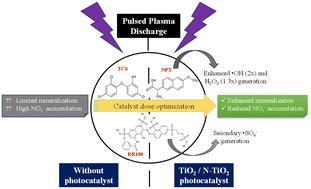
This work aims toward the remediation of multiple organic micropollutants simultaneously present in municipal wastewater. Catalytic pulsed plasma treatment (CPPT) coupled with TiO2 and N-TiO2 photocatalysts was employed to degrade naproxen (NPX), triclosan (TCS), and reactive red 180 (RR180). This study addressed a key challenge towards achieving Sustainable Development Goal (SDG) 6 for clean water and sanitation. The operating conditions were 23 kV at a pulse frequency of 33 Hz for a 50 mL sample volume. The synergy of photocatalysts with plasma was observed with N-TiO2 reducing the treatment time for complete degradation by 50% as compared to the non-catalytic system. This improvement was due to enhanced radical generation, catalyst activation by UV-visible light, and increased surface area. The enhancement in radical generation noted was ∼85% for H2O2 and ∼100% for ˙OH. The role of SO4˙− in RR180 degradation was noted. The disc diffusion test showed no inhibition zone for NPX and TCS at 1 mg L−1 and RR180 at 10 mg L−1 within 8 min. The degradation yield increased by 25% compared to the non-catalytic system. The mineralization efficiency follows the order TCS > RR180 > NPX. Finally, CPPT demonstrates >99% degradation efficiency in the multipollutant system of real secondary treated wastewater, showcasing its broad applicability in diverse wastewater scenarios.
期刊介绍:
Environmental Science: Water Research & Technology seeks to showcase high quality research about fundamental science, innovative technologies, and management practices that promote sustainable water.



 京公网安备 11010802042870号
京ICP备2023020795号-1
京公网安备 11010802042870号
京ICP备2023020795号-1

 分享
分享
 求助内容:
求助内容: 应助结果提醒方式:
 扫码关注我们
